

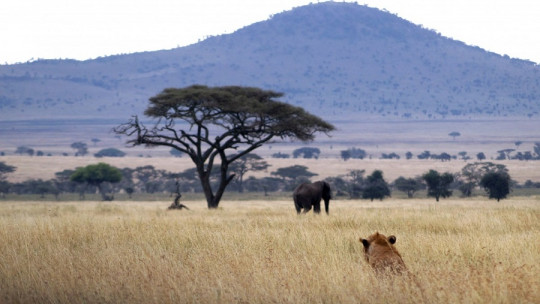
Africa is the cradle of humanity, the place where the first hominids evolved and from which species like ours originated, Homo sapiens, to colonize the rest of the world. A land of great wealth and history that, however, today is the one with the highest levels of poverty and hunger in the world.
There are many countries that are part of said continent, many tribes and many stories that all of them have been telling since ancient times to explain their world. That is why throughout this article we will see this cultural wealth, making a small selection of ten African myths and legends from different regions and tribes
A dozen great African legends
Below we leave you with a series of ten of the stories, myths and legends that we can find throughout the extensive African geography, many of them referring to elements of nature, the stars and geographical elements.
1. The creation of the world
Almost all cultures on earth have at some point imagined some possible explanation based on their beliefs that try to make sense of how the world appeared The different cultures present in Africa are no exception. In fact, there are many legends that different tribes and local cultures have developed in this regard, among which in this article we are going to see one: that of the Boshongo.
Legend has it that in the beginning there was only darkness and water, in addition to the creator god Bumba. The latter was in the strictest solitude. One day the god noticed a great pain in his stomach and a lot of nausea, after which he vomited. Said vomit was the Sun, and light emerged from it. Likewise, areas of dry land arose from its heat. The great Bumba suffered nausea again, this time expelling the moon and stars. In a third discomfort vomited the leopard, the crocodile, the ray, the heron, the goat, the beetle, the turtle, the eagle, the fish and the human being
After that, the gods, sons of Bumba and born to him, undertook to finish their father’s work, helping to form the rest of the things in the universe. Only the lightning proved problematic and erratic, something that made the deity decide to lock him up and send him to heaven. Since its lack left human beings unable to make fire, the god himself taught humanity to generate it through the use of wood
2. The appearance of man at the hands of Mukulu
Human beings have often wondered how the world in which they live appeared, but they have also asked themselves more specifically how they arrived at it. In this sense, there are legends that speak more specifically about its creation, in a way that actually reminds us in some sense of our evolution. This is the case of the myth or legend of Muluku, god of the Makua and the Banayi, and the creation of man.
Legend says that the great god Muluku, After creating the world, he decided to create a species that could enjoy and take care of his work The deity dug two holes in the earth, from which the first man and the first woman would eventually be born. Muluku also being a god of agriculture, he taught them to cultivate and take care of the fields so that they could feed themselves and live independently. But although they initially followed the god’s instructions, the couple ended up ignoring them and abandoning the care of the world.
Little by little the plants began to die, to the point that the fields became deserted. Thoughtful, the god called a couple of monkeys and gave them the same knowledge. While the first pair of humans had been wasting time, The apes dedicated themselves to taking care of and building a house and a planted field
Given this, the god made a decision: remove the tails from the monkeys and put them on the couple, who would transform into apes. In turn, the monkeys, now without tails, would become humans. And it is from the latter that the rest of humanity are descendants.
A third African legend, this time from the ancient Antankarana of Madagascar, tells us about how one of the lakes in their region, Antañavo, appeared, which is considered sacred and whose waters should never be touched by the body
Legend says that at first Lake Antañavo did not exist, but in its place there was a prosperous town. In that place lived a couple who had had a baby a few months ago. One day, as night fell, the baby began to cry uncontrollably. His mother tried to calm him down by every means, but nothing had any effect. She finally decided to go for a walk with the child, reaching a tree under which the women ground rice during the day. Once they were seated and under the night breeze, the baby calmed down and fell asleep.
The woman tried to return home with the child, but on the way the little boy started crying again. The mother returned to the same place as before, under the tree, and her son calmed down again. When trying to return home again, she repeated the same situation. And this happened several more times. Finally the young mother, tired, he made the decision to sleep under the tree But just when she was about to do it, the entire town suddenly disappeared, the entire area sinking into the waters up to where her mother and her baby were.
After that, the mother ran to tell what happened to the neighboring towns, which They began to consider the place as sacred They say that the crocodiles that populate Lake Antañavo are the souls of the town’s former inhabitants.
4. The legend of Seetetelané
Another traditional African story is that of Seetetelané, which is a short story that offers us a moral that indicates the need to respect others and the contributions they make to our lives. It is also a warning to avoid drunkenness and to avoid throwing away everything we have achieved through mere arrogance.
Once upon a time there was a man of great poverty who had to hunt mice to survive and who lacked practically everything, his clothes being woven from the skin of the animals he hunted and he was often cold and hungry. He also had no family or partner, and spent his time hunting or drinking
One day, while hunting mice, he found a huge ostrich egg that he planned to eat later. She took it to his house and hid it there before returning to look for more food. When he returned, having gotten only two rodents, he found something truly unexpected: he had a table set and prepared with lamb and bread. The man, seeing the food, wondered if he had gotten married without knowing it.
At that moment From the ostrich egg came a beautiful woman, who introduced herself as Seetetelané The woman indicated that she would remain with him as his wife, but she warned him that she should never call her daughter of the ostrich egg or she would vanish from her, never to return. The hunter promised never to drink from her again to avoid ever calling her that.
They spent the days together and happily, until One day the woman asked him if he would like to be a tribe chief and possess all kinds of wealth, slaves and animals. The hunter asked him if he could provide them, to which Seetetelané laughed and with a kick of his foot he opened the ground, and a large caravan emerged from it with all kinds of goods, servants, slaves and animals.
Furthermore, the woman made him see that he had become young and that his clothes were warm and valuable. The house had also been transformed into another, going from being a hut to a stone hearth full of skins.
Time passed and the hunter acted as a leader for his people for a while, until at a celebration the man began to drink. Because of this he began to behave aggressively, to which Seetetelané tried to calm him down. But he pushed her and insulted her, calling her the daughter of an ostrich egg.
That same night, the hunter felt cold, and when he woke up he saw that there was nothing left but his old hut. He was no longer a leader, he had no animals or servants, nor were his clothes warm. And he no longer had Seetetelané. The man regretted what he had done and said. A few days later, partly because he had become accustomed to a better standard of living, the man became ill and died.
5. The legend of the story tree
Some African legends tell us about events such as disappearances, sometimes attributed to time travel. We have an example in Tanzania, where the Chagga tell the legend of the story tree.
Legend has it that once a young woman set out with her friends in order to collect herbs. Trying to access an area where there seemed to be a large number, The girl fell into an area full of mud, in which she ended up sinking completely despite the attempts of her companions to get her out of there. After that, they ran to the village in order to bring the news to the parents.
They, desperate, asked the rest of the town for help, all going to the place where the young woman had disappeared. There they followed the recommendation of a wise old man who recommended that they sacrifice a sheep and a cow. This resulted in everyone being able to hear the girl’s voice, increasingly distant, until they could no longer hear her.
Time after, In that same place a large tree would begin to grow, which was often used by livestock keepers to protect themselves from the heat of the Sun. Two young men climbed that same tree one day, who before disappearing shouted to their companions that it was taking them to a world before the present. That is why the tree is known as the Tree of History.
6. The legend about Anansi and the spread of wisdom
Knowledge and experience have been deeply respected elements in most cultures and are linked to leadership and respect, as well as knowing what to do in times of need. In this sense, there is a legendary character called Anansi, who is responsible for the fact that wisdom is part of everyone and that no one has it completely.
The legend says that Once upon a time there was a wise man in the form of a spider who observed that humanity was, to say the least, irresponsible and cruel Seeing this, the wise man made the decision to gather all the wisdom in a single jar and keep it in a safe place. To do this, he decided to lock this knowledge in the top of the tallest tree in the world. However, the climb became very difficult as the being had to hold the jug while advancing up the tree.
Anansi was increasingly frustrated, not being able to climb the tree with the jug on his head as it was in the way. However, her son, seeing his situation, asked her why she didn’t have him tied to her back. Anansi realized that his son was right, and with the surprise of finding more wisdom than he had accumulated, he dropped the jug. It crashed and broke on the ground, from which a storm spread it to the rest of the world
Wisdom spread throughout the world, reaching all humanity. That is why no one is capable of having absolute wisdom but all of us have the capacity to recognize and exercise it.
7. The legend Ayana and the spirit of the tree
The people who have passed away from us have been and are of great importance in our lives, marking us hard. Some cultures establish the possibility of contacting those people who have already died. An example of this is found in the legend of Ayana and the spirit of the tree.
Legend has it that there was once a young girl named Ayana who had lost her mother, and despite being sweet and good, she only had an absent father and a harassing stepmother for company. The girl went to the cemetery every day to talk to her mother, to whom she listened softly One day, next to her mother’s grave, she saw a small tree, which over time grew until it bore fruit. Her mother’s voice sounded at that moment, indicating that she should eat them.
The young woman enjoyed the taste, and decided to take some to her father and stepmother. The latter demanded to know where she had gotten the fruit from, since she wanted it for herself. Ayana carried her, but the tree kept its branches away from the woman and only allowed the girl to touch it. This caused the stepmother to order her husband to cut down the tree.
After that, the girl continued returning to see her mother’s grave, from which another day she saw a pumpkin of impressive flavor grow. This she possessed a nectar that reminded Ayana of the affection of her progenitor. But one day the stepmother saw her and followed her, and After tasting the nectar and understanding why the girl was so happy in the last few days, she decided to destroy her
Another day and once she had discovered the destruction of the pumpkin, Ayana discovered the presence of a stream with similar characteristics. On this occasion the stepmother covered the river with earth. The girl decided to stay away from the grave from then on, for fear that her stepmother would destroy it.
Years passed and the girl became a woman, with whom another young man fell in love, to whom she reciprocated. However, the stepmother demanded that the young man prove himself worthy of Ayana, for which He ordered him to hunt twelve buffaloes
Ayana told the story to her boyfriend, who decided to go see the tree, and there after seeing the remains of the cut tree. She asked Araya’s mother for permission to marry, something that was granted and that the young man noticed as a feeling of approval and well-being when he picked up the wood: the approval of the mother of his future wife.
From the wood of the tree the young man made a bow, which helped him kill the twelve animals. Thus, Araya and her husband were able to get married regardless of the stepmother’s opinion.
8. The legend of the baobab
Pride and arrogance is a quality that can be expensive, and this is also true in the mentality of some African people. It is because of that There is an African legend that refers to the effects of arrogance and explains it in the shape of one of the most famous African trees: the baobab.
Legend says that the baobab tree was considered the most beautiful on the planet, to the point that all beings admired it. Even the gods marveled at her beauty, so much so that they even gave her an enormous life expectancy.
As time went by, the tree grew more and more proud of itself, blocking the sunlight from other trees and beings. He said that soon he would be at the level of the gods themselves Once the branches of the tree were close to their home, they became enraged at the vanity and arrogance of the plant. Furious, they condemned the tree to grow in reverse: its flower would grow underground, while only its roots would reach the air. That is why these trees now have such a special and anomalous appearance compared to the rest.
9. The origin of death
Not only are there legends linked to life and creation, but African peoples also have legends related to destruction and death. An example of them is found in the following Zulu legend
Legend says that after the creation of man, he did not know if his life would end or not. The creator deity Unkulunkulo initially decided to grant him immortality. To bring the news to man he sent the great chameleon Unawabu, who carried the news that humanity would not die However, this being, on his way, stopped to eat and began to take longer than expected to deliver the message.
The deity expected the human being to thank him for the gift of immortality that he had just given them, but since they had not yet received the message, the humans did nothing. Not knowing that the cause was ignorance and thinking that humanity was ungrateful, the god changed his mind: from then on the human being would be mortal and would end up dying. He sent the lizard Intulus to carry the message, which acted quickly to fulfill his mission. This is why we are mortal and destined to die.
10. The legend of Bamako
The last of the African legends explained here will be directed to the legend that explains the origin of the Moon.
The legend says that At the beginning of time the Earth was accompanied only by the Sun, which when hidden left the world in complete darkness, something that favored looting. One day, in the village where the beautiful and gentle Bamako lived, there was an attack on her village during the night taking advantage of the darkness.
The villagers tried to defend themselves, but they couldn’t see and little by little they began to fall in the successive attacks. Bamako was deeply concerned about this situation.
One day, the god N’Togini appeared to him in his dreams. She told Bamako that her son Djambé had been in love with her for a long time, and he promised her that if she agreed to marry him, he would take her to heaven and she could light up the night to avoid attacks like the one that happened. The woman accepted and asked for instructions. The god told her that at sunset she should climb the largest rock next to the river and jump into it, in addition to assuring her that she should not have it since her future husband would be there to lift her to the heavens.
Bamako fulfilled her mission, and just as her husband, the Sun, had promised her, he lifted her into the heavens with him and transformed her into the Moon. Thanks to her, the townspeople were able to fight and defeat their attackers.
By citing this article, you acknowledge the original source and allow readers to access the full content.
PsychologyFor. (2024). The 10 Best African Legends (and Their Explanation). https://psychologyfor.com/the-10-best-african-legends-and-their-explanation/