


You built a beautiful, logical sales pitch, complete with charts and a clear value proposition, and the customer still walked away to buy the competitor’s product for reasons they could not fully explain. That gap between what people say and what actually drives their choices is not a mystery. It is neuromarketing. Decades of brain research now show that most purchasing decisions get made below conscious awareness, shaped by emotion, framing, and subtle cues long before rational thought ever gets involved.
That disconnect is frustrating for marketers and business owners who genuinely want to serve customers well rather than manipulate them, and it is exactly why this reading list exists. Understanding the psychology of persuasion is not about tricking people into purchases they will regret. It is about recognizing the real cognitive and emotional patterns behind everyday choices, from grocery store layouts to app notification design, so that marketing actually respects how the human brain works instead of fighting against it. Ignore this science and you end up guessing. Study it, and patterns start emerging almost immediately.
So which books actually explain the brain science behind buying, without drowning you in academic jargon?
This guide reviews the 10 best neuromarketing books available today, covering the frameworks, experiments, and named researchers behind each one.
The 10 Best Neuromarketing Books
Verified Top Picks- 1
 Martin Lindstrom Buyology: Truth and Lies About Why We Buy A multimillion-dollar fMRI brain-scanning study decoding subconscious buying triggersCHECK TODAY'S PRICE
 - 2
 Roger Dooley Brainfluence: 100 Ways to Persuade and Convince Consumers One hundred modular, actionable tactics covering pricing, packaging, and copywritingCHECK TODAY'S PRICE
 - 3Patrick Renvoisé & Christophe Morin Neuromarketing: Understanding the Buy Buttons in Your Customer's Brain Applying the six stimuli framework to target the primal decision-making brainCHECK TODAY'S PRICE
- 4Phil Barden Decoded: The Science Behind Why We Buy Applying behavioral economics, prospect theory, and decision framing to marketingCHECK TODAY'S PRICE
- 5Dan Ariely Predictably Irrational: The Hidden Forces That Shape Our Decisions Proving that irrational consumer choices follow consistent, predictable behavioral patternsCHECK TODAY'S PRICE
- 6Daniel Kahneman Thinking, Fast and Slow The System 1 and System 2 cognitive framework underlying consumer judgmentCHECK TODAY'S PRICE
- 7Robert B. Cialdini Influence: The Psychology of Persuasion Seven universal principles of influence that govern modern sales and advertisingCHECK TODAY'S PRICE
- 8Jonah Berger Contagious: Why Things Catch On The STEPPS framework explaining how high-arousal emotion drives word of mouth and sharingCHECK TODAY'S PRICE
- 9Richard H. Thaler & Cass R. Sunstein Nudge: Improving Decisions About Health, Wealth, and Happiness Choice architecture and subtle nudges that guide decisions without restricting freedomCHECK TODAY'S PRICE
- 10Nir Eyal Hooked: How to Build Habit-Forming Products The four-step Hook Model for creating engaging, habit-forming digital productsCHECK TODAY'S PRICE
What Is Neuromarketing, and Why Do These Books Matter?
Neuromarketing applies neuroscience and cognitive psychology research to understand and influence consumer behavior, often using tools like fMRI scans, eye tracking, and behavioral experiments rather than relying solely on surveys people cannot always answer honestly.
Traditional market research asks people why they bought something, and people confidently answer, often incorrectly, since much of the actual decision-making happens outside conscious awareness. Neuromarketing sidesteps that problem by measuring brain activity, eye movement, and physiological responses directly, which is exactly why researchers like Martin Lindstrom turned to brain scanning instead of focus groups. The books on this list translate that clinical research into language marketers, founders, and curious readers can actually use without a neuroscience degree.
- Neuromarketing studies actual brain activity and behavior rather than relying only on self-reported survey answers.
- It draws heavily on cognitive psychology frameworks like System 1 and System 2 thinking.
- Ethical application matters enormously, since the same insights can inform or manipulate consumers depending on intent.
The 10 Best Neuromarketing Books to Read This Year
The following selection covers the most influential, research-grounded titles in the neuromarketing field, ranging from brain-scanning case studies to behavioral economics classics that shaped the entire discipline.
1. Buyology: Truth and Lies About Why We Buy — Martin Lindstrom
Buyology by branding consultant Martin Lindstrom remains the most widely cited popular book in the entire neuromarketing genre, built on a three-year, multimillion-dollar brain-scanning study involving roughly two thousand volunteers. Lindstrom set out to test whether consumers actually know why they buy things, and the fMRI results repeatedly said no.
The book’s most famous finding involves cigarette warning labels, which brain scans showed activated the craving centers associated with smoking rather than deterring it. That single counterintuitive result alone made Buyology required reading for an entire generation of marketers.
- Documents a large-scale fMRI brain-scanning study testing why consumers actually buy.
- Reveals that anti-smoking warnings can activate craving centers rather than deter behavior.
- Introduces readers to somatic marketing findings that predate most later neuromarketing books.
2. Brainfluence: 100 Ways to Persuade and Convince Consumers with Neuromarketing — Roger Dooley

Brainfluence by marketing writer Roger Dooley breaks neuromarketing into one hundred short, standalone chapters, each covering a single tactic grounded in cognitive science. It reads less like a linear argument and more like a reference manual you dip into when a specific problem, pricing, packaging, email subject lines, needs solving.
That structure makes it unusually practical compared to denser academic titles on this list. You do not need to read it cover to cover, and honestly most readers do not, which is exactly the point of its modular design.
- Organizes one hundred bite-sized tactics around specific, everyday marketing decisions.
- Covers pricing psychology, packaging, and persuasive copywriting in separate, standalone chapters.
- Works well as an ongoing reference rather than a single, linear cover-to-cover read.
3. Neuromarketing: Understanding the Buy Buttons in Your Customer’s Brain — Patrick Renvoisé and Christophe Morin
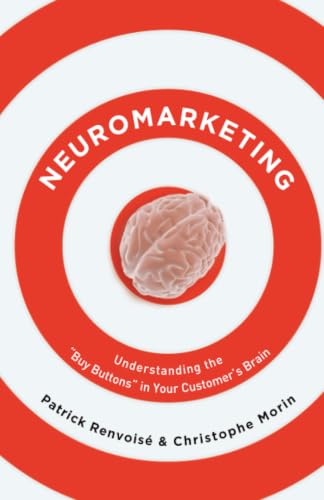
Neuromarketing by Patrick Renvoisé and Christophe Morin was among the first mainstream business books to apply triune brain theory directly to sales and advertising. The authors argue that the most primitive part of the brain, which they call the ‘old brain,’ ultimately decides most purchases, bypassing rational deliberation almost entirely.
Some of the neuroscience framing has since been simplified past what current brain research actually supports. Even so, the six stimuli framework the authors propose, personal, contrastable, tangible, memorable, visual, and emotional, still shows up constantly in modern persuasive messaging training.
- Popularized applying triune brain theory to advertising and sales presentations.
- Introduces six specific stimuli that reliably capture the ‘old brain’s’ attention in messaging.
- Remains historically important despite later critiques of its simplified neuroscience framing.
4. Decoded: The Science Behind Why We Buy — Phil Barden

Decoded by former Bain executive Phil Barden stands out for grounding its claims tightly in behavioral economics rather than loose brain-scan anecdotes. Barden draws heavily on prospect theory and framing effects to explain why identical products sell differently depending purely on how they are presented.
The book’s case studies, real campaigns from clients like Sixt and O2, give the theory a concreteness many competing titles lack. Marketing professor Rory Sutherland, who contributes commentary to later editions, adds further practitioner-level texture to Barden’s academic framework.
- Grounds its arguments in prospect theory and framing effects rather than anecdote alone.
- Uses real corporate case studies to demonstrate decision framing in practice.
- Balances academic rigor with practitioner commentary on consumer decoding techniques.
5. Predictably Irrational: The Hidden Forces That Shape Our Decisions — Dan Ariely

Predictably Irrational by behavioral economist Dan Ariely is not written as a marketing book at all, yet it belongs on nearly every serious neuromarketing reading list. Ariely’s experiments repeatedly show that irrational decisions are not random noise; they follow consistent, predictable patterns marketers can anticipate and design around.
His famous decoy pricing experiment, where adding a deliberately unattractive third option changed how people chose between the other two, remains one of the most frequently cited findings in modern pricing strategy discussions.
- Demonstrates that irrational consumer choices follow consistent, predictable behavioral patterns.
- Introduces the decoy pricing effect that still shapes modern pricing strategy today.
- Provides the behavioral economics foundation that many later neuromarketing books build upon.
6. Thinking, Fast and Slow — Daniel Kahneman

Thinking, Fast and Slow by Nobel laureate Daniel Kahneman is the theoretical backbone underneath almost every neuromarketing concept discussed elsewhere on this list. Kahneman’s System 1 and System 2 framework distinguishes fast, automatic, emotional judgment from slower, effortful, deliberate reasoning.
Marketers who understand which system a given decision engages, impulse snack purchases versus a mortgage refinance, can design messaging that matches how the brain processes that specific purchase decision. It is dense reading. It is also, genuinely, foundational.
- Introduces the System 1 and System 2 framework underlying most consumer decisions.
- Explains cognitive biases like anchoring that directly shape pricing perception.
- Serves as the theoretical foundation cited across nearly every other neuromarketing book on this list.
7. Influence: The Psychology of Persuasion — Robert B. Cialdini

Influence by psychologist Robert B. Cialdini organizes decades of persuasion research into six, later seven, core principles: reciprocity, commitment, social proof, authority, liking, scarcity, and unity. Nearly every modern sales funnel or landing page borrows at least one of these principles, whether consciously or not.
What sets this book apart is Cialdini’s insistence on ethical application. He explicitly warns against weaponizing these persuasion principles to manipulate people against their own interests, a distinction worth taking seriously rather than skimming past.
- Organizes persuasion research into seven core, repeatable influence principles.
- Explains scarcity and social proof effects that dominate modern digital marketing design.
- Explicitly warns against unethical manipulation, framing persuasion as a responsibility rather than a trick.
8. Contagious: Why Things Catch On — Jonah Berger

Contagious by Wharton professor Jonah Berger asks a narrower, more specific question than most books on this list: why do certain products, ideas, and stories spread through word of mouth while others quietly disappear? Berger’s STEPPS framework, social currency, triggers, emotion, public visibility, practical value, and stories, breaks virality into testable components.
It works particularly well as a companion to more brain-focused titles, since it applies psychological principles specifically to social spread rather than individual purchase decisions. Two different problems. Two complementary lenses.
- Breaks virality down into the testable STEPPS framework of six components.
- Explains how high-arousal emotions drive social sharing more reliably than low-arousal ones.
- Applies psychological principles to word-of-mouth spread rather than individual purchase decisions alone.
9. Nudge: Improving Decisions About Health, Wealth, and Happiness — Richard H. Thaler and Cass R. Sunstein

Nudge by Nobel laureate Richard H. Thaler and legal scholar Cass R. Sunstein introduced the concept of ‘libertarian paternalism,’ the idea that subtle changes to how choices are presented, called nudges, can steer behavior without restricting anyone’s actual options.
Default settings on retirement plans are the book’s classic example, and the same logic now shows up constantly in checkout flows, subscription renewals, and app onboarding sequences. Whether every use of that logic is ethical is a separate, genuinely important question the book itself raises directly.
- Introduces libertarian paternalism as a framework for shaping choices without restricting them.
- Explains how default settings quietly steer major decisions like retirement savings.
- Raises important ethical questions about where helpful nudging ends and manipulation begins.
10. Hooked: How to Build Habit-Forming Products — Nir Eyal

Hooked by product consultant Nir Eyal focuses specifically on digital products rather than traditional advertising, mapping out the four-step Hook Model, trigger, action, variable reward, investment, that keeps users returning to apps and platforms.
It is the most directly actionable book on this list for anyone building a product rather than a single campaign. Eyal has since written a companion book on managing distraction, which adds useful nuance to how far this habit-forming design should ethically go.
- Maps the four-step Hook Model behind habit-forming digital products.
- Explains how variable rewards keep users engaged more effectively than predictable rewards.
- Focuses on product design rather than advertising, making it distinct from other neuromarketing books here.
Which Cognitive Biases Do These Books Explain Best?
Several recurring cognitive biases show up across nearly every book on this list, and understanding them is arguably more useful than memorizing any single author’s framework.
Daniel Kahneman’s distinction between System 1 and System 2 thinking underlies almost everything else. System 1 is fast, automatic, and emotional; System 2 is slow, deliberate, and effortful. Most everyday purchases, a snack at checkout, an impulse click on a discounted item, engage System 1 almost entirely, which is exactly why rational, feature-heavy advertising often underperforms simpler, emotionally resonant messaging. Anchoring bias, also documented extensively by Kahneman, explains why the first price a customer sees shapes every subsequent judgment, even when that first number was arbitrary or irrelevant.
Dan Ariely’s decoy effect research adds another layer. Adding a deliberately unattractive third pricing option can shift preference toward a specific target option, simply by changing the comparison set available. Loss aversion, the tendency to feel losses more intensely than equivalent gains, explains why “don’t miss out” messaging so consistently outperforms “gain this benefit” framing in advertising tests. None of these biases are exotic tricks. They are simply how human cognition works, and pretending otherwise produces weaker marketing.
- System 1 thinking drives most impulse purchases through fast, automatic emotional judgment.
- Anchoring bias means the first price shown shapes every subsequent price perception.
- Loss aversion explains why scarcity-based messaging reliably outperforms simple benefit-focused framing.
How Do Emotions Drive the Buying Decisions These Books Describe?
Emotion, not logic, is the primary engine behind most purchasing decisions, and several books on this list build their entire argument around that single behavioral finding.
Martin Lindstrom’s brain-scanning research in Buyology found that strong brands activate regions of the brain associated with personal identity and even religious devotion, not simply product evaluation. That helps explain why customers defend favorite brands with an intensity that seems disproportionate to the actual product differences involved. Jonah Berger’s research on emotional arousal adds a related, sharper insight: high-arousal emotions, whether awe, anger, or excitement, drive far more sharing and word-of-mouth spread than low-arousal emotions like contentment, even when contentment is technically positive.
This matters practically. A campaign that makes someone feel calm satisfaction may still fail commercially if it never generates the emotional intensity needed to prompt action or sharing. Marketers chasing “positive feelings” broadly, without distinguishing arousal level, frequently produce likable content that simply does not move anyone to act. That gap between likability and actual behavioral impact trips up more campaigns than most people realize.
- Strong brands activate identity-related brain regions, not just product evaluation circuits.
- High-arousal emotions drive significantly more word-of-mouth sharing than calm, low-arousal positivity.
- Likable content can still fail commercially without generating sufficient emotional intensity to prompt action.
What Persuasion Principles Appear Across Multiple Neuromarketing Books?
A handful of persuasion principles show up repeatedly across nearly every title on this list, almost as though the authors are all describing the same underlying phenomenon from slightly different angles.
Robert Cialdini’s seven principles, reciprocity, commitment, social proof, authority, liking, scarcity, and unity, form the backbone most other books either build on or quietly assume. Scarcity framing in particular resurfaces constantly. Patrick Renvoisé and Christophe Morin’s ‘old brain’ framework treats scarcity as one of six stimuli that reliably capture primitive attention, and Richard Thaler and Cass Sunstein’s default-setting research shows how scarcity framing can be embedded structurally into a choice architecture rather than announced explicitly.
Social proof appears just as often, though under different names. Berger calls it social currency; Cialdini calls it social proof directly; Nir Eyal frames it as part of the variable reward that keeps users checking a platform for validation from others. The mechanism stays essentially the same. People look to others’ behavior as a shortcut for deciding what is valuable, safe, or worth their own attention, and that shortcut gets exploited, or respected, depending on the marketer’s intent.
- Scarcity framing reliably captures primitive attention across nearly every framework on this list.
- Social proof appears under different names but describes the same underlying behavioral shortcut.
- Choice architecture can embed persuasion structurally rather than announcing it through explicit messaging.
Common Misconceptions About Neuromarketing These Books Correct
Popular coverage of neuromarketing often oversimplifies or outright misrepresents what the research actually shows, and several of these books directly address the confusion.
The most persistent myth claims there is a single “buy button” in the brain that marketers can press to guarantee a sale. Renvoisé and Morin’s own title practically invites this misreading, even though their actual argument is considerably more nuanced, describing a cluster of stimuli that increase persuasive impact rather than a literal neurological switch. No serious researcher, including Kahneman or Ariely, claims decision-making reduces to one identifiable trigger. Human choice remains messy, contextual, and genuinely variable across individuals.
A second misconception assumes neuromarketing requires expensive fMRI equipment to apply meaningfully. It does not. Most of the practical guidance in books like Brainfluence or Hooked comes from behavioral experiments and design testing that any small business can adapt without a neuroscience lab. A third misconception treats all persuasion techniques as inherently manipulative. Cialdini spends considerable space in Influence distinguishing ethical persuasion, which respects the customer’s genuine interests, from exploitative manipulation, which does not, and that distinction deserves more attention than it usually gets.
- There is no single “buy button” in the brain; decision-making involves multiple, interacting cognitive systems.
- Applying neuromarketing insights does not require expensive equipment or a formal neuroscience lab.
- Ethical persuasion and exploitative manipulation are distinct, and conflating them ignores Cialdini’s own explicit warnings.
How Can Marketers Apply These Concepts Ethically?
Applying neuromarketing insights ethically means using them to reduce genuine friction and confusion for customers, not to exploit cognitive weaknesses against their own interests.
A useful test, drawn loosely from Thaler and Sunstein’s libertarian paternalism framework, asks whether a given nudge would survive full transparency. Would the customer still feel good about the interaction if they understood exactly why a page was designed that way? Default settings that quietly auto-renew subscriptions people forgot about fail that test badly. Default settings that simply make a genuinely beneficial retirement contribution easier to select pass it comfortably. The technique is identical. The intent, and the outcome for the customer, is not.
Practically, this means auditing your own marketing against a short set of questions before deploying persuasive techniques drawn from any book on this list. Does the message respect the customer’s actual interests, or only your short-term conversion metric? Is scarcity or urgency genuinely true, or fabricated for pressure alone? Cialdini’s own later writing on this topic grew increasingly direct about the reputational and ethical cost of manufactured urgency, once audiences started recognizing the pattern.
- Ask whether a persuasive technique would still feel acceptable under full transparency with the customer.
- Verify that scarcity or urgency claims are factually true rather than artificially manufactured.
- Prioritize nudges that genuinely benefit the customer, not just your short-term conversion metrics.
Which Book Should You Start With Based on Your Goals?
Choosing where to begin depends heavily on whether your goal is broad theoretical understanding, tactical application, or something specific like digital product design.
Readers who want a single, foundational text should start with Thinking, Fast and Slow, even though it demands patience and is not written specifically for marketers. Everything else on this list becomes easier to understand once the System 1 and System 2 distinction feels intuitive rather than abstract. Readers who want immediately actionable tactics without heavy theory should start with Brainfluence instead, since its short, modular chapters let you apply a specific idea the same afternoon you read it.
Founders and product managers building digital tools specifically should prioritize Hooked, since it addresses habit formation and engagement loops that traditional advertising books rarely cover in depth. Anyone drawn more to the ethical and behavioral economics side of the conversation will get more out of Predictably Irrational or Nudge than the more overtly commercial titles on this list.
Small business owners with limited reading time might reasonably start with Influence instead of the denser academic titles, since Cialdini’s principles translate almost immediately into everyday sales conversations, email sequences, and landing page copy. It rewards a quick read far more than the neuroscience-heavy titles do.
| Reader Goal | Best Starting Book |
|---|---|
| Foundational theory | Thinking, Fast and Slow |
| Immediate tactics | Brainfluence |
| Digital product design | Hooked |
| Ethics and behavioral economics | Predictably Irrational or Nudge |
FAQs about the Best Neuromarketing Books
What is the single best neuromarketing book for beginners?
For most beginners, Roger Dooley’s Brainfluence works better than denser academic titles because it breaks neuromarketing into one hundred short, standalone chapters rather than one long theoretical argument. Each chapter covers a specific, applicable tactic, so you can start using the material immediately without first mastering technical neuroscience vocabulary. Readers who want a more foundational, if slower, starting point often choose Daniel Kahneman’s Thinking, Fast and Slow instead, since it explains the System 1 and System 2 framework that underlies most other books on this list. Both are reasonable starting points depending on your patience for theory versus tactics.
Is neuromarketing the same thing as manipulative advertising?
No, though the line between persuasion and manipulation depends heavily on intent and transparency rather than the techniques themselves. Neuromarketing simply studies how the brain actually processes marketing stimuli, using tools like eye tracking and brain scanning rather than assumptions. Whether that knowledge gets applied ethically or exploitatively is a separate question the research itself does not answer. Robert Cialdini’s Influence spends considerable time distinguishing legitimate persuasion, which respects a customer’s genuine interests, from manipulation, which exploits cognitive shortcuts against those interests. The distinction matters more than the underlying science.
Do you need a background in neuroscience to understand these books?
Not at all. Most of the books on this list, including Buyology, Brainfluence, and Hooked, were written specifically for marketers and business readers without a scientific background. They translate research findings into plain language and practical examples rather than technical jargon. Thinking, Fast and Slow is somewhat denser than the others, since Kahneman writes primarily for a general educated audience rather than marketing practitioners specifically, but it still requires no prior training in neuroscience or statistics to follow the core arguments and takeaways.
How reliable is the neuroscience behind older neuromarketing books?
Some older titles, particularly early triune brain theory framing used in books published in the mid-2000s, have been simplified in ways that current neuroscience research does not fully support. The broader behavioral findings, how framing, scarcity, and emotional arousal influence decisions, have held up considerably better than the specific brain-region claims some early books made. Readers benefit from treating brain-scan anecdotes as illustrative rather than as definitive proof, while still taking the underlying behavioral patterns seriously, since those patterns have been replicated repeatedly across many different research methods and decades.
Can small businesses actually use neuromarketing without a big budget?
Yes, and this is one of the more reassuring findings across this entire reading list. Most practical neuromarketing techniques, adjusting price framing, testing scarcity messaging honestly, simplifying choice architecture, cost nothing beyond time and careful testing. Books like Brainfluence and Predictably Irrational focus heavily on low-cost behavioral adjustments rather than expensive brain-scanning equipment. Small businesses can apply concepts like anchoring, social proof, and loss aversion in everyday copywriting and website design without any specialized neuroscience tools or a dedicated research budget.
Are these neuromarketing books relevant for digital and social media marketing specifically?
Very much so. Jonah Berger’s Contagious focuses specifically on why content spreads through social sharing, while Nir Eyal’s Hooked addresses habit formation within digital products and apps directly. Both apply core neuromarketing and behavioral psychology principles to distinctly digital contexts rather than traditional advertising alone. Even older titles like Influence translate surprisingly well into digital settings, since principles like social proof and scarcity now show up constantly in app design, email marketing, and social media engagement strategies built by teams who may not even realize they are applying decades-old psychological research.
Bibliography
- Ariely, D. (2010). Predictably Irrational: The Hidden Forces That Shape Our Decisions (Revised and Expanded Edition). Harper Perennial.
- Barden, P. (2013). Decoded: The Science Behind Why We Buy. John Wiley & Sons.
- Berger, J. (2013). Contagious: Why Things Catch On. Simon & Schuster.
- Cialdini, R. B. (2006). Influence: The Psychology of Persuasion (Revised Edition). Harper Business.
- Dooley, R. (2011). Brainfluence: 100 Ways to Persuade and Convince Consumers with Neuromarketing. John Wiley & Sons.
- Eyal, N. (2014). Hooked: How to Build Habit-Forming Products. Portfolio.
- Kahneman, D. (2011). Thinking, Fast and Slow. Farrar, Straus and Giroux.
- Lindstrom, M. (2010). Buyology: Truth and Lies About Why We Buy. Crown Currency.
- Renvoisé, P., and Morin, C. (2007). Neuromarketing: Understanding the Buy Buttons in Your Customer’s Brain. HarperCollins Leadership.
Use this citation format to reference the article clearly and help readers find the original source.
PsychologyFor. (2026). The 10 Best Neuromarketing Books. PsychologyFor. https://psychologyfor.com/the-10-best-neuromarketing-books/