

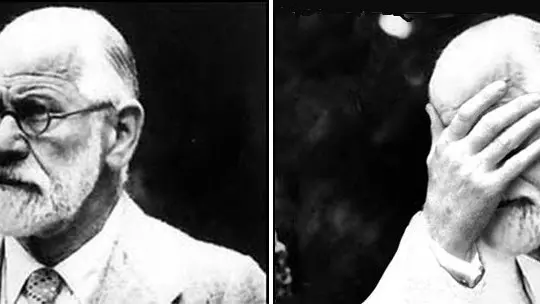
The psychologists and psychology students They face, day after day, a good number of clichés, stereotypes and myths surrounding their profession. One facet of these clichés are the phrases that, for some reason, every psychologist has had to hear on multiple occasions.
Phrases most hated by psychologists (or myths about psychologists)
Are topical and hackneyed phrases, the result of ignorance about the profession of psychologist. With this article we hope to raise awareness among the general population: Refrain from using these clichéd phrases! Your family member, friend or acquaintance who is dedicated to psychology will thank you eternally
Let us begin.
1. “Are you a psychologist? Don’t read my mind!”
It is a phrase that can irritate the psychologist quite a bit. Nobody has the ability to read minds from other people, nobody. If this were the case, mental health professionals would not use tests and a multitude of techniques to explore the patient’s psyche; A “mental reading” would be enough to know the person’s problems.
On the other hand, what is the point of this aggressive attitude? You may not be the most interesting person in the world, I have no reason to long to discover the wonderful things you think. You don’t need to warn me about something I hadn’t even thought of doing
Psychologists are dedicated to analyzing behavioral patterns, personality traits, psychosocial contexts and that kind of thing. From this objective information, we can make some hypothesis on patients, or foresee behaviors that may develop in the future based on the parameters studied. This means that we are not like Sandro Rey: We do not have crystal balls or “scientifically proven” glasses that allow us to see beyond common perception.
There is also the personable person who insists that you “read their mind.” This is a nice variant of the cliché, since at least it is not born from a passive-aggressive attitude. A few words for the person who asks me to read their mind: I admire your open and jovial disposition toward life and that you want to show me your inner world. I hope I don’t disappoint you if I tell you that the job of a psychologist is much less mystical. Anyway, I’ll buy you a coffee, to compensate you
2. “Psychologists are crazy”
It is not foolish to think that In every psychologist there is a point of madness . It happens with everyone who loves the discipline of knowledge of it; that which he has studied and that is probably his vocation. It is perhaps for this reason that people may conclude that “he who spends so much time thinking about the psyche may end up a little touched…”.
The truth is that many television series have paved the way for this myth of psychologists’ madness to gain followers. The cultural products they offer us are fiction and their plots are based on the anomalous, the unexpected, the shocking… hence the psychotherapists who come to life in series or films are most eccentric Just like, for example, the Doctor House He plays a misanthropic doctor addicted to narcotics, but extrapolating that all doctors are like him would be a big mistake.
However, the reality is very different. The majority of psychologists we are very normal and even boring, if you push me.
3. “Where is the couch? You can’t be a psychologist if you don’t have a couch”
To start: to the psychologists They don’t give us the couch at the graduation ceremony Buying a couch if you are going to have a consultation (which is another matter, not all psychologists are dedicated to psychotherapy) is not mandatory nor does it violate any law if you do not have one.
The couch was widely used by psychoanalysts as a matter of tradition. Some current psychotherapists, whether from the current of psychoanalysis or any other, may decide to have it, or not. The couch has no magical powers nor does it represent any added value. Its function is to help the patient relax and be able to better express their concerns and problems, and to prevent them from looking into the psychotherapist’s eyes and feeling self-conscious.
If you go to therapy and your psychologist does not have a couch but rather a normal sofa or an armchair or couch, please, don’t think he’s a bad psychologist for that and prevents you from having to hear the cliché phrase: “where is the couch?”
4. “With what psychologists earn, they must be rich”
This point depends a lot on the country you are in: in each region there are parameters for fees for psychotherapists, or the profession is valued better or worse. This influences what is paid for a psychotherapy session. Is it expensive to go to a psychologist? Well… as Pau Donés would say, it all depends.
Generally speaking, psychologists we are not rich Far from it, wow. Many people believe that by studying Psychology they are going to become millionaires by consulting, and then they find the harsh reality.
So why do psychologists charge so much? Well, let’s start doing the math. You must be aware when assessing whether a therapy session is very expensive, as therapists have studied for four years and, having graduated, we have had to take postgraduate degrees, masters.It is a significant investment in time and money. Master’s degrees in Spain do not go below €3,000. And, with the latest fee increase, each year of the degree can cost more than €1,500.
Besides, the tests necessary to diagnose patients They are astonishingly expensive Add the office rent, taxes (IRPF, self-employed…), civil liability insurance, material (the couch too, but it is optional). And note, also, that psychologists not only work with our patients during sessions, but we can spend many hours at home reviewing the history, searching for information, correcting tests and activities, learning better techniques, updating ourselves, training… There are many hours invested behind each patient, and they are not visible to the naked eye.
In any case, and especially after the crisis, the truth is that there are psychologists who They can treat you at a very affordable price There are also those who, for reasons of prestige, charge much more for sessions. There is everything in the Lord’s vineyard, but if you really need therapy, money should not be an impediment.
5. “No, I just don’t believe in that” (in psychology)
I’m happy for you, that you know. From the heart.
But let’s proceed to analyze this cliché phrase. The truth is that Psychology is not a religion or anything like that It’s not about “believing or not believing,” as if psychology were some kind of leap of faith. You may not believe in the law of gravity, but it has been proven that there is something that attracts bodies to the ground. Consequently, your opinion on the matter is totally irrelevant since physical laws are there and they will not stop acting no matter how much you do not believe in them. We could say that psychology or physics have sufficient self-esteem so that it doesn’t affect them if you pass by them.
Psychology is governed by the scientific method; try analyze reality based on methodological bases contrasted in order to reach truthful conclusions. This does not mean that everything that bears the surname “psychology” is absolutely indisputable, nor does it mean that there cannot be methodological flaws that can lead to wrong conclusions (as occurs in almost any social or health science).
Psychology is a science that is currently part of the Health Sciences You cannot “not believe” in psychology, in any case you will have a critical vision of the methodology and empirics used by this discipline. The empirical evidence that psychology provides regarding knowledge about the psyche is dynamic and mutable There is no doubt about that (human beings are changeable!), but it is undeniable that these data result in an improvement in the quality of life of people who come to therapy, this has been scientifically proven (sorry for the tautology).
Of course, the study of psychology is regulated within a quite demanding legal framework.
If with that phrase “I don’t believe in psychology” you want to imply that you don’t like psychologists you are within your right to have that opinion, but if that is the case it is better that you explain yourself properly and not use the typical phrase, because as you have read, it is a falsehood.
6. “You can’t get angry; You are a psychologist!”
Following this same logic, a doctor cannot catch a cold, a mechanic cannot have a car breakdown or a dentist cannot have a toothache. You must keep in mind that psychologists expose ourselves to high levels of stress: we face the emotional charge which involves listening to all the patients’ problems, and we are supposed to be trained not to let it affect us, but…
Outside of the consultation, Psychologists are people of flesh and blood, we get excited, we laugh, we cry, and… we have flaws. Although it is incredible.
Although our training and profession provide us with skills in controlling emotions and managing stress and conflicts, we are not immune to having bad moments, making mistakes, getting angry, etc. This It doesn’t mean that we are bad psychologists: We must learn to separate personal and professional life, and also know how to consider that psychotherapists are people, and therefore, perfection is not our common denominator. Not ours, not anyone’s.
7. “Psychology is not a science!”
We return again to those types of people who, for one reason or another, “do not believe in psychology.” This time it is the turn of the person who asserts that psychology is not a science. First of all, one might ask what that person understands by “science.” Because perhaps his vision of the scientific is reduced to mathematical and physical laws, perfect and immutable. This purist vision of the concept ‘science’ is not accepted by almost anyone.
Actually, science is. (let’s use an encyclopedia):
«The ordered set of systematically structured knowledge. Science is the knowledge obtained through the observation of regular patterns, reasoning and experimentation in specific areas, from which questions are generated, hypotheses are constructed, principles are deduced and general laws and systems organized through of a scientific method.” (Source: Wikipedia)
And, without a doubt, psychology is science insofar as it is the discipline of knowledge that studies, in an orderly manner and following the scientific method, human behavior and mental processes. What this means is that psychology establishes hypotheses about phenomena and then tests them empirically (through systematic observation), like any other science In fact, psychology is still a discipline that draws from biology, medicine, chemistry, neuroscience, social sciences and even quantum mechanics. Aren’t they sciences, either?
Psychology, therefore, is a science. It is a fait accompli, not an opinion. If you think you are the master of the universe, boasting about your skepticism, I recommend you carefully read the following article:
No hard feelings.
8. You meet a person by chance, you start a conversation, by chance he finds out that you are a psychologist and… He explains his problems to you and demands diagnosis and treatment in 5 minutes.
What psychologist hasn’t happened to: you take a taxi to go to another part of the city, and as soon as the taxi driver finds out about your profession, he starts to bombard you with their personal stories and expects you to “diagnose” and “cure” it before reaching the destination.
Let’s see: returning to the same thing a little, psychologists are not magicians nor do we work miracles. I’m really sorry. It is also not very pleasant that someone explain your problems to you in five minutes in a hurry, and make you responsible for your future based on a diagnosis and a cure that you have to carry out at the speed of sound.
Normally, psychologists are open people and we have no problem in lend a hand to those who need it But you have to understand that, in the same way that the doctor is not 24 hours a day exploring people he meets on the street in search of illnesses or the waiter is not dedicated to offering you the menu when he is on vacation, the psychologist cannot be permanently attending the psychological problems or existential concerns of strangers.
You have to know when it is time to raise these issues, and how to do it To establish a serious diagnosis, a work of hours, even days, of methodical exploration is necessary; requires concentration on the part of the psychologist.
And, be that as it may, and no matter how much humanism is attributed to us, you must also keep in mind that we try to earn a living from our work.
9. “Going to a psychologist is for mentally retarded people!”
This is one of the most irritating phrases, since it shows absolute ignorance on many levels. Let’s start: what does a mentally retarded person mean to you? A crazy? If you are referring to people who have some type of emotional problem, some temporary mood disorder, or some family conflict… How many people would escape your conception of crazy?
Also, in case you didn’t know, psychologists also try issues as aseptic as sick leave learning difficulties or relationship problems… Not to mention the branch of positive psychology, which is responsible for enhancing the qualities of the person (and therefore its objective is not to “treat” anything, but to enhance some skills that the person wants to improve).
Of course, saying that those who go to a psychologist are because they are crazy is truly outrageous. What is crazy is not seeking help when you are not well. And keep in mind that everyone, at some point in their life, will go through some type of conflict in which the intervention of a therapist would be necessary.
None of the cases mentioned fall under the category of “madness.” Ask a professional for help if you have a problem It’s not going to make that problem bigger or smaller The point is to try to help people, and each case is unique. Let us not fall into the stigma of ignorance with those who have the courage to face their fears.
10. “The other day I had a dream… (he explains it to you) what does it mean?”
Being a psychologist is not the same as being a psychoanalyst. And I bet that most psychoanalysts wouldn’t know how to offer you a rigorous explanation of the meaning of the dream you just explained in three minutes, either. without knowing more crucially relevant data when it comes to investigating something as complex and intangible as your unconscious.
The truth is that Most psychologists do not have training in this type of theories that inquire about the interpretation of dreams based on the analysis of the unconscious, symbols, etc. This is so.
As a diversion, most of us therapists can try to make some hypothesis about what we think these dreams that you have explained may mean, but do not expect an incontestable conclusion, because it will still be a summary interpretation and a lot of data will be missing to be able to analyze well how your unconscious works.
Have you heard other cliché phrases about psychologists or psychology?
By citing this article, you acknowledge the original source and allow readers to access the full content.
PsychologyFor. (2024). The 10 Phrases That Psychologists Hate to Hear the Most. https://psychologyfor.com/the-10-phrases-that-psychologists-hate-to-hear-the-most/