

Greece was one of the main cradles of Western civilization, and from which some of the greatest philosophers and precursors of science came, such as Aristotle, Socrates and Plato, as well as theorems, basic socio-cultural elements or even political systems. like democracy.
Greek culture is rich and varied, as are the myths that have accompanied the formulation of the Hellenic identity and way of understanding the world.
Throughout this article we are going to see you several short greek mythsall small but valuable examples of the beliefs that have been part of one of the most recognized and extensive cultures of Antiquity.
Memorable short Greek myths that tell about the culture of Ancient Greece
Below we are going to show you a dozen great short Greek myths, most of them highly known, that allow us to delve into the idiosyncrasy and way of seeing the world of Hellenic culture, in Ancient Greece.
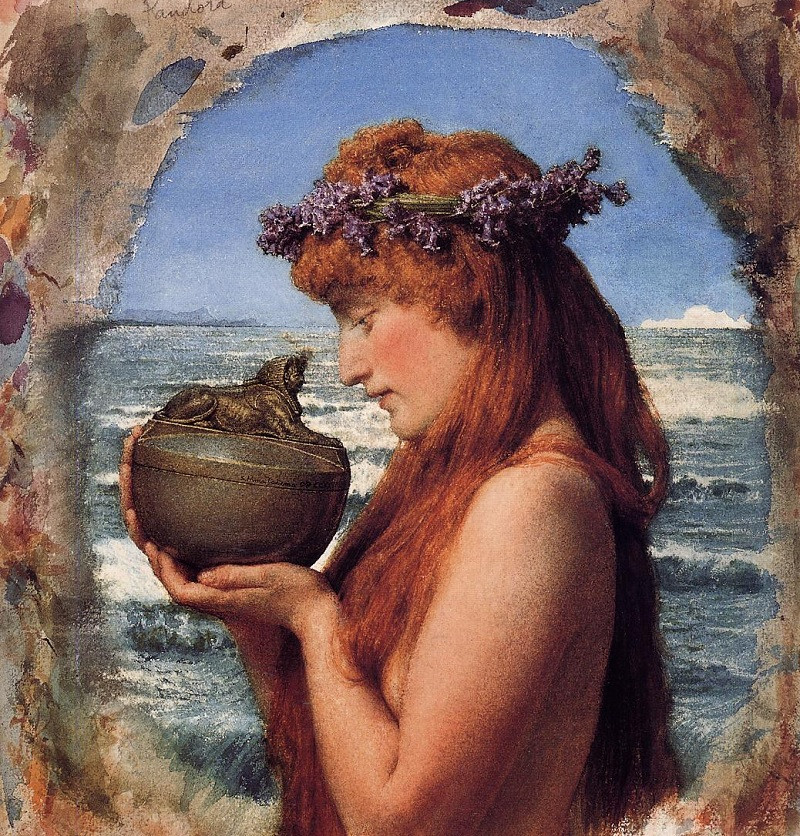
1. Pandora’s Box
We have all heard the expression “open Pandora’s box” at some point.and most have at least the notion that this expression refers to a Greek myth, which tells us about the price of unhealthy curiosity and the birth of the evils of the world, but also about hope. Although there are several variants of this myth, the most common and well-known is the following:
“Pandora was the first human woman, created by Hephaestus by order of Zeus and being endowed by the different gods with some of her greatest qualities and virtues, but also including the ability to seduce and lie. Its creation obeys the desire of the king of Olympus to take revenge on Prometheus and his people.
The god made Pandora and Prometheus’ brother Epimetheus meetand eventually led to them getting married. But Pandora also received a box intended for her husband, in which all the evils of the world were locked up, with instructions never to open it. However, one of the gifts that Pandora had received was curiosity. One day, the woman opened the box to see what was inside, something that would cause all evil to come out of the box and spread throughout the world. Frightened, Pandora closed the box, but only hope remained. “Then Pandora dedicated herself to offering hope to men, in order to help them endure the evils and vicissitudes of the world.”
2. The birth of Aphrodite
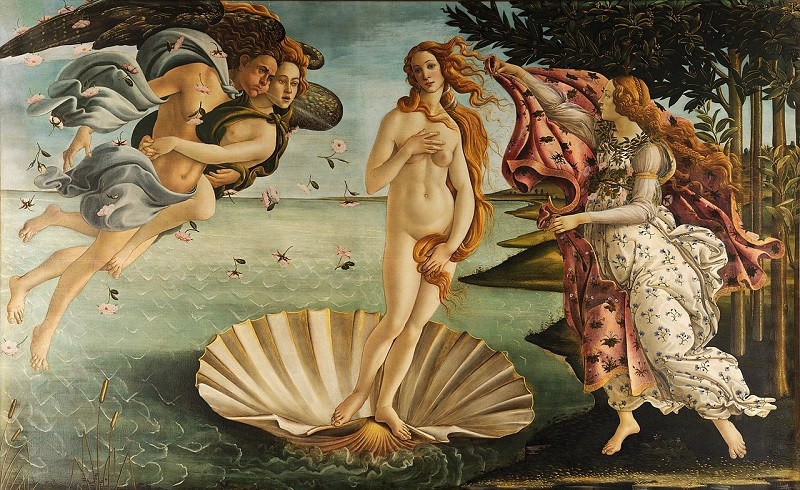
The goddess of love and passion, Aphrodite is a highly recognized deity within the Greek pantheon and was widely revered in the past. However, unlike other deities, she was not a natural daughter of any god, but rather, as her name suggests, she emerged from the foam of the sea. The myth of his birth, which comes to us from Hesiod, is as follows.
“Gaia, mother Earth, gave birth by herself to Uranus, the heavens. Together with him she would engender and give birth to numerous children, who would however be buried in their mother due to the hatred and fear that Uranus had for her offspring. One day the youngest son, Cronus (a titan who would become the father of the Olympian gods, whom he would devour), with the help of a sickle provided by his mother, castrated his father Uranus by cutting off his genitals.
The remains of said genitals fell into the sea, where the blood and semen would mix with the waters, forming a foam from which a deity, Aphrodite, would end up being born, already fully adult from birth.
3. The origin of Medusa
The name Medusa is highly known in Western culture, this Gorgon being a very popular Greek mythological figure. The best-known myth of which he is a part has to do with his death at the hands of Perseus, but another that may be of interest is the origin of his birth. Although there are various versions, one of them states the following.
“Medusa was once a beautiful young woman, a priestess of Athena whose beauty was admired by all who looked at her and who enjoyed many suitors. One day the god Poseidon observed the young woman and fell in love with her. The god of the seas decided to kidnap Medusa and take her against her will in the temple of Athens.
This event provoked the wrath of Athena, who He decided to curse the woman by transforming her beautiful hair into angry snakes.in addition to causing from then on anyone who looked into her eyes to turn into stone.”

4. The fall of Icarus
One of the myths that most warns us of the risks of ignoring what wisdom dictates and acting carelessly without taking into account the possible consequences, or of wanting to achieve and encompass more than we can, is that of Icarus. The myth says the following.
“Icarus was the son of Daedalus, a wise old man of great knowledge who was able to build the labyrinth in which King Minos imprisoned the minotaur. Said king, to prevent anyone from ever knowing how to find the way out of the labyrinth, decided to lock the wise man and Icarus for life in a tower.
Daedalus dreamed of escaping from his prison, but he could not escape by land or sea. Over time he came to the conclusion that he could escape through the air, and in this way he made two large pairs of wax wings from wax and bird feathers. Before leaving, the wise Daedalus warned Icarus not to fly too high or too fast, as the wax wings would not hold up.
They both began the flight, escaping from their confinement. But Icarus, seeing the beauty of the Sun, ignored his father’s instructions and flew higher and higher, trying to get closer until he almost touched the sun. But the wings could not withstand the heat, falling apart and causing Icarus to fall into the void and die.”

5. The people that come from the ants: the myrmidons
The name Myrmidon may not be especially well known today, but it is the name of a people famous in ancient times for the high reputation and skill of its warriors, being even mentioned in the Iliad. Although there are different versions of this myth, the one shown here is the one transcribed by Ovid in “The Metamorphoses.”
“Legend says that the king of Olympus, Zeus, had relations with the nymph Aegis and later named an island off the Peloponnese after her. However, when Hera found out about her husband’s adventure and the name given to the island, she decided to send a horrible plague that ended up killing the vast majority of those who lived there. Among the few survivors was the island’s king, Aeacus of Aegina, who begged Zeus to repopulate the island.
While he was praying, a ray of sunlight illuminated a row of ants on an oak tree, something that made the king decide to ask for as many people to appear as there were ants he had seen on the tree. Aeacus of Aegina fell asleep and dreamed that the ants on the oak tree fell to the ground and as they did so they were transformed. in people. Upon awakening, the island had recovered the number of inhabitants of yesteryear, being named in honor of the ants from which they came (myrmidon could be translated as ant men).”
6. The myth of Sisyphus
Another relatively short Greek myth is that of Sisyphus, king of Ephyra (later Corinth, the city of which he is considered the founder in the myths). This myth has been used as symbolism of the price of greed and deceptionin addition to making useless efforts (especially due to the punishment that was inflicted). The myth says the following.
“There was a time when the region of Ephyra had a king named Sisyphus, of great cunning but who had the great defect of being tremendously manipulative and greedy. But a day came when his ambition and his actions would provoke the wrath of Zeus by accusing him of kidnapping the nymph Aegina before her father, Asopus, in exchange for sources of fresh water for his city. Zeus ordered Thanatos to come and take King Sisyphus to the underworld, but once there the devious king invited the deity of death to eat, tricking him in such a way that he managed to chain him in a cell.
Since death was locked up, no deaths occurred, something that ended up angering Hades and make it finally decided that Ares would free Thanatos and take Sisyphus to the underworld. However, the intelligent king asked his wife not to honor him at his funeral upon his death, a request she complied with. This fact would be used by Sisyphus to deceive Hades, asking him to bring him back to life since his wife had not celebrated the funeral properly and had not honored him. The god of the underworld accepted in exchange for him returning after doing so. But Sisyphus did not return, until death came many years later.
Sisyphus would eventually be punished by Zeus and Hades. His sentence was having to carry a stone up the side of a mountain to the top. However, when it got there it would fall to the other side of the mountain, so it would have to be pushed to the top again, something that would repeat itself in an eternal cycle.”

7. The myth of Tiresias
Tiresias is one of the most famous blind seers in all of Greek mythology, being consulted by a large number of heroes. It is also part of one of the cases of transsexuality that appear in mythology. One of the myths that tells us about him is the following, which in turn explains the origin of his blindness.
“Legend says that while walking through the mountains one day, Tiresias found two snakes in full copulation on his way up the mountain. Tiresias wanted to separate them and hit the female with his staff.killing her. But in doing so, his action resulted in him being cursed and in revenge his sex was changed, becoming a woman. Tiresias would live as a woman for 8 years, after which she would encounter the same snakes again. On this occasion he hit and killed the male, turning him back into a male.
Years later, the gods Zeus and Hera would have a dispute over which of the two sexes enjoyed sex more. Tiresias was chosen as judge, since he had lived as a man and as a woman. But Tiresias’ response, which proposed that the woman enjoyed it more, provoked Hera’s wrath. As punishment, the goddess blinded him. However, as compensation for said action, Zeus gave him the gift of clairvoyance. This would make Tiresias one of the most famous seers in all of Greek mythology throughout his life.”
8. The myth of Eco
Some myths attempt to explain the origin of some phenomena, such as the echo. The mythological explanation of this phenomenon is explained below:
“Eco was an oréades or nymphs of the forest and the mountains. The most beautiful words came from her lips, but they were so beautiful that Zeus would begin to feel attracted to her. Hera, discovered the betrayal, He cursed Echo, taking away his voice. and making it so that he could only repeat the last words that his interlocutor said to him.
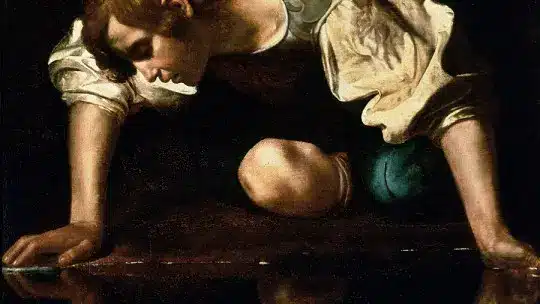
Time passed and the nymph fell in love with young Narcissus, observing him secretly. One day, the young man separated from his companions and perceived the nymph. However, he cruelly rejected her, something that caused the nymph to hide in a cave, where she was consumed until only her voice remained.
9. The myth of Narcissus
The myth that gives its name to narcissism and that warns us that we should not overvalue ourselves, the myth of Narcissus is another short myth of Greek origin which is also deeply linked to the previous one. The myth tells us the following.
“Son of the god Cephisus and Liriope, Narcissus was a very beautiful and attractive young man, who according to the great fortune teller Tiresias would live many years as long as he did not see his reflection. The young man generated the admiration of both men and women and was aware of his attractiveness, to the point of being highly conceited and despising the virtues and feelings of others, among which was the nymph Echo or the young Aminias.
He would give the latter a sword, with which the rejected young man would kill himself. Shortly before dying, he prayed to the goddess of revenge Nemesis asking that Narcissus know unrequited love. The deity responded. One day, as he approached to drink, Narcissus saw his reflection in the water of a pond and fell madly in love with him. Finally, trying to get closer to his beloved, Narcissus fell into the waters and ended up drowning.”
10. The myth of the Minotaur
This Greek myth dates back to the times of the Minoans, a pre-Hellenic civilization that existed until the collapse of the Late Bronze Age, when the majority of peoples of the Aegean Sea suffered a strong cultural and economic crisis and returned to Prehistory, forgetting how read and write. For this reason, it arose at a time when the Greeks of Hellenic societies only knew through legends.
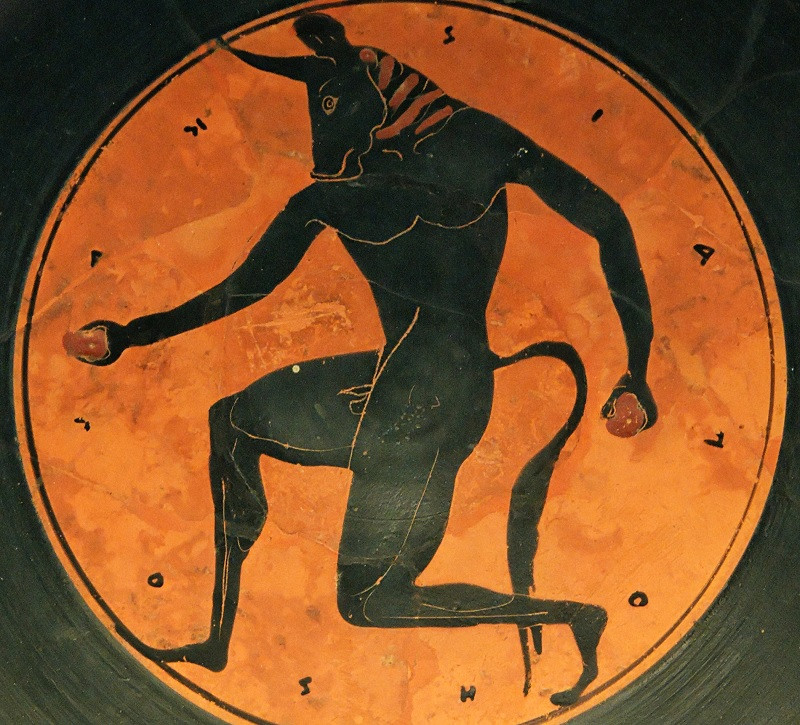
This one in particular tells us that King Minos of Crete offended the god Poseidon, so he made his wife Pasiphae give birth to a monstrous and aggressive being, the Minotaur.half man and half bull, who fed on human flesh. To hide the reason for his shame, the king ordered the construction of a labyrinth inside which the Minotaur was to live. With the intention of appeasing him, every nine years he would offer human sacrifices, forcing young people to enter the labyrinth never to return.
However, Theseus eventually offered to enter the labyrinth to kill the minotaur and end the sacrifices. He achieved this with the help of Princess Adriadne, daughter of King Mnos, and Daedalus, inventor of the labyrinth, who sent him a ball of thread so that Mo could get lost in the labyrinth.
11. The myth of Prometheus
The myth of Prometheus is one of the best known, and in it we can see how the ancient Greeks already wondered how we had discovered and tamed fire, considering it a gift of practically divine origin. The myth goes like this:
“Prometheus was one of the Titans, son of Iapetus and Clymene. According to some myths, together with his brother Epimetheus, he was charged with the task of creating animals and humans, with Prometheus being the one who decided to give man the ability to walk upright.
He also mocked and deceived the gods to favor mortals. On one occasion when Zeus forbade fire to mortals and seeing the needs and difficulties of man to survive, decided to grant them fire. Therefore Prometheus entered Olympus and stole fire from Helios’ chariot using a reed, after which he gave it to mortals so that they could warm themselves and light themselves.
But Zeus was enraged by the theft, condemning the titan to be chained to Mount Caucasus, where every day and forever, an eagle would come to devour his liver. The organ would grow back during the day, so that the torment would be repeated eternally for this immortal being.”
12. The Ship of Theseus
This is one of the stories that tells us about the dilemma of identity, the essence of things. This Greek legend, sometimes called the “ship of Theseus paradox,” and recounted by Plutarch, tells us that The ship in which Theseus (son of Poseidon) and his men traveled from Crete to Athens was being repaired for a decades, to a point where almost the entire ship had been replaced with new parts.
Taking into account that long process of transformation, was that Theseus’ ship, or had it been replaced by another?
13. The three sisters of destiny
The Fates, known in Greco-Roman mythology as Fates, were known as the three sisters of destiny according to Greek mythology.. These creatures, who were called Lachesis, Clotho, Atropos, were described as the goddesses of what is to come, so in their hands the destiny of mortals and gods alike passed, and they did so by carrying out an activity typical of spinners.
To do this, they were spinning with white wool, braiding it with black wool threads and gold threads. Black represented the bad moments of life, and gold, the good moments and extreme happiness.. The final cut to the thread represented the moment of death of the person or god to whom that thread corresponds, thus sealing the fate of his death.
Thus, the youngest sister, Clotho, spins the ball to separate the wool thread from it; Lachesis, the middle one, is responsible for the preparation and determination of the length of the thread that is braided; Finally, Átropos is in charge of the final cut.
14. The origin of Athens
Cecrops I was, according to Greek mythology, king of Attica and the first of Athens, although according to old stories he had named this city after his name, baptizing it Cecropia. However, several gods of Olympus noticed that beautiful urban center and decided to compete among themselves to become the patrons of their city. To mediate this dispute between deities, Zeus determined that each of the competing pairs would present a gift to the citizens of Cecropia so that they could decide who would win.
So, one day the inhabitants of the city went to a hill to see how the gifts were presented to them. First of all, Poseidon split a large rock near Cecropia with his trident and a spring gushed out of it.showing that the residents would never be affected by the drought. However, they warned that the water in that place tasted very salty, something logical considering that Poseidon reigned in the sea.
Next, Athena thrust her spear into the ground, and a large olive tree quickly sprouted from it.which would provide wood and food to the citizens. This present was highly appreciated by the local people, and that is where the name of the city of Athens arose.
15. The myth of Oedipus
This is another of the most famous Ancient Greek myths, and as with many others, there are several versions of it. However, the most famous narrative is the one created by Sophocles.
The myth says that Oedipus was the son of Laius and Jocasta, who were the king and queen of the Hellenic city of Thebes.. Because they could not have children, Laius consulted the Oracle of Apollo at Delphi to explain what would happen to their offspring. The oracle predicted that any son born to Laius would kill him. To prevent the prophecy from being fulfilled, when Jocasta finally gave birth to a baby, Laius had the baby’s ankles pierced and handed him over to a servant to be abandoned on the nearby mountain. However, he gave it to a shepherd from Corinth.
The boy Oedipus finally arrived at the home of Polybus, the king of Corinth, and his queen, Merope, who adopted him, because they had no children of their own. Oedipus received his name, which means “swollen foot” in ancient Greek, because of the swelling in his ankle. After many years, a drunken man revealed to Oedipus that he was not the biological son of the family that raised him, but a “bastard.” Therefore, he confronted his adoptive parents, the king and queen of Corinth, but they denied everything.
Given this, Oedipus decided to consult the same oracle in Delphi that his biological parents had gone to. The oracle revealed to him that he was destined to kill his father and marry his mother.. To avoid that fate, Oedipus decided not to return to Corinth and travel to Thebes, which was closer to Delphi.
During his journey to Thebes, Oedipus met King Laius at a crossroads. The two fought for the right of way and Oedipus killed Laius when the charioteer tried to run him over. The only witness to the king’s death was a runaway slave.
Continuing his journey, Oedipus encountered the Sphinx, a monster who stopped all travelers going to Thebes and asked them a riddle. Those who could not answer correctly were killed and eaten, while those who succeeded could move on. The riddle of the Sphinx was: “What walks on four legs in the morning, on two at noon, and on three at night?”. Oedipus answered correctly: “Man: as a baby he crawls on four legs, as an adult he walks on two legs and in old age he uses a cane as a ‘third leg’.” By answering correctly, Oedipus was able to continue his journey towards Thebes.
Jocasta’s brother, Creon, had announced that whoever could free the city from the Sphinx would be crowned king of Thebes and would marry Jocasta, who had recently become a widow. The marriage of Oedipus and Jocasta fulfilled the rest of the prophecy. Oedipus and Jocasta had four children together.
Later, an epidemic hit Thebes, wreaking havoc on the population. Oedipus claimed that he would put an end to this plague and sent his uncle, Creon, to the Oracle at Delphi for information. Upon returning, Creon told Oedipus that according to the oracle the murderer of Laius must be punished, and Oedipus promised and sent for the prophet Tiresias, who, in a heated discussion, revealed to Oedipus that he was the murderer. Enraged, Oedipus blamed Creon for the false accusations and the two clashed, so Jocasta intervened to calm Oedipus, revealing to him the story of her first-born son and his supposed death. Therefore, Oedipus realized that he could have killed Laius and unleashed the epidemic. At that moment, a messenger from Corinth arrived and announced that King Polybus had died, to which Oedipus was relieved, since the prophecy could not be fulfilled if his alleged father was dead.
However, knowing that his mother was still alive, Oedipus refused to attend the funeral in Corinth, but to reassure him, the messenger revealed to him that Oedipus was adopted. Jocasta, finally understanding that he was her son, begged him to stop searching for King Laius’ murderer, but Oedipus sought confirmation of the story from the messenger of the same shepherd who was supposed to have abandoned him at birth. Through the shepherd, Oedipus discovered the truth, including the fact that the man he had killed many years before was his father and that he had married his own mother. When he returned to Thebes, he found Jocasta hanged.
Why are Greek myths important?
The summarized Greek myths that you have found here are much more than interesting stories to educate children and young people or to entertain them. It must be taken into account that for many centuries the inhabitants of Ancient Greece formed a society based on oral culture, in which what we know today as textbooks were practically not used, and that is why Education consisted of learning myths and legends to “internalize” their lessons and morals.. If we add to this that Ancient Greece has provided one of the most important intellectual pillars in the development of the West (through its influence on the Romans and the societies of the Near East), it is not surprising that these stories are part, even today, from the popular culture of countries such as Spain, Mexico, Colombia, the United States, etc.
In fact, Greek myths have inspired all kinds of thinkers, such as Sigmund Freud, who saw in many of these myths symbolism that would explain the relationships between the Ego, the Ego and the Superego. Or like Claude Lévi-Strauss, who from the research approach known as structuralism, tried to combine anthropology and semiotics by analyzing many of these myths and seeing parallels between them.
All this tells us that we are dealing with narratives that are not limited to offering entertainment, but they tell us about the society we live in and they deal with universal themes that affect us all.
By citing this article, you acknowledge the original source and allow readers to access the full content.
PsychologyFor. (2025). The 15 Best Short Greek Myths. https://psychologyfor.com/the-15-best-short-greek-myths/