

See more of our articles in your search results.
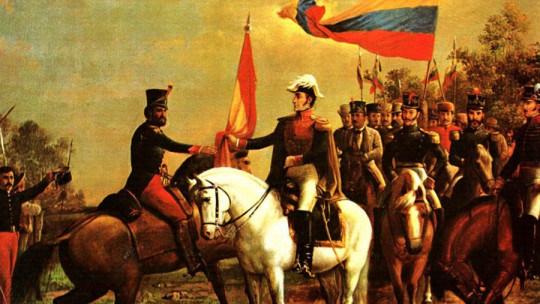
Colombia is a Latin American country whose history has been very intense. He has experienced the exploration of European powers firsthand, Spanish conquests that have shaped his identity that would later emerge with the outbreak of Latin American independence.
After its independence, the country went through many political changes, unstable governments, occasional dictatorships and catastrophes, but also events that filled it with hope, such as winning a Nobel Prize.
Next we will know the most important historical events in Colombia
The 16 main historical facts of Colombia
Colombia is a country very rich in culture and history. Since it was first explored by Spanish conquerors in the 16th century until its independence in the 19th century, the Andean country has witnessed countless historical events.
This does not mean that before the arrival of the Spanish there was no one living there, of course not, however, referring to the most important events in the history of Colombia we will delve into those that have contributed significantly to making the country the way it is. nowadays.
How many of these have you been "meaning to read" for months?
- 1
 Irvin D. YalomLove's ExecutionerRadically honest case studies on existential dread and changeListen Free On Audible
- 2
 Irvin D. YalomThe Gift of Therapy85 practical, warm clinical insights from a master therapistListen Free On Audible
- 3
 Oliver SacksThe Man Who Mistook His Wife for a HatUnforgettable clinical case studies on perception and identityListen Free On Audible
Below we are going to discover the 16 most important.
1. Foundation of the first South American city
On July 29, 1525, a great event takes place on the Caribbean coast of present-day Colombia The Spanish conqueror Rodrigo de Bastidas, accompanied by two hundred compatriots and several aborigines, officiates the ceremony and draws up the minutes of the founding of the city of Santa Marta, a city that would become the first large city in South America, being the starting point for the colonization of the rest of Colombian territory.
2. Foundation of Cartagena de Indias
Less than a decade after the founding of Santa Marta, on June 1, 1533, the Spanish navigator Pedro de Heredia and his sailors from Cartagena (Murcia) founded the city of Cartagena de Indias, in present-day Colombia. It would take a short time for the city to become one of the busiest and most important ports on the American continent being the place where the great riches extracted from the colonies would be shipped to the Spanish ports of Cartagena, Cádiz and Seville.
3. First Royal Court of the New Kingdom of Granada
On April 7, 1550, the First Royal Audience of the New Kingdom of Granada took place in the city of Santa Fe de Bogotá. The event took place in a mansion that overlooks the Plaza Mayor, the same building that today is the Palace of Justice in Plaza de Bolívar. The Royal Court was the highest court of the Spanish Crown over the territory of the New Kingdom of Granada Its objectives were to consolidate good governance of the territory and manage to administer real justice in the territory.
4. Revolt in Cartagena de Indias
On November 11, 1811, the noble city of Cartagena de Indias rose rarified. Very early, The crowd storms the weapons room in the Plaza de la Aduana and, later, gathers in front of the Government Junta to pressure its members to proclaim independence The pressure increases and, finally, Commissioner Muñoz publishes the Minutes, in which the decision to separate forever from the Spanish yoke is promulgated. Thus Cartagena becomes the first city to become independent from Spain.
5. Proclamation of the Second Republic of Venezuela
On May 14, 1813, With the departure of Simón Bolívar’s army from the city of Cúcuta (Colombia), what is known as “The Admirable Campaign” begins, which will take it to the doors of Caracas There, on August 6, he will achieve the liberation of western Venezuela. Together with the victories achieved in eastern Venezuela by Santiago Mariño, the Second Republic of Venezuela will be born. These events would contribute greatly to Colombia’s independence a few years later.
- You may be interested: “The 14 branches of Geography: what they are and what they study”
6. Creation of Gran Colombia
On November 28, in Panama, and after several desertions among the imperial ranks, the American Isthmus was proclaimed free and independent of the Spanish Crown. Immediately, and joining the libertarian dream of Simón Bolívar, Greater Colombia was formed, a huge nation made up of the current territories of Colombia, Venezuela, Ecuador and Panama, in addition to containing portions of Costa Rica, Peru, Brazil and Guyana.
7. Battle of Pichincha
On May 24, 1822, on the slopes of the Pichincha volcano, near Quito (present-day Ecuador), the Battle of Pichincha took place. The conflict occurs in the context of the Spanish-American War of Independence and as a result of the failure of peace talks with the new Spanish government Despite being a constitutional and liberal government, Spain refuses to accept the emancipation of the overseas territories.
The battle ends with the victory of the separatist troops of Marshal Antonio José de Sucre against the troops of the royalist leader José Aymerich, giving way to the definitive independence of the territory of the Republic of Gran Colombia and, consequently, being able to liberate Peru. The next day, Sucre will enter the city of Quito with his army, accepting the surrender of the Spanish troops established in the territory.
- You may be interested: “The 11 types of violence (and the different types of aggression)”
8. Naval Battle of Lake Maracaibo
On July 24, 1823, the Naval Battle of Lake Maracaibo took place, in which Admiral José Prudencio Padilla defeated the Spanish Navy commanded by Captain Ángel Laborde. This Colombian triumph guaranteed the independence of Venezuela and was an important step for the independence of the territory of Colombia.
9. New Granada Constitution of 1853
On May 21, 1853, the president of Colombia José María Obando sanctioned the Constitution, a document that consisted of only 64 articles and one transitional article. Despite its short length, this constitution represents great advances for Colombian society, including the prohibition of slavery, freedom of thought, press and religion, the guarantee of criminal trials through juries and the separation between Church and State In addition, suffrage is extended to all men.
However, in 1861 a great civil war began which, in 1863, led to the adoption of a new Constitution, establishing the union of the sovereign states in the United States of Colombia.
- Related article: “What is Political Psychology?”
10. The Bogotazo
It was April 9, 1948. Serious riots begin in the city of Bogotá after the tragic news that the leftist leader of the Liberal Party, Jorge Eliécer Gaitán, had been murdered Considered one of the most important events in modern Colombia, this episode of violence and frustration would go down in the annals of history as “El Bogotazo.”
Colombians remember Jorge Eliécer Gaitán as a great politician, good and dedicated to his country whose activism was stopped by three bullets that would end his life. As time went by, guerrillas would emerge in the Latin American country that would mark the rest of the 20th century and part of the 21st.
11. Dictatorship of Rojas Pinilla
Gustavo Rojas Pinilla came to power through a bloodless coup d’état, supported by liberals and non-Laureanist conservatives, on June 13, 1953. The soldier had proposed to end the violence and pacify the country, counting on great political and popular support and, if necessary, use force. His government, which is also classified as a dictatorship, lasted from 1953 to 1957, acting as president and being re-elected up to two times.
However, his second reelection did not take place, since the parties, the Church, the students, the banks, the industry and the unions They declared a general strike on May 6 against him returning to govern Almost immediately, Gustavo Rojas Pinilla announced his resignation from power and went into exile to Spain, the same country where Laureano Gómez was, whom he had overthrown four years earlier. The military junta took office the following month and dissolved the Assembly.
- You may be interested: “The 5 types of dictatorship: from totalitarianism to authoritarianism”
12. Gabriel García Márquez, Nobel Prize winner in References:
On October 21, 1982, Colombia witnessed how one of its most illustrious citizens, the writer and journalist Gabriel García Márquez, won one of the most important prizes in the world: the Nobel Prize in
References:
. Practically unexpected for everyone, Colombia acquires its moment of glory, standing out in the world of culture and the arts thanks to its complete work his novel “One Hundred Years of Solitude” (1967) being one of the most famous.
13. Armero Tragedy
It was November 13, 1985 and, despite warnings about volcanic activity and ash falling from the sky, the tragedy could not be avoided.
The Monte Nevado del Ruiz volcano, in the Central Mountain Range of the Andes, erupts twice Its violent explosion of dust and ash causes the city of Armero, next to the Lagunilla River, to be buried under mud and debris. 25,000 people die, including the 13-year-old girl Omayra Sánchez Garzón, whose last moments of life were followed around the world.
14. The Constituent Assembly of 1991
On December 9, 1990, during the government of César Gaviria Trujillo, Colombians voted for the democratic formation of the group of leaders in charge of discussing and drafting a new constitution This new Constitution, made public and applied in 1991, was a replacement for the already outdated Constitution of 1886.
15. Death of Pablo Escobar
On December 2, 1993, all of Colombia was stunned by the news that Pablo Escobar, the most influential drug trafficker of the moment, had died.
Although the death of this criminal was celebrated worldwide, in Colombia there were divided opinions For the media and politics it was a great success, an advance and progress for the world. On the other hand, for many citizens Pablo Escobar was the character who helped Medellín to be better, and there are even those who consider him a figure to emulate.
16. Peace between the Colombian government and the FARC
On August 24, 2016, in Havana (Cuba) and after almost four years of conversations, The Colombian government and the FARC guerrilla announce the success of the peace negotiations This brings to an end a war that lasted 52 years and caused the death of 220,000 people, 45,000 missing and more than six million displaced.
The peace agreement was submitted to a plebiscite on October 2 of that same year, waiting for Colombian society to give its approval for the agreement to be signed. However, despite all efforts to get the population to ratify it, the “no” triumphed by a narrow margin (50.2%). The two parties, guerrilla and government, despite everything, stated that there was no turning back for peace and President Juan Manuel Santos announced that he would continue the dialogue with everyone.
Use this citation format to reference the article clearly and help readers find the original source.
PsychologyFor. (2024). The 16 Most Important Historical Events in Colombia. PsychologyFor. https://psychologyfor.com/the-16-most-important-historical-events-in-colombia/