


A multidisciplinary thinker, committed and critical of the system. This is how you can define Noam Chomsky (United States, 1928) a veteran psycholinguist and political activist who is one of the most applauded figures of contemporary thought.
Chomsky, born in East Oak Lane, Pennsylvania, has directed his academic career along several lines. Perhaps the best known are his role as a researcher and psycholinguist, in addition to his staunch political activism as a defender of anarcho-syndicalism.
As an academic, he formulated his theory of language development. As an activist, he published (and continues to publish) valuable works in which he analyzes the impact of US imperialism on international geopolitics, in addition to being one of the most renowned discourse analysts.
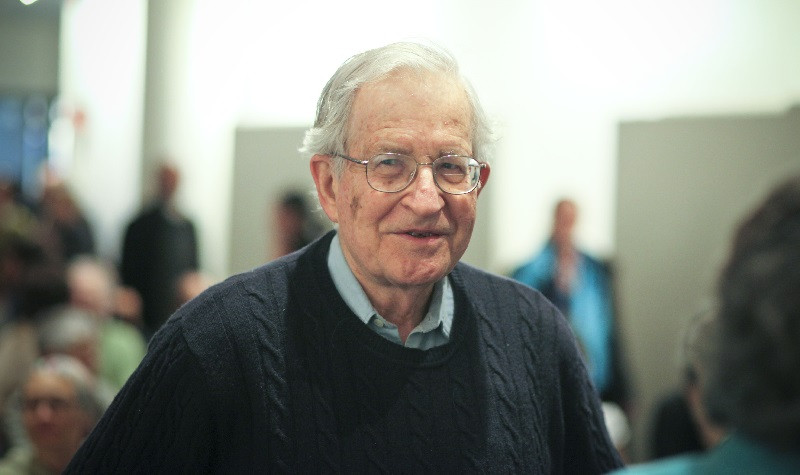
Phrases by Noam Chomsky to understand his political thought
This versatility in the topics that Chomsky has addressed has aroused admiration and misgivings in equal measure. He is criticized for his permanent disagreement with American foreign policy. However, few dispute that Noam Chomsky is one of the most brilliant and prolix thinkers of the 20th and 21st centuries.
1. Case after case, we see that conformism is the easy path, and the path to privilege and prestige; dissent, however, brings personal costs.
His political activism has brought him strong detractors.
2. The people who were honored in the Bible were false prophets. Those whom we call the prophets were the ones who were imprisoned and sent to the desert.
A reflection by Noam Chomsky about one of the fundamental pillars on which the Catholic Church bases its doctrine.
3. If you assume that there is no hope, then you guarantee that there will be no hope. If you assume that there is an instinct towards freedom, then there are opportunities to change things.
A phrase from Chomsky that is reminiscent of that of the great Eduardo Galeano.
4. People pay for their own subordination.
Accepting a precarious job or paying thousands of euros for a postgraduate degree are signs of living in a society of grateful slaves.
5. The basic idea running through modern history and modern liberalism is that the public must be marginalized. The general public is seen as nothing more than ignorant, interfering outsiders, like disoriented cattle.
Western democracy lacks a true sense of handing decision-making power to the people.
6. When you have the opportunity to take a look at the file they keep on you at the FBI is when you discover that intelligence agencies in general are extremely incompetent.
Apparently, Chomsky had access to his own secret report and found what he saw quite ridiculous.
7. The intellectual tradition is one of servility towards power, and if I did not betray it I would be ashamed of myself.
Ethics in the academic world is not usually very present, and this is confirmed by Chomsky.
8. Freedom without opportunities is a devilish gift, and refusing to give those opportunities is criminal.
An indirect criticism of economic liberalism.
9. Who are the guardians of history? Historians, naturally. The educated classes, in general. Part of their job is to shape our view of the past in a way that supports the interests of present power. If they do not do so, they will probably be marginalized in one way or another.
Another reflection about power relations in today’s society.
10. We shouldn’t be looking for heroes, we should be looking for good ideas.
Ideas and creativity above individualism and personalism.
11. What financial capital basically wants is stable currency, not growth.
A thought that challenges the financial system.
12. Companies are, simply, as totalitarian as Bolshevism or Fascism. They have the same intellectual roots of the early 20th century. Therefore, just as other forms of totalitarianism had to disappear, the same has to happen with private tyrannies. They have to be put under public control.
The days of the private company and its vertical hierarchy are numbered, according to the reflection of the thinker and activist.
13. The principles are clear and explicit. The free market is fine for the third world and its growing counterpart in our country. Mothers with dependent children can be firmly educated about the need for self-sufficiency, but not dependent executives and investors, please. For them the welfare state must flourish.
Another famous quote from Chomsky that reviews the status quo in contemporary capitalism.
14. Sports play a societal role in the procreation of jingoistic and chauvinistic attitudes. They are destined to organize a community that is committed to its gladiators.
The hooligan phenomenon can be a powerful weapon of the neoliberal system.
15. If we don’t believe in freedom of expression for people we despise, we don’t believe in it at all.
Does freedom of expression have limits?
16. Propaganda is to a democracy what coercion is to a totalitarian state.
A parallel that can make us reflect on the supposed free society in which we live.
Another reflection on politics and democratic culture.
18. Rights are not granted, they are conquered.
Democracy was not delivered by the guarantors of the dictatorship.
19. Part of the reason capitalism seems to be successful is that it has always relied on a lot of slave labor, half the population. What women do – outside the world of work – doesn’t count for anything.
Feminism and social criticism, two key elements in the work of Noam Chomsky.
20. The criticism of “democracy” among anarchists has often been the criticism of parliamentary democracy, as it has arisen in societies with deeply repressive features.
Anarchism and its vision on public life.
21. You can’t have a functioning democracy without what sociologists call “secondary organizations,” places where people can meet, plan, talk, and develop ideas.
Meeting places for the people are essential to create large-scale changes.
22. The purpose of the mass media… is not so much to inform and report what is happening, but rather to shape public opinion according to the agendas of dominant corporate power.
The media and its harmful influence on the opinions of the uninformed population.
23. Who are the guardians of history?
A rhetorical phrase that refers to the dominant classes.
24. The United States is unusual among industrial democracies in the rigidity of the system of ideological control, indoctrination, we might say, exercised through the mass media.
Another thought that delves into the manipulation exercised by the mass media.
Famous quotes about education and learning
Since Chomsky developed much of his intellectual career as a psycholinguist and philosopher of education, it is also interesting to echo several of his phrases and quotes that deal with this topic.
25. The purpose of education is to show people how to learn for themselves. The other concept of education is indoctrination.
A clear phrase that tells us what the path to follow should be in terms of education.
26. Education has a value in itself, regardless of the economic impact it produces on society.
A reflection against the excessive economicism with which the educational system is organized today.
27. Do we want to have a society of free, creative and independent individuals, able to appreciate and learn from and contribute to the cultural achievements of the past, or do we want people who increase the GDP? It is not necessarily the same.
Along the same lines as the previous one.
28. If you don’t know what you’re looking for, if you have no idea what’s relevant, be willing to question this idea, if you don’t have that, exploring the internet is just randomly picking up unverifiable facts that don’t mean anything.
The Internet can be very useful, but we must have enough judgment to know where to navigate.
29. The Internet is like any other technology, basically neutral, you can use it in constructive or harmful ways. The construction forms are real, but very few.
Famous quote that, like the previous one, questions the use we give to the network of networks.
30. In the common problems of human life, science tells us very little, and scientists, as people, are certainly no guide. In fact, they are often the worst guides, as they often tend to focus, laser-like, on their own professional interests, and know very little about the world.
An essential difference between the scientist and the freethinker.
31. Science is an exploration of very difficult questions. Without disparaging the theory of evolution, that is a tremendous intellectual advance, but it tells you nothing about whether or not there is what people believe when they talk about God. He doesn’t even talk about that topic.
Religion is another of the topics of study of the Jewish intellectual.
These quotes showcase Chomsky’s deep critique of political, social, and educational systems while also highlighting his belief in intellectual responsibility and human dignity. Through his words, he challenges us to rethink the structures of power and the role of the individual in resisting them.
By citing this article, you acknowledge the original source and allow readers to access the full content.
PsychologyFor. (2025). The 31 Best Quotes by Noam Chomsky. https://psychologyfor.com/the-31-best-quotes-by-noam-chomsky/