

See more of our articles in your search results.
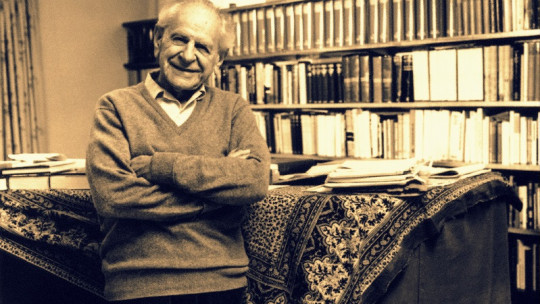
Karl Popper (1902 – 1994) was an Austrian philosopher, professor and writer of Jewish origin, later naturalized as British.
Popper is still studied in Western social science faculties as one of the most prolific and profound thinkers of the 20th century. His works, which cover any form of political, philosophical and sociological analysis, were characterized by the analysis of his experiences in the two world wars at the beginning of the century.
The best famous quotes by Karl Popper
Agnostic and anti-nationalist, Popper’s work includes titles such as “The Open Society and Its Enemies” or “The Logic of Scientific Research.” His social theories and thoughts are still central when analyzing the dynamics of society.
In this article we are going to compile the best phrases of Karl Popper an essential philosopher from whom we can learn a lot.
How many of these have you been "meaning to read" for months?


1. For a nation, freedom is more important than wealth, and, in political life, this is an indispensable condition to live at least humanly.
The bases for democracy, according to Karl Popper.
2. In the name of tolerance, we would have to claim the right not to tolerate the intolerant.
A play on words that hides a great truth.
3. Anyone who is unable to speak clearly must remain silent until they can do so.
If you are not able to express yourself adequately… you better keep practicing until you get it.
4. The open society is one in which men have learned to be to some extent critical of taboos, and to base decisions on the authority of their own intelligence.
Reflecting on the perfect society.
5. True ignorance is not the absence of knowledge, but the refusal to acquire it.
Sought ignorance is extreme misery, according to Popper.
6. Reason is not all-powerful, it is a tenacious worker, tentative, cautious, critical, implacable, eager to listen and discuss, risk-taking.
One of those phrases from Karl Popper that scrutinizes the characteristics of reason and common sense.
7. The increase in knowledge depends entirely on the existence of disagreement.
Discrepancy builds better arguments and reasoning.
8. You have to be against what has already been thought, against tradition, which cannot be dispensed with, but which cannot be trusted.
Faithful to the critical and empirical spirit, Karl Popper makes it clear that tradition should not be inscrutable.
9. Science must begin with myths and with the criticism of myths.
In the same sense as the previous famous quote.
10. We should only sacrifice ourselves for ideals.
A proselyte of his ideas, Popper was clear about his ethical principles.
11. Science can be described as the art of systematic oversimplification.
His curious conception of science.
12. You can choose any name for the two types of government. Personally, I call the type of government that can be removed without violence “democracy”, and the other “tyranny”.
Differentiating between democracy and authoritarian forms of government.
13. No matter how many examples of white swans we have been able to observe, this does not justify the conclusion that all swans are white.
This sentence is a clear example of his radical rationalism.
14. No rational argument will have a rational effect on a man who does not want to adopt a rational attitude.
Reflection to apply to daily life and avoid absurd discussions.
15. The game of science, in principle, never ends. Anyone who one day decides that scientific statements do not require any further testing and can be considered definitively verified is removed from the game.
Science, certainly, has the obligation to review each of its knowledge. Therefore, it is dynamic by definition.
16. The history of political power is the history of international crime and mass murder.
A disheartening vision of international politics and the interests of rich nations.
17. Equality before the law is not a fact but a political demand based on a moral decision. And it is totally independent of the (probably false) theory that all men are born equal.
The ethics that should accompany any legal principle.
18. I can be wrong and you can be right and, with an effort, we can both get closer to the truth.
Discrepancy can move us forward as a society.
19. It is impossible to speak in such a way that it cannot be misunderstood.
Words are always ambiguous, and it is difficult to avoid being misunderstood.
20. Theory dominates experimental work from its initial planning to the final touches in the laboratory.
Another consideration by Popper about the scientific method.
21. For strictly logical reasons it is impossible for us to predict the course of history.
The future is impossible to predict. Not even through theories.
22. We don’t know: we can only guess.
In this phrase, Karl Popper shows signs of a certain philosophical idealism.
23. I think that the challenge is the only excuse there is to give a lecture. This is the only way the spoken word can be better than the printed word.
About his motivation to come to the fore.
24. That which promises us paradise on earth never produced anything but hell.
In this phrase, Popper makes his anti-religious position clear to us.
25. Equality before the law is not a fact, but a political demand based on a moral decision. And it is totally independent of the theory – probably false – that all men are born equal.
Great thought that reflects his position on equality, linking it with his notion of ethics.
26. When a theory appears to you as the only possible one, take this as a sign that you have understood neither the theory nor the problem it should solve.
Simplicity is usually condemned, since the truth always has complex edges.
27. Our civilization has not yet fully recovered from the shock of its birth: the transition from the tribal or closed society, with its submission to magical forces, to the open society that unleashes the critical powers of man.
A historically rapid transition that has led us to a society for which we have not been biologically prepared.
28. We can become the creators of our destiny, when we have stopped thinking like prophets.
Living each moment is what drives us towards the future.
29. The world is not made up of things, but of processes.
Constantly changing, nothing is immutable. A teaching from Karl Popper to take into account.
30. All life is problem solving.
Therefore, we must adapt to constant uncertainty.
31. Science is the only human activity in which errors are criticized and corrected.
Without science it would be impossible to distinguish true knowledge from simple gossip.
32. There is no history of humanity, there are only many stories of all kinds of aspects of human life.
The understanding of civilization can only be partially studied.
33. We are social creatures in the most intimate part of our being. The idea that one can start anything from scratch, free from the past, or without intervention from others, could not be more wrong.
Our cultural nature is indisputable, according to Popper.
34. The majority never establishes what is right or wrong, the majority can also be wrong.
An argument that some use to question the basis of democratic societies.
35. Our knowledge is necessarily finite, while our ignorance is necessarily infinite.
About knowledge and its limitations.
Use this citation format to reference the article clearly and help readers find the original source.
PsychologyFor. (2024). The 35 Best Quotes from Karl Popper. PsychologyFor. https://psychologyfor.com/the-35-best-quotes-from-karl-popper/