

See more of our articles in your search results.
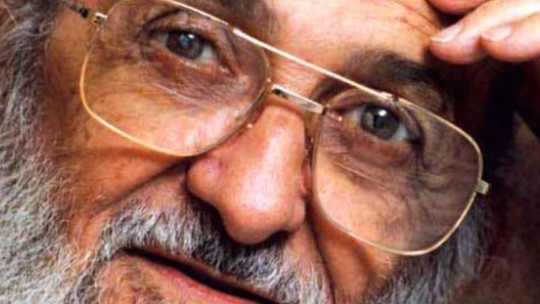
Paulo Freire (1921 – 1997) was an influential pedagogue, educator and activist for the rights of the most disadvantaged. Born in Recife, Brazil, he is considered one of the most important theorists in the field of education of the 20th century.
Paulo Freire had to deal with poverty from birth. This personal background helped him build what would become his theory of education in adulthood. He studied law, psychology and philosophy at the University of Recife. He worked with poor communities to whom he introduced literacy with a method created by himself, which is considered a variant of liberation theology, since knowing how to read and write were essential requirements to be able to have the right to vote in Brazil at that time. epoch.
Famous phrases and quotes by Paulo Freire
His legacy as a pedagogue goes beyond the boundaries of education. Paulo Freire was a global thinker, committed to his people and who took an active part in the literacy of excluded minorities.
In today’s article Let’s get to know the best phrases of Paulo Freire
1. The important thing, however, is that the working classes continue learning in the very practice of their struggle to establish the limits for their concessions, that is, that they teach the dominant classes the limits within which they can move.
Education should promote that social and labor rights are respected.
How many of these have you been "meaning to read" for months?
- 1
 S&S/Simon ElementProtocolsAn Operating Manual for the Human BodyListen Free On Audible
 - 2
 Undercover Publishing HouseStop Letting Everything Affect YouHow to break free from overthinking, emotional chaos, and self-sabotage.Listen Free On Audible
 - 3
 Grand Central PublishingIn the Shadow of EightSurviving the Reality of My ChildhoodListen Free On Audible
2. The teacher’s gesture was worth more than the grade of ten he gave to my writing. The teacher’s gesture gave me a confidence that was still obviously distrustful that it was possible to work and produce. That it was possible to trust me, but that it would be as wrong to trust beyond the limits as it was wrong at that moment not to trust.
About the importance of positive reinforcement.
3. Education is an act of love, therefore, an act of courage.
Beautiful phrase by Paulo Freire about teaching.
4. Accepting and respecting difference is one of those virtues without which listening cannot occur.
Empathy, in short, must govern our communication.
5. The Pedagogy of the oppressed ceases to be of the oppressed and becomes the pedagogy of men in the process of permanent liberation.
About his pedagogical proposal.
6. Their ideal (of the oppressed) is, really, to be men, but for them, being men, in the contradiction in which they have always been and whose overcoming is not clear to them, is equivalent to being oppressors. These are their testimonies of humanity.
Famous quote to reflect on relationships of domination.
7. My vision of literacy goes beyond ba, be, bi, bo, bu. Because it implies a critical understanding of the social, political and economic reality in which the literate person is.
The depth of his philosophy is reflected in this reflection.
8. No one has the freedom to be free, but not being free, they fight to achieve their freedom.
Paradox to keep in mind. Free is he who fights to be so.
9. The oppressed must be the example of themselves, in the fight for their redemption.
Very much in line with the previous sentence.
10. In the “banking” vision of education, “knowledge”, knowledge, is a donation from those who consider themselves wise to those who judge ignorant.
On commercialization in certain educational practices.
11. Education, as a practice of domination that we have been criticizing, maintaining the naivety of the learners, what it aims to do, within its ideological framework, is to indoctrinate them in the sense of their accommodation to the world of oppression.
Education without redemption is simple indoctrination.
12. Education as a practice of freedom, contrary to that which is a practice of domination, implies the denial of the abstract, isolated, loose man, detached from the world, as well as the denial of the world as a reality absent from men.
Gregariousness is part of the consumer culture imposed by capitalism.
13. Education is constantly remade in praxis. To be, it has to be being.
An essential characteristic of teaching practice.
14. True education is praxis, reflection and action of man on the world to transform it.
The reasons for the educational event.
15. Sectarianism creates nothing because it does not love.
Dogmatic people do not know how to contribute valid ideas or debate, according to Freire.
16. The more critical a human group is, the more democratic and permeable it is.
Reflection against democratic centralism.
17. Our presence in the world, which implies choice and decision, is not a neutral presence.
Everything we do is imbued with a certain political vision.
18. Children need to be assured of the right to learn to decide, something that can only be done by deciding.
Childhood must be respected, and thus children’s decisions, regardless of their economic resources.
19. Education is always a kind of theory of knowledge put into practice, it is naturally political, it has to do with purity, never with puritanism, and it is, in itself, an experience of beauty.
Masterful philosophical phrase by Paulo Freire.
20. Existence is life that knows itself as such, that recognizes itself as finite, unfinished; that moves in time-space subject to the intervention of what exists.
21. As a presence in history and in the world, I fight hopefully for dreams, for utopia, for hope, with a view to a critical pedagogy. And my fight is not in vain.
An ethical struggle through praxis.
22. Education is freedom.
Perhaps, the most remembered phrase of the Brazilian pedagogue.
23. Only the power that arises from the weakness of the oppressed will be strong enough to liberate everyone.
About the power of the oppressed masses.
24. Freedom is acquired through conquest, not as a gift. It must be carried out constantly and responsibly.
No civil conquest was made in deference to the oppressors.
25. Jaspers said: “I am to the extent that others are also.” Man is not an island, he is communication. So there is a close relationship between communion and searching.
Philosophical reflection about our personality based on interpersonal relationships.
26. Looking at the past should only be a means to understand more clearly what and who we are, to be able to build the future more intelligently.
Phrase about time.
27. Language is never neutral.
It always has ideological and political connotations, according to Freire.
28. The trust of the people in the leaders reflects the trust of the leaders in the people.
About good politicians.
29. It is not the unloved who initiates disaffection, but the one who cannot love because he only loves himself.
Narcissism leads us to unhappiness.
30. Men are not formed in silence, they are formed in words, in work, in action, in reflection.
About the contextual variables of each individual’s learning.
31. The narration, which has the teacher as its subject, directs the students towards the mechanical memorization of the content that is narrated… the narration turns them into containers that the teacher must fill.
A criticism of the rote teaching system.
32. There is no dialogue if there is no humility, nor if there is no strong and unbreakable faith in human beings.
A sample of his philanthropy.
33. There is no life without correction, without rectification.
Knowing how to forgive and forgive yourself is absolutely essential.
34. No person ignores everything. Nobody knows everything. We all know something. We all ignore something. That’s why we always learn.
We are all capable and good in some facets of life.
35. Reading the world precedes reading the word.
Know and then reflect.
36. The more we are able to become children again, to remain childish, the more we can understand why we love the world and are open to understanding, to understanding; When we kill our inner child, we are no more.
The vitality of childhood is irreplaceable.
37. Only by abolishing the situation of oppression is it possible to restore the love that that situation made impossible. If I don’t live in the world, if I don’t love life, if I don’t like people, I can’t enter into dialogue.
Phrase to apply to our daily lives.
38. Educating is imbuing with meaning everything we do at every moment.
Nothing has pedagogical value if it does not explain or transmit an emotion.
39. I noticed a farmer and asked him how many children do you have? Three – she answered. Would you sacrifice two of your children by subjecting them to suffering, so that the third could study? No – he answered… then is it really God who does those things?… No. It is not God who does them. He is the boss.
A little story that should make us reflect.
40. Sectarianization represents an obstacle to the emancipation of human beings.
Having free and permeable thinking allows for greater integration of knowledge and knowledge.
41. Every relationship of domination, exploitation, oppression is already violence in itself. It does not matter whether it is done through drastic means or not.
About implicit forms of violence.
42. The revolution is born as a social entity within the oppressive society.
In line with thinkers like Lenin, Paulo Freire establishes this characterization of social revolutions.
43. As long as the oppressed remain unaware of the causes of their fatalistic condition, they accept their exploitation.
A kind of slave complacency.
44. Reading is not walking in the words; It is taking their soul.
Reflection that gives meaning to the knowledge acquired.
45. Men and women rarely admit their fear of freedom openly, however they tend rather to camouflage it, presenting themselves as defenders of freedom.
About the prevailing hypocrisy.
Use this citation format to reference the article clearly and help readers find the original source.
PsychologyFor. (2024). The 45 Best Phrases of Paulo Freire. PsychologyFor. https://psychologyfor.com/the-45-best-phrases-of-paulo-freire/