


See more of our articles in your search results.
Human beings have been leaving their mark on the world for millions of years. Through the ages we have learned a lot: among many other things we have developed agriculture and livestock, art and technology, faith, philosophy and science, civilization and culture. Countless peoples, civilizations, empires and systems have been born and disappeared, while many others have evolved to become what they are today. The entire set of events that occurred over time that we have evidence of is what we consider history.
But history is not completely uniform: we can distinguish specific time periods within it in which different advances or great changes have occurred. Is about the different ages of history
The ages of history
We consider history set of events and events that humanity in general has experienced over time that has been on Earth since writing was invented as a method of symbolic recording that allows us to analyze and know what happened in the past. Although technically before this the human being had already suffered great tribulations and had developed multiple skills, knowledge and techniques, the fact of not being able to know the specific events they experienced means that the period prior to writing is considered outside of history.
Since the invention of writing, there are countless facts and events that have marked the course of history and have changed our world to a great extent. History is vast, and historians have divided it into several ages to facilitate its understanding by identifying great moments of change.
There are four great ages into which historians (since Christopher Cellarius introduced them) usually divide history, although some subdivisions can be found within them. When assessing the development of the human being, however, the time before what we know as history is also usually added: prehistory. It must be taken into account, however, that These historical stages are separated from each other mainly based on the events that occurred in Europe Once this is clarified, it is worth mentioning that the main ages of history are the following.
How many of these have you been "meaning to read" for months?
- 1
 TarcherThe Artist's Way30th Anniversary EditionListen Free On Audible
 - 2
 New Harbinger PublicationsThe Dialectical Behavior Therapy Skills WorkbookPractical DBT Exercises for Learning Mindfulness, Interpersonal Effectiveness, Emotion Regulation...Listen Free On Audible
 - 3
 New Harbinger PublicationsAdult Children of Emotionally Immature ParentsHow to Heal from Distant, Rejecting, or Self-Involved ParentsListen Free On Audible
1. Prehistory
As we have said, this stage would not really be part of history since it includes the set of events prior to the invention of writing. But it is a period of great progress, being in fact the longest period that humanity has experienced The appearance of Homo sapiensthe emergence of oral language, the discovery of fire, the creation of the first tools and the first fixed villages or the transition from hunters/gatherers to farmers/ranchers occurred at this time.
This stage is subdivided into the Stone Age (which in turn is divided into Paleolithic, Mesolithic and Neolithic) and the Age of Metals (divided into Copper, Bronze and Iron, although many of the events of this last period already belong to the history).
Possibly the most important milestone of this age is the appearance of the first permanent settlements of human beings, linked to the appearance of the first crops, about 12,000 years ago in the area of Mesopotamia, Anatolia and the East of the Zagros Mountains. These settlements were made up of people who left the hunter-gatherer life behind and began to live off the accumulation of agricultural surpluses. This allowed the members of these small populations to specialize in tasks that others did not know how to do, giving rise to more elaborate and specialized goods.
Over time, these towns gained the capacity to accommodate people, and soon temples began to emerge, often associated with the centralized management of agricultural surpluses (a part of the harvest was given in sacrifices).

2. Ancient Age
The first of the ages of history, the Ancient Age begins with the invention of writing (which is approximately considered to have emerged between 3500 and 3000 BC). The Ancient Age would then begin at a time between the aforementioned Bronze and Iron ages. Its completion dates back to approximately 476 AD, with the fall of the Western Roman Empire.
This stage is characterized by being the longest in history, and part of the events that occurred in it have been lost. It is in the Ancient Age that the human being Most of them abandon nomadism and become sedentary, this age being the time when great civilizations such as the Greek, Egyptian, Mesopotamian, Persian and Roman emerged. This stage is also famous for the high prevalence of battles and wars, slavery and the emergence of various political systems and concepts such as democracy or dictatorship.
At the European level, the presence of a large number of peoples and traditions stands out that little by little were invaded and were lost as they were brought together by the Roman Empire, which expanded throughout Europe and parts of Asia and Africa.

On the other hand, this stage of history is one in which great advances were made in human knowledge, being the period in which the classical stage of philosophy appears (from which all the sciences will later depart). Different systems of beliefs and values were generated. At the level of religion, different cultures maintained generally polytheistic beliefs. Also in it some of the main current religious beliefs emerged, both polytheistic (such as Hinduism) and monotheistic (Judaism and Christianity).
Within the Ancient Age two stages can be distinguished: classical antiquity and late antiquity.
classical antiquity
The period characterized by the expansion of the Greek and Roman civilizations, technically from the 5th to the 2nd century BC. In this stage we observe the emergence of both civilizations, the Empire of Alexander the Great, the Persian Wars, the emergence of democracy, the Roman Republic and its expansion throughout Italy, the creation and expansion of the Roman Empire and the beginning of its decline.
late antiquity
Late antiquity would go from the 2nd century BC to 476 AD, corresponding to the stage of decline of the Roman Empire and the transition from slavery to feudalism At this stage, Rome and its empire began to suffer more and more frequent uprisings (the one carried out by Spartacus stands out) and was invaded by the Germanic peoples (as happened in the Iberian Peninsula).
One of the best-known invasions was that of Attila the Hun Also relevant is the appearance and expansion of Christianity as the official religion of the Empire, which would later become the dominant religion in European territory. Late Antiquity would technically end in 476 AD, with the fall of the Roman Empire.
3. Middle Ages
This stage is curiously linked to the destiny of the Roman Empire, since it originates with the fall of the Western Roman Empire (in 476 AD and ends with the fall of the Byzantine Empire to the Ottomans (the Eastern Roman Empire) in 1453. However, other historians consider that its completion corresponds more to the arrival of Columbus in America in 1492.
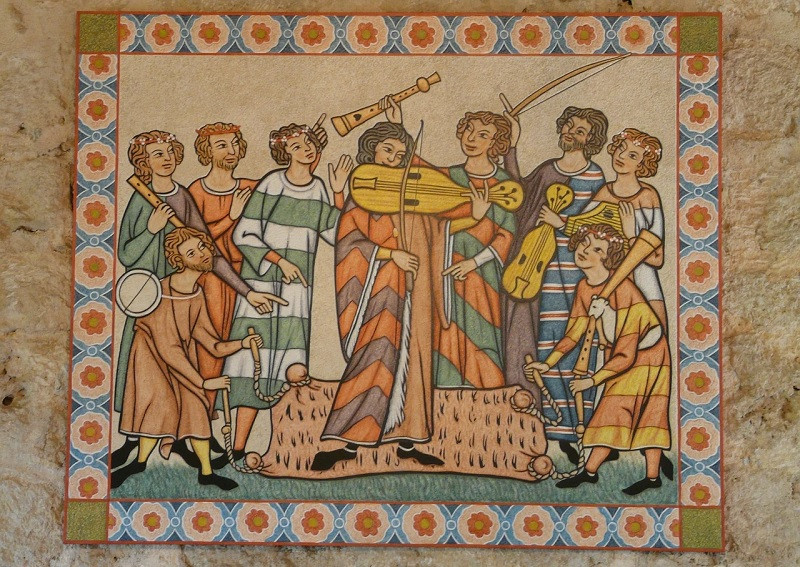
After the fall of the Roman Empire, which centralized power, different kingdoms and civilizations emerged, establishing different peoples and nations in an ethnic sense. Feudalism appears as a political system, in which The lords governed their lands while obeying the figure of the king Monarchs could reign over very different peoples and ethnic groups, and the power relations established that all of their individuals owed themselves to their king, regardless of their language, race or status.
During this stage, the expansion and dominance of Christianity as the predominant religion in Europe was observed, and Islam as a religion was also born in Arabia.
Likewise, it is during this time that the bourgeoisie appears as a social class, although the technological development of this time did not yet allow it to accumulate much wealth (something that will happen after the industrial revolutions, later).
The economy is divided between the agricultural sphere and the urban sphere, in which the most important figures are merchants and guilds of crafts and manual manufacturing of goods. However, In most places the cities are still small and the population lives either dispersed or in small urban centers, where almost all important sites are within walking distance.
War conflicts framed or justified by religious differences are frequent, being the time of the Crusades and different religious persecutions Different groups and sects appear, many of which are considered heresies and eliminated. The figure of the Inquisition, acts of faith and the burning of witches also appear.
This historical period can be divided into two stages: Early Middle Ages and Late Middle Ages. Although sometimes an intermediate stage is added, the Feudal Age.
Early Middle Ages
The Early Middle Ages is considered the period of time between the 5th and 10th centuries. It represents a period of time in which different empires and civilizations fought against each other, once the Roman Empire fell. Vikings, Hungarians, Muslims, Byzantines and the Carolingian Empire They were some of the most relevant at the European level.
The population lived mostly in the countryside, and was divided into nobles and commoners. The class differences are very noticeable, with the nobility having all the rights and the commoners practically none. Feudalism arises and constant war conflicts arise derived from the control of lands and lordships. Culture is highly mediated by the Church and the Inquisition arises.
Middle Ages
The final stage of the Middle Ages, the Late Middle Ages, corresponds to the period of time between the 11th century and the fall of Constantinople to Turkish hands in 1453 (or the discovery of America in 1492, depending on where you draw the line). ).
This stage represents a general economic resurgence, with the bourgeoisie appearing and the population beginning to focus on the cities. The number of war conflicts decreases and the population begins to increase. The mill is invented and the first rights begin to appear for the peasants and bourgeoisie, the latter working in exchange for remuneration and not for servitude. During the 14th century, feudalism entered into decline and dissolved. The power of the Church also diminishes, although it continues to have great influence.
Another great event of great importance is the appearance of the Black Death epidemic, the largest epidemic on record and which ended the lives of around a third to half of the population at the time.
4. Modern Age
The fall of Constantinople in 1453 or the arrival of Columbus in America in 1492 are the two main starting points of the so-called Modern Age. The end of this age is in 1789, specifically the day of the storming of Bastille, which begins the French Revolution.
During this stage absolutism appears, in which the kings concentrated political power The end of this form of government would also lead to the end of the Modern Age, with the French Revolution. Other events of great relevance were the aforementioned discovery of America (and its subsequent invasion) and its colonization by various countries. Expansionism abounds, in a period marked by the colonization of what are considered new territories. However, as the centuries pass, uprisings end up occurring that culminate in the American Revolution and the War of Independence of the United States and multiple colonies. Slavery is abolished.

Culturally, highlights the emergence of the Enlightenment, a cultural movement that transformed the intellectual life of the time: God left the core of intellectual interest to focus on the figure of the human being. It was a time when great scientific and social advances were made, including the appearance of the steam engine and the first vaccines. There were also political and religious changes, as well as major conflicts linked to these changes, such as those produced based on the Lutheran Reformation and the Counter-Reformation. Likewise, it was during this time that the Spanish Golden Age took place, with the Spanish Empire being one of the most powerful of the time.
The completion of this stage occurs with the French Revolution, a historical milestone of great importance in which absolutism was abolished. This stage and its end are characterized by the appearance and subsequent persistence of the values of Western society.
5. Contemporary Age
The last of the ages contemplated in history includes all the events that occurred from the French Revolution to the present day. There are many known milestones of this stage. The French Revolution itself, the advancement of technology until reaching the so-called Industrial Revolution, the First World War, the appearance of fascism and the Second World War are some of the best-known events that occurred.

In addition to this we can observe the evolution of the rights, duties and freedoms of citizens and the different social groups. The fight for the eradication of social classes, for the rights and equality of women, of different races and sexual orientations are other milestones that have been achieved or are in the process of being achieved during this stage.
There is still great social inequality, although the traditional social classes lose part of their validity: power begins to be shared between the aristocracy and the bourgeoisie, and the latter monopolizes more and more resources through the accumulation of capital. The bourgeoisie is established as the predominant class and the middle class appears. However, it still exists (even today). social classism, although this time it is more linked to economic capacity and not to the social stratum of birth.
On the other hand, nation-states are configured through bourgeois revolutions, in which the idea that the sovereign is the monarch is put to an end. This consolidates national sovereignty in many countries, and the meaning of the term “nation” becomes very specific, being associated with the “demos” of each country: Italians, French, Spanish, Americans…
That is to say, The idea arises that it is the population that must exercise sovereignty, under the idea of equality and respect for the laws (which must be applied to all people). With the exceptions of the territories in the process of decolonization, it is understood that the sovereign entity is no longer embodied by the king, but by all the citizens of each nation equally. Throughout the 20th century, this principle will give shape to the concept of “rule of law”, from which it is established that even state governments must behave in accordance with current legality.
In addition, the great economic systems still in force appear, capitalism and communism, which come to confront each other in numerous historical moments such as during the Cold War. The ideologies derived from both make up what is known as the welfare state, based on the idea that States must combine respect for individual freedoms with the ability to satisfy the basic needs of the population.
Science has also evolved greatly, improving the living conditions of the majority of the Western population. Medicine advances to the point where previously deadly diseases can be controlled and even eradicated, although new diseases (such as AIDS) are discovered or reconceptualized. Man engages in space exploration, reaching the Moon and seeking to go beyond she. Recently, computing has appeared, and over time the Internet (some authors believe that this milestone could be considered a change towards another new age).
Use this citation format to reference the article clearly and help readers find the original source.
PsychologyFor. (2024). The 5 Ages of History (and Their Characteristics). PsychologyFor. https://psychologyfor.com/the-5-ages-of-history-and-their-characteristics/