


See more of our articles in your search results.
Mozart, Verdi, Puccini, Wagner… are names that will undoubtedly sound familiar to you, even if you are not opera fans. And these composers have left us authentic musical monuments, authentic masterpieces that deserve to be rescued.
We propose a tour of 7 famous operas in history Obviously, many, many are missing; If at the end of the article you are left wanting to know more, do not hesitate to continue investigating: there are many musical gems to discover.
What are the most famous operas in history?
Below, you will find a list of 7 of the most famous operas in the history of music. The criteria that have been followed have been based, among other things, on the success of the performances, the quality of the compositions and the legend or fame that may exist behind them. As always, we warn you that the article may contain spoilers.
1. Toscaby Giacomo Puccini
For many, it is the masterpiece of the Italian composer. The original work, intended for the theater, was written by the playwright Victorien Sardou and was premiered in 1887. Puccini went to see it in Milan, where the famous actress Sarah Bernhardt played the role of the heroine, Floria Tosca. The composer was so enamored of the work that he wanted to put the story to music, a fact that he did not achieve until 1896, since until then the rights were held by the composer Alberto Franchetti. Finally, Puccini’s opera premiered at the Teatro Constanzi in Rome in January 1900, incidentally, amid rumors of a possible anarchist attack
Tosca is part of the so-called “Italian verismo”, which incorporates brutal scenes of everyday life (murders, suicides, blackmail, torture…) into opera. The action takes place in Rome in 1800, just as news reaches the city that Napoleonic troops have defeated the Austrians in the Battle of Marengo. Mario Cavaradossi, Floria Tosca’s lover, is imprisoned and tortured to make him testify about a political enemy. The evil Scarpia, head of the Roman police, promises Tosca that Cavaradossi will not be shot if she surrenders to him. Tosca will have to struggle between her love for Mario and the disgust she feels towards Scarpia…
How many of these have you been "meaning to read" for months?
- 1
 Mary PipherLetters to a Young TherapistWarm wisdom on boundaries, longevity, and clinical self-careListen Free On Audible
- 2
 Irvin D. YalomThe Gift of Therapy85 practical, warm clinical insights from a master therapistListen Free On Audible
- 3
 Lori GottliebMaybe You Should Talk to SomeoneA bestselling memoir on the shared humanity of therapist and clientListen Free On Audible
2. The Traviataby Giuseppe Verdi
The script of The Traviata It is based on the novel by Alexandre Dumas Jr. The Lady of the Camellias which, in turn, is inspired by the relationship that the writer had with Alphonsine ‘Marie’ Duplessis, a famous French luxury courtesan. Dumas’s version is evidently sweetened, since this woman’s life was, in reality, quite unfortunate, forced by her father to prostitute herself at only 12 years old.
In The Traviatathe main courtesan is called Violeta Valéry, with whom Alfredo, a passionate young man from a rich family, falls madly in love Violeta reciprocates her love, but when Alfredo’s family finds out about the affair, he forces Violeta to abandon her lover for the good of the family. The tragic events continue until the fateful end, in which Violeta, deathly ill, succumbs in Alfredo’s arms.
One of the arias of this opera, Libiamo ne’lieti calici (better known as the “Toast”) is probably one of the most famous and most repeated operatic pieces in history. In it, Alfredo raises his glass and sings a praise to love and beauty, with his eyes fixed on Violeta. Immediately, the party guests join in the singing. It is an aria of extraordinary strength and a great joy of living.
3. The Barber of Sevilleby Gioachino Rossini
It is commonly thought that opera is always tragic, and this is not the case. Rossini is, along with Mozart, one of the best composers of opera buffa, that is, comic opera. His Barber of Seville, premiered at the Teatro Argentina in Rome in 1816 with the title Almaviva or useless precautionis one of the best examples of the genre, considered by many to be the best opera buffa of history.
The plot is based on the play by Pierre-Agustin de Beaumarchais, premiered in 1775 at the Comédie-Française in Paris. The barber It is the first part of the trilogy that Beaumarchais wrote about Figaro, a cunning barber with the soul of a pimp. The second part, The Marriage of Figarowas also turned into an opera (on this occasion, by the no less magnificent Mozart).
The plot is classic in comedies of the time: a story of entanglements and misunderstandings that, finally, has a happy ending. It narrates the adventures of Rosina, a young woman from Seville, and the Count of Almaviva, with whom she is in love and who reciprocates her love. The young woman’s tutor, the dark Bartolo, also pursues her and opposes her love affair with Almaviva. In all this mess, Figaro, the barber, has a prominent role, who is in charge of bringing and carrying messages from the lovers and promoting their romance.
4. The Marriage of Figaroby Wolfgang Amadeus Mozart
Beaumarchais wrote The weddings as the second part of the trilogy dedicated to Figaro, and today it is known as one of the most famous operas. At that time there was already an operatic version of the first part, composed by Paisiello, but it was still thirty years before Rossini presented his own version. Admired by the success that Paisiello’s opera was achieving, Mozart decided to set music to the second part of the trilogy, but not without certain difficulties due to the political and social burden of the plot
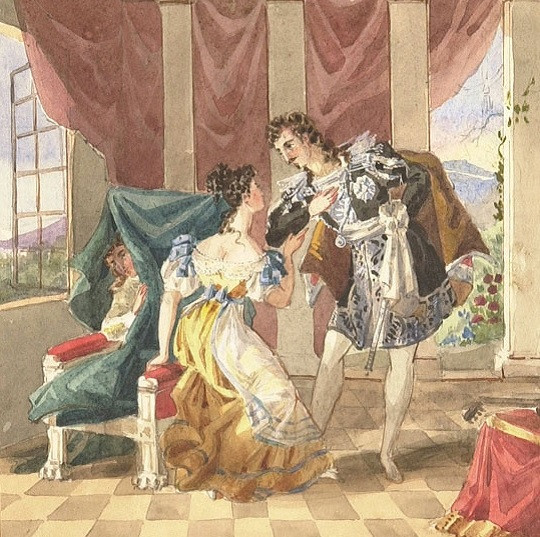
The Marriage of Figaro It takes us back to Seville at the end of the 18th century, after the marriage of Rosina and Count Almaviva. On this occasion, it is Figaro himself who is preparing his wedding with Susanna, Rosina’s little maid. But Count Almaviva has already tired of her wife, and now tirelessly pursues the girl, to the horror of the young woman herself, the countess, and her fiancé. To finish her off, Cherubino, the count’s page, is in love with the countess and intends to win her over. As we see, again the typical delicious plot of entanglements that was so popular at the time but that, at its core, is a social criticism of the abuse of the aristocrats over the people.
5. Carmenby Georges Bizet
When Bizet died at the age of 36, on June 3, 1875, from a devastating heart attack, he could not have known that his opera Carmen would be a resounding success and would become one of the most famous and most performed operas in history. And it is that Its premiere, which took place at the Opéra-Comique in Paris three months earlier, had been a real failure, to the point that the theater reconsidered the suspension of performances. Probably, such displeasure had a lot to do with the composer’s sudden and premature death.
As is usual in operas, Carmen’s libretto is based on a novel. In this case, it was inspired by the story that Prosper Mérimée had written in 1845. The plot revolves around a beautiful gypsy from Seville, Carmen, who awakens passions wherever she goes. But Carmen is a free creature and she doesn’t want to feel tied to anyone. She affirms this in her famous aria. L’amour est un oiseau rebelle (Love is a rebellious bird), probably, along with the bullfighter Escamillo’s aria, the most famous in the opera.
6. Tristan and Isoldeby Richard Wagner
Any opera lover worth their salt knows that German opera is very different from Italian opera. While the latter tends to be light and very focused on the singers’ brilliance (the well-known Italian bel canto), German opera is much more expressive and, so to speak, much “thicker.” Wagner is a clear example of this. All opera singers know that you have to have a lot of vocal power to be able to sing Wagner’s arias, since the instrument acquires, in the composer’s works, an indisputable role.
The script of Tristan and Isolde It was written personally by Richard Wagner, inspired by the story of Godfrey of Strasbourg which, in turn, included a medieval Arthurian legend. It tells the love story between Tristan, a Breton knight, and Isolde, an Irish princess who must marry Tristan’s father. The impossibility of her love, brought about by a love concoction that Isolde’s maid gives them, triggers the tragedy. Isolde’s final aria, the famous Liebestod (the “death of love”) is, quite simply, one of the most impressive and powerful operatic moments in the history of music.
7. The magic Fluteby Wolfgang Amadeus Mozart
It is the last opera by the Austrian genius and, probably, his masterpiece. Its fantastic story has given rise to numerous interpretations, which include explanations of a Masonic nature (which may not be far-fetched, since it seems that both Mozart and the opera’s librettist were Masons). It premiered at the Theater auf der Wieden in Vienna on September 30, 1791, just two months before the composer’s death.
The magic Flute constitutes a unique opera, since is treated in the manner of singspielthe popular German operetta that had a much lighter tone and combined music with spoken scenes To give us an idea, it would be comparable to the Spanish zarzuela. One of the best-known arias that exemplifies this popular tone is Der Vogelfanger bin ich ja, the catchy little song performed by Papageno, a unique bird hunter. Despite this, we also find apotheotic moments in The Magic Flute, such as the famous aria Der Hölle Rachewhich the Queen of the Night sings.
The story revolves around Prince Tamino, who is in love with Princess Pamina, daughter of the powerful Queen of the Night. As the young woman is a prisoner of Sarastro, priest of Isis, the queen asks him to go rescue her from her, for which she gives him an enigmatic magic flute. The young Tamino, accompanied by Papageno, will begin an authentic journey of initiation that will culminate in a happy ending.
Use this citation format to reference the article clearly and help readers find the original source.
PsychologyFor. (2024). The 7 Most Famous Operas in History. PsychologyFor. https://psychologyfor.com/the-7-most-famous-operas-in-history/