

See more of our articles in your search results.
Since time immemorial, anthropocentrism has led us to think that human beings are the only species capable of recognizing itself and having self-awareness. However, research has shown that this is not the case and that many other animals, such as dolphins, orangutans or elephants, could have this same ability.
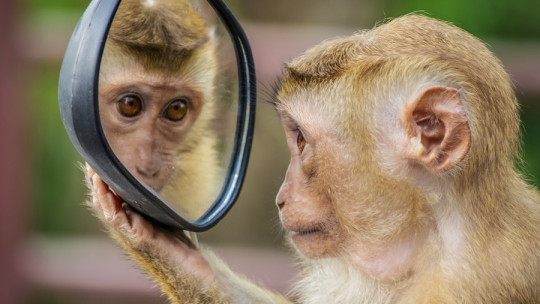
To study this phenomenon, the mirror test has been used, a test that, until now, has been used to measure self-recognition or self-awareness in animals. And we say until now because in recent years, with the discovery that even ants or fish pass the test, part of the scientific community has questioned the validity of the test to measure this cognitive ability.
Self-awareness is a fundamental aspect of cognition and consciousness, allowing an individual to recognize themselves as distinct from their environment. In psychology and animal behavior studies, the Mirror Self-Recognition Test (MSR), commonly known as the mirror test, is used to determine whether an animal possesses self-awareness.
Developed by Gordon Gallup Jr. in 1970, this test involves exposing an animal to a mirror and assessing whether it can recognize itself. The ability to do so suggests a level of higher-order thinking and self-recognition, traits once believed to be unique to humans.
The self-awareness mirror test: what is it and what is it for?
The mirror test, developed in 1970 by Gordon G. Gallup Jr, is a test that measures the level of self-awareness and visual self-recognition. What the test determines is If an animal can recognize its own reflection in a mirror as if it were an image of itself.
How many of these have you been "meaning to read" for months?
- 1
 Undercover Publishing HouseStop Letting Everything Affect YouHow to break free from overthinking, emotional chaos, and self-sabotage.Listen Free On Audible
 - 2
 Penguin Random HouseAtomic HabitsAn Easy & Proven Way to Build Good Habits & Break Bad OnesListen Free On Audible
 - 3
 Harriman HouseThe Psychology of MoneyTimeless lessons on wealth, greed, and happinessListen Free On Audible
This test is quite simple: just put a mirror at the animal’s disposal and observe its behavior. When the animal gets used to the mirror, the researchers mark with an odorless dye a part of its body that cannot be seen without the help of the mirror. Thus, if the animal reacts in a manner consistent with being aware that the dye is in its own body, positive evidence of self-awareness is obtained.
Behaviors that indicate that the animal is able to recognize itself in its mirror image include turning and adjusting its body to better see the mark in the mirror, or touching the mark with its own body or a finger while looking in a mirror. The animals that until recently had passed the mirror test have been: chimpanzees, bonobos, orangutans, dolphins, elephants, common pigeons and, of course, humans.
However, recent research has found that Even some species of ants and fish have reacted positively to the self-awareness mirror test which has generated great controversy in the scientific community, dividing opinion between those who believe that the test is neither valid nor conclusive and those who believe that the implications it may have for the study of human self-awareness must be reconsidered.
How the Mirror Test Works
The mirror test follows a structured four-stage process to assess whether an animal recognizes its reflection:
1. Social Response Stage
Initially, the animal perceives the reflection as another individual and may display social behaviors, such as aggression or curiosity.
2. Physical Inspection Stage
The animal starts exploring the mirror, often moving around to test if the reflection mimics its actions. This stage indicates an increased level of curiosity.
3. Repetitive Testing Stage
The animal may perform deliberate movements, such as turning its head or lifting a limb, to see if the reflection does the same.
4. Mark Test Stage
A mark is placed on the animal’s body in a location it cannot see without a mirror (e.g., the forehead or ear). If the animal uses the mirror to investigate or touch the mark, it is considered to have passed the test, demonstrating self-recognition.
Which Animals Have Passed the Mirror Test?
Though self-recognition was initially thought to be exclusive to humans, various species have demonstrated self-awareness through the mirror test. Here are some of the most notable ones:
1. Great Apes
- Chimpanzees – The first species to pass the test in Gallup’s original experiments.
- Bonobos, Orangutans, and Gorillas – Have also demonstrated self-recognition, though gorillas tend to show mixed results, possibly due to eye contact avoidance in their social behavior.
2. Elephants
Studies with Asian elephants have shown that they recognize themselves in mirrors and use them to inspect their bodies.
3. Dolphins and Whales
Bottlenose dolphins have been observed using mirrors to inspect marks on their bodies, indicating a high level of self-awareness.
4. Magpies and Other Birds
Some birds, particularly magpies, have passed the mirror test by attempting to remove marks placed on their feathers.
5. Fish
Recent research suggests that cleaner wrasse fish exhibit behaviors that could indicate self-awareness, though some scientists debate whether this meets the criteria for passing the test.
Limitations and Criticisms of the Mirror Test
While the mirror test is widely used, it has several limitations and criticisms:
1. Not All Self-Aware Species Use Vision as Their Primary Sense
- Many animals, such as dogs and rodents, rely more on smell and sound rather than vision.
- Failing the mirror test does not necessarily mean an animal lacks self-awareness; it may simply indicate that the test is not suited to their cognitive abilities.
2. Cultural and Social Factors Affect Responses
- Some animals, like gorillas, avoid eye contact due to their social hierarchies, which could explain why some fail the test despite their intelligence.
3. Alternative Measures of Self-Awareness
- Scientists have explored other forms of self-awareness, such as understanding body ownership, problem-solving, and planning for the future, to assess cognition beyond the mirror test.
Implications of Self-Recognition in Animals
Passing the mirror test has profound implications for how we understand animal intelligence, consciousness, and ethics.
- Ethical considerations – Recognizing self-aware animals could lead to improved welfare standards for those kept in captivity.
- Evolutionary insights – Understanding which species have self-awareness helps researchers explore the evolution of intelligence in different lineages.
- Human cognition – Studying self-recognition in animals may provide clues about the development of consciousness in humans.
Research with wrasse fish
One of the studies that has revolutionized the field of self-awareness research in animals has been the research by Kohda and others (2019) in which. The behavior of a fish from the wrasse family was observed under the conditions of the mirror test.
The results of the study concluded that the fish reacted to its reflection when looking in the mirror and met all the criteria of the mirror test. However, when the fish was provided with a colored label in a modified marking test, the animal attempted to remove the label by scratching its body in the presence of the mirror, but showed no response toward transparent or colored labels in the absence of the mirror.
For the authors of the study, although the wrasse shows behavioral responses that meet the test criteria established for other animals. The result does not imply that this species is self-aware All in all, the results of this research raise several questions that remain to be resolved: is this test really valid for detecting self-awareness in animals? And if so, if this species of fish is self-aware, should we rethink the concept?
Does the mirror test really measure self-awareness?
The validity of a test like the mirror test had not been seriously discussed until the publication of new research with animal species that, a priori, we would never have thought were capable of showing signs of self-awareness. The positive evidence in fish and ants has forced a large part of the scientific community to raise doubts about whether the mirror test is a good measure of self-awareness.
Alex Jordan, an evolutionary biologist and one of the authors of the controversial study on wrasse fish, is reluctant to point out that fish are as intelligent as chimpanzees or 20-month-old human babies can be, and questions the validity of the test mirror to measure the concept of self-awareness.
According to Jordan, one of the problems with the test is that it uses vision to measure self-awareness. However, not all animals (or all humans) rely on sight as the predominant sense For example, it is possible that bats, which rely on their sonar to navigate, are self-aware and we simply are not able, as humans, to formulate a test that detects this due to our visual bias.
Likewise, although elephants can pass the mirror test, they rely more on smell than sight, and the sophistication of their consciousness may have led to misleading interpretations. In this sense, this test may simply not be suitable for some animals, because we do not have the same sensory view of the world.
The “olfactory” mirror test
To overcome the visual bias of the self-awareness mirror test, Horowitz et al (2017) designed a sniff test for dogs that involved altering the smell of their urine It should be noted that these animals have not passed the traditional test, since they are not able to recognize themselves in the mirror.
In the experiment, the researchers presented the dogs with various containers. Each of them with an olfactory stimulus: in one, the dog’s own urine; and in the other, urine whose smell had been altered. By observing the time each dog remained in the containers, it was found that they were able to distinguish between the olfactory “image” of themselves and the modified one tracking its own scent longer when it had an additional scent accompanying it than when it did not.
The ecological validity of the olfactory test was examined by presenting the subjects with odors from other known or unknown dogs: the dogs spent more time investigating the odor of other canids than their own odor. Finally, in a second experiment, the dogs spent more time with the modified stimulus than with the modified odor alone, indicating that novelty alone did not explain their behavior.
In short, the results of this research suggest that dog behavior involves certain recognition of one’s own scent, which translated into the traditional self-awareness mirror test implies the existence of visual self-recognition or “self-awareness” in these animals. Something that should not surprise all those people who live with these domestic creatures.
FAQs About the Self-Awareness Mirror Test
What does passing the mirror test indicate?
Passing the test suggests self-awareness, the ability to recognize oneself as an individual, and higher cognitive processing.
Do all intelligent animals pass the mirror test?
No. Some intelligent animals, like dogs and octopuses, do not pass, but they demonstrate other forms of self-awareness through memory, problem-solving, and communication.
Can human babies pass the mirror test?
Humans typically begin passing the mirror test between 18 and 24 months of age, indicating the emergence of self-awareness.
Are there alternative ways to test animal self-awareness?
Yes, researchers use other tests, such as recognizing their own scent, problem-solving, and understanding body movement constraints, to assess self-awareness.
Does failing the mirror test mean an animal is not self-aware?
Not necessarily. Some animals rely on other senses (such as smell or hearing) rather than vision, making the mirror test less relevant for them.
Use this citation format to reference the article clearly and help readers find the original source.
PsychologyFor. (2025). The Self-awareness Mirror Test: What it is and How it is Used in Animals. PsychologyFor. https://psychologyfor.com/the-self-awareness-mirror-test-what-it-is-and-how-it-is-used-in-animals/