


See more of our articles in your search results.
Picture twenty-four ordinary college students, screened for good mental health, split randomly into “guards” and “prisoners” inside a fake basement jail. Within six days, some of those guards were forcing prisoners to clean toilets with their bare hands and stripping them naked as punishment. The Stanford Prison Experiment has haunted psychology classrooms for over fifty years precisely because it seems to answer a question that keeps most of us awake at night: could I become cruel too, given the wrong circumstances? That question feels almost unbearable to sit with, and it’s exactly why this single 1971 study became one of the most cited, most taught, and most misunderstood pieces of research in the history of the field.
If you’ve ever watched footage of the experiment, or read Philip Zimbardo’s own account of it, you’ve probably felt a specific kind of dread settle in. It isn’t the dread of watching monsters do monstrous things; it’s the far more unsettling dread of watching completely average people slide into cruelty within days, sometimes hours. That discomfort is doing real psychological work, forcing you to reconsider comfortable assumptions about where the line between “good people” and “evil people” actually sits. In recent years, that discomfort has gotten more complicated still, because serious archival scholarship has revealed the study itself was far messier, and far more manipulated, than most textbooks ever admitted.
So was this really evidence of evil hiding in all of us, or evidence of something else entirely?
This article unpacks what the Stanford Prison Experiment actually showed, how it shaped decades of thinking about situational evil, why major critiques have upended its scientific reputation, and what more rigorous research, including work by Stanley Milgram, Hannah Arendt, and the BBC Prison Study team, actually tells us about how ordinary people come to do harmful things.
What Was the Stanford Prison Experiment About?
The Stanford Prison Experiment was a 1971 study led by psychologist Philip Zimbardo that randomly assigned college students to act as guards or prisoners in a simulated jail to see how the assigned roles would shape their behavior. It was scheduled to run two weeks but was shut down after only six days.
How many of these have you been "meaning to read" for months?
- 1
 TarcherThe Artist's Way30th Anniversary EditionListen Free On Audible
 - 2
 New Harbinger PublicationsThe Dialectical Behavior Therapy Skills WorkbookPractical DBT Exercises for Learning Mindfulness, Interpersonal Effectiveness, Emotion Regulation...Listen Free On Audible
 - 3
 New Harbinger PublicationsAdult Children of Emotionally Immature ParentsHow to Heal from Distant, Rejecting, or Self-Involved ParentsListen Free On Audible
Zimbardo built a mock prison in the basement of Stanford’s psychology building, recruited twenty-four young men through a newspaper ad, and screened them carefully for any signs of psychological instability. The plan, on paper, was straightforward: observe how normal, healthy men behaved once given arbitrary power over other normal, healthy men. What happened instead escalated fast. Guards began humiliating prisoners with sleep deprivation, invented punishments, and psychological degradation that went well beyond anything the original protocol described.
Christina Maslach, a graduate student at the time and later a prominent researcher on burnout, is often credited with ending the study early. She visited the basement, watched prisoners being marched to the bathroom with bags over their heads, and told Zimbardo the entire project had crossed an ethical line he could no longer see clearly himself. That single confrontation is now treated as a pivotal moment in the study’s legacy, one that raises uncomfortable questions about how deeply even the lead researcher had become absorbed in the role he’d created.
Psychologist Craig Haney co-designed the study alongside Zimbardo and later became a leading scholar on the psychological effects of incarceration, using lessons from the SPE to inform decades of research on solitary confinement and prison reform. His later academic career, in some ways, outlasted the experiment’s original scientific credibility.
How Did the Experiment Try to Explain “Evil”?
Zimbardo argued the experiment demonstrated that evil behavior emerges primarily from situational forces, not from fixed personality traits, meaning almost anyone could become abusive under the right institutional pressures. He called this framework the situationist explanation of evil.
This was a direct challenge to what psychologists call the dispositional view, the older assumption that cruelty comes from bad character, damaged upbringing, or some inherent flaw in the person doing harm. Zimbardo’s claim flipped that logic. He insisted that put a decent person in a toxic system, strip away accountability, grant anonymity, and cruelty becomes almost predictable rather than exceptional. It’s a genuinely disturbing idea, and it’s part of why the SPE became so widely referenced outside academic psychology.
The framework leaned heavily on three specific mechanisms that Zimbardo believed enabled the guards’ behavior: deindividuation, or the loss of personal identity within a role; diffusion of responsibility, where guards felt less personally accountable because they were acting as part of a system; and dehumanization of the prisoners, who were assigned numbers instead of names. Each mechanism, on its own, sounds almost mundane. Stacked together inside a closed environment with no outside oversight, Zimbardo argued, they produced something closer to institutional cruelty.
Whether that explanation actually holds up under scrutiny is a separate question, and a much messier one than the popular retelling of the study usually allows. Later archival work suggests the situational pressures weren’t simply emerging on their own; they were, in significant part, being actively directed from outside the “prison” itself, a detail that complicates the entire situationist narrative.
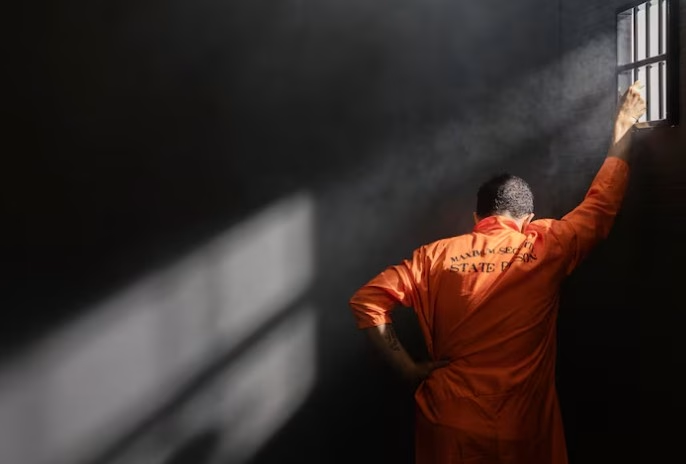
What Is the “Lucifer Effect” and Why Does It Matter?
The “Lucifer Effect” is Zimbardo’s term for the psychological transformation of ordinary, decent people into people capable of cruelty, drawing its name from the biblical fall of Lucifer from favored angel to fallen figure. It became the title of Zimbardo’s 2007 book expanding on the SPE’s implications, and the phrase remains widely cited in popular psychology.
The metaphor is deliberately dramatic. Zimbardo wanted readers to understand that the capacity for cruelty isn’t reserved for a small population of monsters; it’s latent in ordinary psychology, waiting for the right combination of circumstances to activate it. He extended this thesis well beyond the prison basement, applying it to war crimes, genocide, and institutional abuse of power throughout history. The framework gained enormous traction after 2004, when photographs surfaced of American soldiers abusing detainees at Abu Ghraib prison in Iraq, a case Zimbardo himself testified about, drawing direct parallels to his own study decades earlier.
Critics have pointed out that the Lucifer Effect, compelling as a narrative device, risks oversimplifying enormously complex historical atrocities into a tidy psychological formula. Genocide and systemic abuse typically involve ideology, bureaucratic structure, propaganda, and long histories of dehumanization that a six-day basement study can’t meaningfully capture. Still, the core insight, that situational pressure genuinely shapes behavior more than most people intuitively believe, has held up reasonably well across independent lines of research, even as the SPE’s own evidentiary weight has collapsed.
Here’s the tension worth sitting with. A powerful metaphor can be scientifically shaky and still point toward something psychologically real, and untangling those two things requires more nuance than most popular retellings offer. That nuance matters enormously for how we teach this material going forward, and it’s the throughline of much of what follows in this article.
Situational vs Dispositional Evil: What’s the Real Difference?
Situational explanations attribute harmful behavior mainly to external context, roles, and pressures, while dispositional explanations attribute it to internal traits like personality, morality, or character. Most contemporary psychologists now favor an interactionist view that blends both.
| Situational View | Dispositional View |
| Behavior shaped by roles, rules, and environment | Behavior shaped by personality and moral character |
| Emphasizes anonymity, deindividuation, authority | Emphasizes individual differences and prior traits |
| Suggests most people are capable of harm under pressure | Suggests harmful behavior reflects fixed personal flaws |
| Associated with Zimbardo, Milgram-era research | Associated with earlier trait-based personality psychology |
Neither extreme fully explains real-world cruelty on its own. A purely situational account struggles to explain why, even within the same coercive environment, some people refuse to participate in harm while others escalate quickly. A purely dispositional account, meanwhile, struggles to explain why ordinary people with no history of violence commit atrocities under specific institutional conditions, from wartime massacres to workplace bullying that spirals unchecked.
Modern social psychology increasingly treats this as a dynamic interaction rather than a binary choice. Personality shapes how strongly someone responds to situational pressure, and situational pressure shapes how much room personality even gets to express itself. Someone with a strong internal sense of accountability might resist authority in one context but not another, depending on the stakes, the visibility of their actions, and whether anyone around them is also resisting, a pattern closely tied to moral courage.
This matters practically, not just academically. If cruelty were purely dispositional, screening out “bad” individuals would theoretically prevent institutional abuse. If it’s meaningfully situational, then structural safeguards, oversight, accountability, and transparency, matter just as much as who you hire or admit into positions of power.

How Does the Milgram Obedience Experiment Compare?
Stanley Milgram’s 1961 obedience experiments found that ordinary participants would deliver what they believed were painful, even lethal, electric shocks to a stranger simply because an authority figure instructed them to continue. The parallel to the SPE’s themes of authority and compliance is direct and well documented.
Milgram’s study predates the SPE by a full decade and arguably shaped its design. Participants were told to administer increasingly severe shocks to a “learner” in another room whenever that person answered questions incorrectly. Roughly two-thirds of participants continued to the maximum voltage, despite hearing what sounded like agonized protest from the other room. No prison setting, no elaborate role assignment, just a lab-coated authority figure calmly repeating instructions, a stripped-down demonstration of obedience to authority.
What makes Milgram’s findings arguably more robust than the SPE comes down to methodology. Milgram’s experiment has been replicated, with appropriate ethical modifications, across multiple countries and decades, and the core pattern of obedience to authority has largely held up. That replication record stands in sharp contrast to the SPE, which was never designed as a controlled experiment in the first place and has since been shown to involve direct experimenter coaching of the very behavior it claimed to observe emerging naturally.
Both studies converge on an uncomfortable point regardless of their methodological differences: proximity to authority, diffusion of responsibility, and incremental escalation can push ordinary people toward harmful actions they would never predict of themselves in the abstract. That convergence is part of why both remain psychologically compelling, even though one has aged far better scientifically than the other, a gap tied directly to research replication.
What Did Hannah Arendt Mean by the “Banality of Evil”?
Political theorist Hannah Arendt coined the phrase “banality of evil” after observing the 1961 trial of Adolf Eichmann, arguing that Eichmann’s atrocities stemmed less from monstrous personal hatred than from bureaucratic conformity, thoughtlessness, and a disturbing willingness to simply follow orders.
Arendt expected to see a sadistic, ideologically fanatical monster in the courtroom. Instead she described Eichmann as strikingly ordinary, even boring, a bureaucrat obsessed with procedure who seemed to have stopped genuinely thinking about the moral weight of what he was doing. This observation reframed how many scholars discuss atrocity: not always as the product of extraordinary malice, but sometimes as the product of ordinary people failing to exercise independent moral judgment within a system designed to make that failure easy.
Arendt’s framework fits naturally alongside Zimbardo’s situationist thesis, though the two emerged from very different disciplines and methods. Both suggest that large-scale harm rarely requires a population of genuine monsters; it requires enough ordinary people willing to go along, stay quiet, or simply follow the process in front of them. That’s a genuinely bleak conclusion. It’s also, in a strange way, a hopeful one, because it implies that resisting harm doesn’t require heroic exceptionalism, just a willingness to keep thinking rather than simply comply, a habit closer to independent moral judgment.
Critics of Arendt’s thesis have argued that Eichmann was more ideologically committed to Nazi antisemitism than her account suggested, based on later historical research into his private writings. That critique doesn’t erase the value of her core insight; it does mean the concept of “banality” shouldn’t be applied too loosely to every perpetrator of mass violence, since individual conviction still matters in many historical cases.

Why Has the Stanford Prison Experiment Been Discredited?
The Stanford Prison Experiment has been substantially discredited because archival research revealed the guards were directly coached toward cruelty rather than spontaneously discovering it, and the study lacked the basic controls needed to support its dramatic claims. Its scientific standing has fallen sharply since the mid-2010s.
French researcher Thibault Le Texier conducted an exhaustive review of the original SPE archives, including audio recordings, notes, and internal memos held at Stanford’s library, and published his findings in 2019 in the journal American Psychologist. He found that the prison rules the “guards” enforced weren’t spontaneously invented; they were largely lifted from an earlier student-run prison simulation months before the actual study. Guards were also directly briefed on the kind of atmosphere Zimbardo wanted created, including instructions to generate feelings of boredom, fear, and powerlessness among the prisoners.
Perhaps most damaging, Le Texier found that some guards were coached to escalate specifically when they weren’t behaving abusively enough for the researchers’ liking, and that two of the most notoriously cruel guards later admitted, in their own words, that they had been consciously performing rather than losing themselves in an unscripted role. That detail alone undercuts the study’s central claim: that ordinary people spontaneously transformed under situational pressure, with no direction from above.
- Guards were coached directly on the emotional atmosphere researchers wanted, rather than inventing cruelty on their own.
- Data collection was incomplete and selectively reported, undermining basic scientific rigor.
- Guards were unaware they were officially research subjects, leading many to see themselves as assistants rather than participants.
- Zimbardo’s conclusions were largely drafted before the study concluded, raising concerns about confirmation bias.
None of this means situational pressure has no effect on human behavior; substantial independent research still supports that broader claim. It does mean the SPE specifically is no longer considered credible evidence for it, and responsible educators now treat it as a cautionary case study in research ethics and design as much as a finding about human nature.
What Does the BBC Prison Study Reveal About Tyranny?
The BBC Prison Study, conducted by psychologists Alex Haslam and Stephen Reicher in 2002, attempted a more rigorous, ethically monitored partial replication of Zimbardo’s setup and found that guards did not automatically slide into tyranny. Instead, resistance and group identity played a decisive role in shaping outcomes.
Haslam and Reicher’s design addressed several of the SPE’s core weaknesses directly. Researchers didn’t instruct guards on how to behave, participants were monitored by an ethics committee throughout, and the study incorporated closer psychological measurement of group dynamics as they unfolded. Rather than guards spontaneously becoming abusive, the study found that prisoners actually developed a stronger shared identity over time and increasingly resisted the guards’ authority, a dynamic almost opposite to what the SPE popularized.
Eventually, the guard group in the BBC study fractured internally, with some guards favoring harsher tactics and others resisting that shift, until the system itself became unstable and had to be reorganized. Haslam and Reicher argued this pattern supported what they called social identity theory, the idea that people’s willingness to dominate or resist domination depends heavily on whether they identify strongly with their assigned group and believe that group’s actions are legitimate.
This finding complicates the simple, deterministic reading of the SPE considerably. Tyranny, in other words, isn’t an automatic byproduct of granted power; it’s a negotiated outcome shaped by leadership and group cohesion, and whether people believe resisting authority is even a viable option. That’s a more hopeful, if more complicated, picture of behavior under institutional pressure.

Can Ordinary People Really Become Cruel Under Pressure?
Yes, a substantial body of independent research beyond the SPE confirms that situational pressure can push ordinary people toward harmful behavior, though the effect is neither automatic nor universal. Individual resistance, leadership, and group norms all meaningfully shape the outcome.
Milgram’s obedience studies, replicated across cultures with modern ethical safeguards, consistently found high rates of compliance with harmful instructions from perceived authority figures. Separately, research on bystander effects, following the infamous 1964 Kitty Genovese case, showed that diffusion of responsibility in groups can suppress individual willingness to intervene during emergencies. These findings, taken together, paint a consistent picture: proximity to authority and diminished personal accountability really do change behavior, a conclusion independent of any single flawed study.
- Authority figures reduce individual moral deliberation by shifting perceived responsibility upward.
- Anonymity and role assignment weaken personal accountability and encourage deindividuated behavior.
- Group conformity pressures discourage visible dissent, even when private doubts about ethical conduct exist.
- Gradual escalation, rather than sudden demands, makes harmful compliance feel incremental and justifiable.
But none of this suggests inevitability. Plenty of participants across decades of obedience and conformity research have refused to comply, walked out, or actively intervened, and studying those individuals has become its own valuable research area. Psychologists increasingly focus on what predicts moral courage under pressure, not just what predicts compliance, and that shift in focus is arguably long overdue.
What Lessons Does This Teach About Real-World Atrocities?
Real-world atrocities like the Abu Ghraib prisoner abuse scandal show clear echoes of situational dynamics, including dehumanizing language, weak oversight, and diffusion of responsibility, but rarely reduce to a single psychological mechanism. Ideology, bureaucracy, and organizational culture typically compound the effect.
When photographs from Abu Ghraib surfaced in 2004, showing American military personnel abusing Iraqi detainees, Zimbardo was called to testify as an expert witness, drawing explicit parallels to his own study three decades earlier. The comparison was instructive but incomplete. Military detention operates within layered chains of command, wartime stress, propaganda about the enemy, and institutional incentives that a six-day college basement study never remotely approximated.
Genocide scholars studying events like the Rwandan genocide or the Holocaust consistently emphasize that mass atrocity requires infrastructure: propaganda that dehumanizes a target group over years, bureaucratic systems that distribute responsibility across many hands, and social norms that punish dissent while rewarding compliance. Situational psychology explains a piece of that machinery. It doesn’t, on its own, explain the whole machine, and treating it as a complete theory of genocide risks trivializing historical atrocities that took decades to construct.
Still, the situational lens offers something practically useful for institutions today: it suggests that oversight, transparency, and mechanisms for dissent aren’t optional extras, they’re structural safeguards against the specific psychological patterns that research keeps identifying across contexts, from prisons to corporations to military units. Building those safeguards in advance is far more reliable than hoping individual character alone will prevent abuse.

How Should We Teach and Talk About Evil Today?
Educators today should present the Stanford Prison Experiment as a historically influential but scientifically compromised study, pairing it with better-supported research like Milgram’s obedience work and the BBC Prison Study to give a fuller, more accurate picture of situational influence. Presenting the SPE uncritically is now considered a pedagogical mistake by many in the field.
This doesn’t mean discarding the underlying questions the SPE raised. Those questions, about authority, anonymity, dehumanization, and moral courage, remain genuinely important and well supported by more rigorous research conducted since. What needs revision is the specific evidentiary weight placed on one deeply compromised 1971 study, especially given how confidently it has been presented in textbooks, documentaries, and popular psychology books for half a century.
There’s also a broader ethical lesson embedded in how the SPE has been discussed publicly, sometimes lost. Zimbardo himself acknowledged, later in life, that his own deep involvement as “prison superintendent” during the study likely compromised his objectivity as a researcher, an admission that adds a layer of irony to a study about how roles shape behavior. He continued advocating for the situationist framework while simultaneously calling for greater methodological humility.
Talking honestly about evil, in the end, probably requires holding two things at once: taking seriously the disturbing possibility that ordinary circumstances can produce harmful behavior in ordinary people, while refusing to let a single flawed experiment stand in for the far more complex, well-documented body of research that actually supports that broader idea. That balance is harder to teach than a dramatic basement study, but it’s considerably more honest.
FAQs about the Stanford Prison Experiment and the Concept of Evil
Was the Stanford Prison Experiment real or staged?
The experiment itself genuinely took place at Stanford University in 1971, and real participants really did experience psychological distress during it, so it was not staged in the sense of being fictional. However, extensive archival research published in 2019 revealed that key elements presented publicly as spontaneous behavior, especially the guards’ escalating cruelty, were substantially directed and coached by the research team rather than emerging naturally from the assigned roles. This distinction matters enormously. The suffering was real and the six-day timeline was real, but the narrative that ordinary people spontaneously became abusive purely because of situational pressure, with no outside direction, does not hold up against the documented evidence found in Stanford’s own archives, including recordings and internal notes.
Why is the Stanford Prison Experiment considered unethical?
The study is widely considered unethical because participants experienced significant psychological distress, including breakdowns, without adequate provisions for informed consent about what they would actually endure or clear protocols for stopping their participation early. Several prisoners suffered acute anxiety, and one was released after just 36 hours due to severe emotional distress. The researchers, including Zimbardo himself, were deeply embedded in the simulated environment, blurring the line between objective observation and active participation in the abuse. Modern institutional review boards, which now require detailed risk assessment and independent oversight for psychological research, would almost certainly reject a study designed this way today. The SPE is frequently cited in research ethics courses specifically because of these failures.
What is the difference between situational and dispositional evil?
Situational evil refers to harmful behavior primarily caused by external circumstances, such as authority pressure, anonymity, or institutional roles, rather than a person’s underlying character. Dispositional evil, by contrast, attributes harmful behavior to fixed personal traits, moral failings, or psychological pathology within the individual. Most contemporary psychologists reject a strict either-or framing and instead favor an interactionist model, recognizing that personal traits influence how strongly someone responds to situational pressure, while the situation itself shapes how much room those traits have to express themselves. Neither factor alone reliably predicts who will act harmfully and who will resist, which is part of why this remains an actively researched and debated area of psychology.
Is the Lucifer Effect a real scientific theory?
The Lucifer Effect functions more as a popular psychological framework and metaphor than a rigorously tested scientific theory in the strictest sense. It draws together situational psychology, social influence research, and historical case studies to argue that ordinary people can transform into perpetrators of cruelty under specific conditions. While some of its underlying components, like deindividuation and diffusion of responsibility, have reasonable independent research support, the framework as a whole leans heavily on the now-discredited Stanford Prison Experiment for its central illustration. It remains a useful lens for thinking about institutional abuse and historical atrocity, but should be treated as an interpretive framework rather than an established, fully validated scientific model.
How does Hannah Arendt’s banality of evil relate to Zimbardo’s work?
Both frameworks argue that large-scale harm doesn’t necessarily require monstrous individuals; it can emerge from ordinary people failing to exercise independent judgment within systems that make compliance easy and dissent difficult. Arendt developed her concept from observing bureaucratic conformity in a war crimes trial, while Zimbardo developed his from a controlled psychological study, so the disciplinary origins differ considerably. Both have faced scholarly pushback: critics argue Arendt underestimated Eichmann’s ideological commitment, while critics argue Zimbardo overstated the spontaneity of his guards’ cruelty. Despite these critiques, both frameworks remain influential for exploring how ordinary institutional structures, not just individual malice, can produce serious harm.
Did the guards in the Stanford Prison Experiment know they were being watched?
Yes, guards were generally aware that researchers were observing the mock prison, and archival evidence indicates several guards understood they were expected to help create a specific psychological atmosphere for the study rather than simply reacting spontaneously to prisoners. This awareness significantly undermines the claim that their escalating cruelty emerged purely from situational pressure without any outside influence. Some guards later described feeling like research assistants helping produce a desired outcome rather than naive participants losing themselves in an assigned role. This detail is central to why the study’s scientific credibility has been so substantially revised since detailed archival analysis became publicly available in 2019.
What happened to the participants after the experiment ended?
Most participants recovered from the acute distress they experienced during the study, though several reported lingering discomfort when reflecting on how quickly they adapted to their assigned roles. Some former guards later expressed regret and confusion about their own behavior, while some former prisoners described lasting unease about how readily they had accepted a subordinate, dehumanized position. Long-term, rigorous psychological follow-up on the full participant group is limited, which is itself a criticism of the study’s methodology. Philip Zimbardo maintained relationships with several participants for decades afterward, and some have spoken publicly, particularly in recent documentaries and books, about their experience and their views on the study’s legacy and scientific credibility.
How does the Milgram experiment differ from the Stanford Prison Experiment?
Milgram’s obedience experiments measured whether participants would follow direct instructions from an authority figure to deliver increasingly severe shocks to another person, using a controlled, replicable procedure with clear variables. The Stanford Prison Experiment, by contrast, placed participants in an open-ended role-play environment without the same experimental controls, and later archival research revealed it involved substantial direct coaching from researchers. Milgram’s findings have been replicated across multiple countries and decades with appropriate ethical modifications, giving them a stronger scientific foundation. The Stanford Prison Experiment has not been successfully replicated under comparable conditions, and the most rigorous attempt, the BBC Prison Study, produced notably different results.
Can situational psychology excuse harmful behavior?
No, understanding that situational pressure influences behavior does not eliminate personal responsibility or moral accountability for harmful actions. Psychologists studying this area generally emphasize that recognizing situational risk factors is meant to inform prevention, oversight, and institutional design, not to excuse individuals who cause harm. Knowing that authority pressure or anonymity can increase the likelihood of cruelty is valuable precisely because it helps organizations build safeguards, like independent oversight and clear accountability structures, that reduce those risks in advance. Treating situational explanations as a blanket excuse misunderstands their actual purpose in psychological research and ethics.
Bibliography
- Zimbardo, P. (2007). The Lucifer Effect: Understanding How Good People Turn Evil. Random House.
- Le Texier, T. (2019). Debunking the Stanford Prison Experiment. American Psychologist, 74(7), 823-839.
- Milgram, S. (1974). Obedience to Authority: An Experimental View. Harper & Row.
- Arendt, H. (1963). Eichmann in Jerusalem: A Report on the Banality of Evil. Viking Press.
- Haslam, S. A., & Reicher, S. D. (2006). Stressing the Group: Social Identity and the Unfolding Dynamics of Responses to Stress. Journal of Applied Psychology, 91(5), 1037-1052.
- Haney, C., Banks, C., & Zimbardo, P. (1973). Interpersonal Dynamics in a Simulated Prison. International Journal of Criminology and Penology, 1, 69-97.
- Haslam, S. A., Reicher, S. D., & Van Bavel, J. J. (2019). Rethinking the Nature of Cruelty: The Role of Identity Leadership in the Stanford Prison Experiment. American Psychologist, 74(7), 809-822.
- American Psychological Association. (2018). Demonstrating the Power of Social Situations via a Simulated Prison Experiment. APA.
- McLeod, S. (2023). Stanford Prison Experiment. SimplyPsychology.
- Maslach, C., & Jackson, S. E. (1981). The Measurement of Experienced Burnout. Journal of Organizational Behavior, 2(2), 99-113.
Use this citation format to reference the article clearly and help readers find the original source.
PsychologyFor. (2026). The Stanford Prison Experiment: The Concept of “Evil”. PsychologyFor. https://psychologyfor.com/the-stanford-prison-experiment-the-concept-of-evil/