


See more of our articles in your search results.
It’s 3 a.m. and your phone lights up the dark bedroom like a flare. You squint, wince, and fumble for the brightness slider. Take that same screen outside at noon and it’s practically invisible, a gray rectangle you can’t read without cupping your hand around it. Same device. Same pixels. Wildly different experience. Your eyes didn’t malfunction, and neither did the phone: your senses simply don’t count things the way a ruler does. They compare. They ask “how much more than what I’m already getting?” and they answer in ratios, not in raw amounts. It’s a small, daily proof that perception is a negotiation between the world and whatever you were already used to.
That quiet habit has a name, or rather two names stuck together. The Weber-Fechner law is one of the oldest findings in psychology, dating to the 1830s and 1860, and it explains why a whisper in a library is startling while the same whisper at a rock concert is nothing. It also turns up in places nobody expected: supermarket price tags, how toddlers place numbers on a line, even why the tenth notification doesn’t bother you like the first. Textbooks tend to present it as a tidy equation and move on, which is a pity, because the story is messier and better than that. It’s also a rare case of a nineteenth-century idea that psychologists still argue about at conferences, with good reason.
Messier, and partly wrong.
This article explains what the Weber-Fechner law is and what it explains, who discovered it, where it works in everyday life, and where modern psychophysics says it breaks down.
What is the Weber-Fechner law in simple terms?
The Weber-Fechner law says that the smallest change you can notice in a stimulus depends on how strong the stimulus already is, and that the felt intensity of a sensation grows more slowly than the physical intensity behind it. In plain words: to notice a change, you need more of it when you’re already getting a lot.
How many of these have you been "meaning to read" for months?
- 1
 TarcherThe Artist's Way30th Anniversary EditionListen Free On Audible
 - 2
 New Harbinger PublicationsThe Dialectical Behavior Therapy Skills WorkbookPractical DBT Exercises for Learning Mindfulness, Interpersonal Effectiveness, Emotion Regulation...Listen Free On Audible
 - 3
 New Harbinger PublicationsAdult Children of Emotionally Immature ParentsHow to Heal from Distant, Rejecting, or Self-Involved ParentsListen Free On Audible
The name actually bundles two separate ideas. Weber’s law is an observation about detecting differences. Fechner’s law is a mathematical inference built on top of it, claiming that sensation tracks the logarithm of the stimulus. People often treat them as one thing, and that’s fine for everyday conversation, but the distinction matters later when we get to the criticisms.
Here is the shape of the idea:
A candle in a pitch-black room is unmistakable. Light a second candle and the room visibly brightens. Now picture a room already lit by a hundred candles; adding one more changes nothing you’d notice. The extra candle gives the same physical increase of light each time, yet the felt change shrinks as the baseline climbs.
Written as a formula, Weber’s law is \( \Delta I / I = k \), where \( I \) is the starting intensity, \( \Delta I \) is the smallest increase you can reliably detect, and \( k \) is a constant called the Weber fraction. Fechner’s law is usually written \( S = c \log(I / I_0) \), meaning the sensation \( S \) grows with the logarithm of the intensity.
Don’t let the symbols put you off. A logarithm here just means “multiplying the stimulus by a fixed factor adds a fixed step to the sensation.” Double the intensity, add one notch. Double again, add another notch. That’s all.
Take Rosa, an illustrative composite. She’s carrying groceries home from a late shift. Adding one tin of beans to an empty bag feels like something; adding the same tin to a bag already stuffed with a bottle of milk and a melon barely registers. The tin weighs the same both times. What changed was the baseline.
Why should a psychologist care? Because it was the first time anyone showed that the mind obeys a quantitative rule. Before this, feelings were “private” and unmeasurable. Weber and Fechner made sensation a subject for numbers, and that opened the door for the whole field of psychophysics, the science of relations between physical stimuli and psychological experience.
What is Weber’s law and the just noticeable difference?
Weber’s law states that the just noticeable difference (JND), the smallest change a person can detect about half the time, is a constant proportion of the starting stimulus. Hold 100 grams and you may need roughly 5 extra grams to notice the change; hold 1,000 grams and you’d need about 50.
That proportion is the Weber fraction, and it varies by sense. The numbers below are typical textbook approximations (different sources report somewhat different values, and the figure shifts with the method used):
| Sensory dimension | Approximate Weber fraction | What it means for a baseline of 100 units |
|---|---|---|
| Visual line length | about 0.02 | A 2-unit change is noticeable |
| Lifted weight | about 0.05 | A 5-unit change is noticeable |
| Sound intensity | about 0.05 to 0.08 | A 5- to 8-unit change is noticeable |
| Salt taste | about 0.20 | A 20-unit change is needed |
Smaller fractions mean sharper discrimination. Your eyes are very good at telling whether two lines differ by a couple of percent; your tongue is far worse at telling how salty a soup has become.
The historical credit goes to Ernst Heinrich Weber, a German physician and anatomist at Leipzig, who tested how well people could tell two lifted weights apart and how far apart two touches on the skin had to be to feel like two (the two-point threshold). His 1834 work reported that the judged difference depended on the ratio between the stimuli, not on the absolute gap. Weber himself did not write the equation we use today; the neat formula and the name “Weber’s law” came later through Fechner.
Imagine Kenji, an illustrative composite, adjusting the volume on a car stereo. In a silent parking lot, one click up is obvious. On the highway with the windows down, he needs three or four clicks before he hears anything different. The clicks haven’t changed; the background has.
A practical lesson sits in there. When the baseline is high, small improvements vanish, whether you’re adding a tiny seasoning to an already salty dish or a minor feature to an already feature-packed product.
Does Weber’s law hold perfectly? No. Researchers have long known it breaks down at very low and very high intensities, which is where later sections pick up.
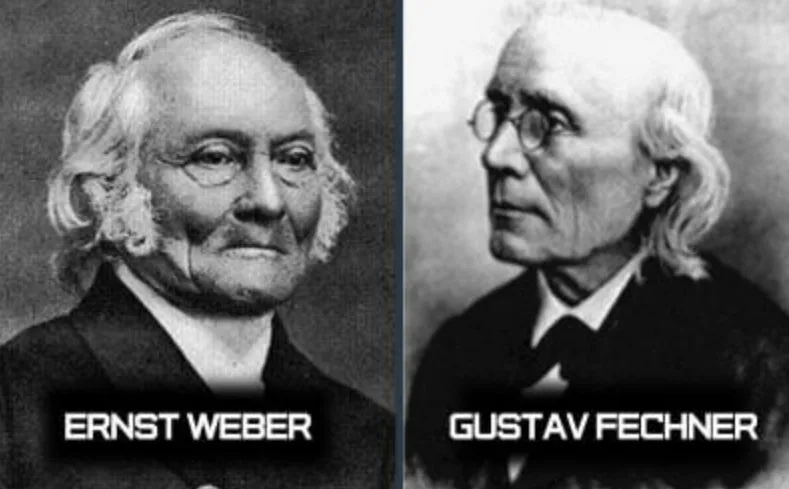
Who were Weber and Fechner, and how did psychophysics begin?
One was a careful anatomist, the other a physicist-turned-philosopher with a breakdown and a cosmic theory of the universe. That odd pairing launched experimental psychology.
Ernst Heinrich Weber (1795 to 1878) spent his career at the University of Leipzig, where he studied touch, temperature and muscle sense with small, clever experiments. He showed that two skin points could feel like one when they were close together and that the required separation differed across body regions, fingertips being far more discriminating than the back. His interest was physiological. He wasn’t trying to found a new discipline.
Gustav Theodor Fechner (1801 to 1887) was also at Leipzig, trained in medicine and physics, and wrote on everything from electricity to the afterlife. In the early 1840s, after staring at the sun while studying afterimages, he damaged his eyesight (a breakdown followed) and suffered a prolonged period of illness and withdrawal. He eventually recovered and turned to a project that fused his scientific and philosophical sides: find the exact mathematical link between the material world and the mind.
Psychologists commemorate October 22, 1850, as the morning when Fechner, lying in bed, hit upon the idea that tied Weber’s ratios to a measurable scale of sensation. He spent a decade developing it, and in 1860 published Elemente der Psychophysik (Elements of Psychophysics). He also supplied the classic experimental methods: the method of limits, the method of constant stimuli and the method of adjustment. Many labs still teach them.
Historian Edwin G. Boring, in A History of Experimental Psychology, treated Fechner’s book as one of the founding works of the discipline, in part because it showed that mental events could be measured and treated mathematically. Boring was an influential, sometimes opinionated historian, so take his rankings as one view among several, but few dispute the book’s importance.
Fechner coined the label “Weber’s law” for the proportion Weber had observed. Weber, as far as the record shows, never made grand claims about it. That’s a nice irony. The man whose name is on the law was modest; the man who generalized it was ambitious and metaphysical.
It’s worth remembering how bold the move was. Fechner proposed to measure the mind by measuring the body’s responses to controlled stimuli, and many contemporaries thought it absurd. Philosophers argued that sensations were not quantities at all. That argument, in updated form, still rumbles on.
Fechner himself saw the work as a step toward showing that mind and matter are two sides of one reality. Most readers today keep the method and quietly drop the metaphysics.
How does Fechner’s law get from ratios to a logarithm?
Gustav Theodor Fechner made two assumptions. First, that Weber’s law is true. Second, that every just noticeable difference adds an equal step to the sensation, no matter where you are on the intensity scale. Put those together and the math gives a logarithm.
Walk through it slowly. If each JND is one equal “unit” of sensation, then sensation is just a count of JND steps from the threshold up to the current intensity. By Weber’s law, each step is a constant fraction bigger than the last. Stepping up by 5 percent each time, you’d go from 100 to 105, then to 110.25, then 115.76, and so on. The steps get larger in absolute terms but remain equal in felt terms.
That kind of growth, equal multiplications giving equal additions, is exactly what a logarithm describes. Integrating the tiny steps gives \( S = c \log(I / I_0) \). Here \( I_0 \) is the absolute threshold, the faintest intensity you can detect at all, and \( c \) depends on the sense in question.
What follows from the formula? Sensation rises quickly at low intensities and flattens out at high ones. A ten-fold increase in physical energy is not felt as ten times as much. It is felt as one fixed step more. That compression is useful. It lets a single eye handle everything from starlight to full sun, a range spanning many orders of magnitude, without saturating.
Consider Lucy, an illustrative composite who sits in a recording studio with headphones on. She nudges the gain up in small ratio steps, each one doubling the signal power, and hears roughly equal increments. If she’d tried adding equal amounts of power instead, the first few changes would be huge and the later ones inaudible.
A fair question: is the assumption of equal JND steps justified? Fechner took it as a working postulate. He did not prove it, and it turned out to be the weak link.
Critics point out that you can accept Weber’s law (JNDs grow proportionally) and still reject Fechner’s step from JNDs to sensation size. Nothing guarantees that every just-noticeable change adds the same amount of felt magnitude. A 2021 review in Psychological Review by Daniel Algom argued that the two can be separated, concluding that one can accept Weber’s law without accepting Fechner’s.
So the derivation is elegant, but it rests on a postulate, and elegance is not evidence. The next sections show where the data supported the log idea and where they pushed back.
What does the Weber-Fechner law explain in hearing, seeing and tasting?
It explains why many of our measurement scales are logarithmic: the decibel for loudness, the astronomers’ magnitude scale for stars, musical octaves for pitch. Those scales were built, knowingly or not, to match how our senses compress large ranges.
Here are the clearest examples:
- Decibels (loudness). A jump of 10 dB represents a tenfold increase in sound power, yet it sounds only about twice as loud. Quiet rooms near 30 dB and rush-hour traffic near 80 dB differ in power by a factor of 100,000, but we hear them as a manageable step.
- Stellar magnitudes (brightness). Ancient Greek astronomers sorted stars into six classes of apparent brightness, a system traditionally credited to Hipparchus. In 1856 Norman Pogson formalized it: five magnitudes equal a brightness ratio of 100, so each step is about 2.512 times brighter.
- Musical pitch. Each octave doubles the frequency (A at 440 Hz, then 880 Hz, then 1,760 Hz), yet we hear equal musical distances. Pitch perception roughly follows a ratio rule.
- Visual contrast and brightness. Cameras and displays apply “gamma” curves so image values match how we see tones, since equal numeric steps in raw light look very uneven.
- Taste concentration. Small additions of salt or sugar are obvious in plain water and hard to detect in already-seasoned food.
In clinical settings, the same logic shows up quietly. Hearing tests use decibel scales, and vision tests of contrast sensitivity are built around ratio thresholds. The general principle that detecting a change depends on baseline carries into how clinicians interpret sensory complaints, although specific clinical claims should come from audiologists and eye specialists, not a psychology article.
Think of what this does for ordinary life. Your senses are not trying to be accurate in absolute terms. They are trying to be useful. A hunter-gatherer at dusk needs to notice a predator’s movement against a changing background, not to measure photons. Ratios do that job well.
It also explains a nuisance. Turn the music up gradually in a car and you won’t realize you’ve doubled the sound power. Your ears have quietly rescaled the baseline. That’s one reason long-term loud listening feels normal until someone else gets in the car.
A word of caution about “explains.” The law gives a description that fits many senses within a mid-range of intensities. It doesn’t say why the nervous system compresses the way it does. For that, researchers look to neural coding, where individual neurons have limited firing ranges and populations share the load. The explanation is partial, and still being worked out.
Why does a $5 discount feel huge on a $15 item and tiny on a $125 one?
Because we judge money in ratios, much as we judge light and sound. Saving $5 on $15 is a third off; saving $5 on $125 is 4 percent. The dollars are identical and the feeling isn’t.
Psychologists Amos Tversky and Daniel Kahneman used exactly this contrast in a famous 1981 study. People were told they could save $5 on a calculator costing $15 if they drove to another store 20 minutes away. About 68 percent said they would make the trip. When the same $5 saving applied to a jacket costing $125, only about 29 percent would. A rational accountant sees one identical $5. Most shoppers see a percentage.
The same principle sits inside prospect theory, which Kahneman and Tversky published in 1979. One of its building blocks is diminishing sensitivity: the gap between $100 and $200 looks bigger than the gap between $1,100 and $1,200, even though both are $100. They drew explicitly on the psychophysics tradition when they described how value changes from a reference point. Their framework is not a direct test of the Weber-Fechner law, but the family resemblance is plain.
Take Omar, an illustrative composite. He’s buying a laptop for $1,400 and the salesperson offers a $60 case. He accepts without thinking. Two hours later he refuses to pay $60 for a decent pair of earbuds because “that’s too much.” The earbuds cost the same $60. The baseline moved.
Businesses lean on this deliberately. Add-ons look small next to the main purchase, so retailers tuck in extended warranties, upgrades and shipping. Price rises of 3 percent often go unnoticed, while a $2 increase on a $4 coffee draws complaints. Pricing teams think in terms of just noticeable differences, though they may not call them that.
What can you do? A few simple habits help. Convert a price to a whole-dollar amount in your head (“this is $60, full stop”) and ask whether you’d pay it by itself. Compare absolute savings for decisions where the absolute amount matters, such as time spent versus money saved. And be suspicious of “only an extra $50” when the base price is large.
Consider also the opposite trap. Because large numbers feel compressed, a $50,000 mistake can feel smaller in the moment than a $50 slip. Decisions with big stakes deserve a deliberately slow, absolute-value look.

Is our sense of numbers logarithmic too?
Partly, and in children and some adults it looks strikingly so. Ask a young child to place the numbers from 1 to 100 on a line and they often cram the small numbers apart and squeeze the big ones together, as though the number line were logarithmic.
Neuroscientist Stanislas Dehaene argued in a 2003 paper that the Weber-Fechner law reaches beyond the senses into our approximate number sense. He proposed that the brain represents quantities on a compressed, logarithmic internal scale, which would explain why distinguishing 8 from 9 is much harder than distinguishing 2 from 3, even though both gaps equal one. The distance effect and size effect in number comparison, familiar to cognitive scientists, are the kind of pattern the law predicts: closer and larger numbers get confused more easily.
In a 2008 study in Science, Dehaene and colleagues tested adults and children in an Amazonian community with little formal schooling and found that their placements on a 1-to-10 line leaned logarithmic, while Western educated adults placed numbers evenly along a line. The result suggested that the linear number line is partly something schooling teaches, not something we are born with.
Picture Sofia, an illustrative composite, who is five and asked to put a sticker for “10” on a line from 1 to 100. She puts it near the middle. To an adult that seems silly. To her it’s roughly right, if the internal ruler is stretched at the low end.
The finding connects to ordinary life more than you’d expect. People underestimate how different 1 million and 1 billion are (a gap most of us feel as “a lot more” rather than as a thousand-fold). They treat the difference between 3 and 4 as big, and between 3,000 and 4,000 as modest. Money, population, deaths in a disaster: all get compressed.
That has uncomfortable implications for judgment. When a news story reports 100 deaths versus 10,000, the felt difference doesn’t scale to the real hundred-fold gap. A well-known phenomenon sometimes called “psychic numbing” describes this blunting, although the explanation there involves emotion and attention as well as number sense.
Caveats are due. The evidence for a strictly logarithmic number sense is mixed. Some researchers see a better fit with a power function, others argue the pattern reflects strategy and context as much as a fixed internal scale, and the developmental shift from log to linear is not identical across cultures or tasks. It’s a live debate.
Did Stevens’ power law replace the Weber-Fechner law?
Myth: Fechner’s logarithmic law is the final word on sensation. Fact: since the 1950s, many psychophysicists have preferred Stevens’ power law, which fits direct ratings of sensation better across a wide range of senses.
Harvard psychologist S. S. Stevens asked people to rate sensation sizes directly. In his method of magnitude estimation, a participant might be told that a tone is “10” and then asked to assign numbers to other tones in proportion. In a 1957 paper, Stevens reported that the numbers people gave followed a power function, \( \psi = k\phi^{n} \), where \( \phi \) is the physical intensity and the exponent \( n \) depends on the sense. Loudness had an exponent near 0.67, brightness around 0.33 under his test conditions, and electric shock about 3.5.
The exponent tells a story. When it’s below 1, the sense is compressive: big physical increases feel modest, as with brightness. When it’s above 1, the sense is expansive: tiny increases feel large, as with electric shock, which is precisely why shock is a bad thing to be casual about. Apparent length has an exponent near 1, tracking reality closely.
Stevens argued that Fechner’s equal-JND assumption was wrong, since JND size doesn’t map neatly onto sensation size. A neural-coding review noted that no consistent relationship has been found between the size of a JND and the growth of subjective magnitude. In that sense Fechner’s bridge from Weber’s ratio to a logarithmic sensation scale is the broken plank.
But it’s not a clean victory for Stevens. His method has its own critics, who note that it fits curves to data without independently testing its assumptions, that averaging across participants hides large individual differences, and that numerical ratings are affected by how people use numbers. Some mathematical work shows the power law can be derived from the logarithmic function under certain conditions, so the two are not strictly opposed.
Which one should you use? It depends on the question. For detecting small differences near a baseline, Weber’s law is a decent guide. For describing how strong sensations feel across wide intensity ranges, the power law usually fits better. For a broad summary of “senses compress big ranges,” both agree.
Textbooks often say Stevens “disproved” Fechner. A fairer summary: he exposed a weak assumption and offered a better-fitting description, and the argument about what ratings measure goes on.
Where does the Weber-Fechner law break down?
It breaks down at the extremes, in noisy conditions, across individuals, and whenever attention or expectation gets involved. It’s a good approximation in the middle of a sense’s range and a rough one elsewhere.
The standard failures are worth knowing:
- Very low intensities. Near the absolute threshold the Weber fraction rises, because internal neural noise starts to swamp tiny differences. The law needs a correction term, which Weber-law fits often add.
- Very high intensities. Near saturation, the constant fraction can climb again as receptors reach their limits.
- Different measurement methods. The same person can show different thresholds depending on how the experimenter asks.
- Adaptation and context. Your recent history changes the baseline, which is partly why you can’t judge the dimness of a room after leaving bright sunlight.
A deeper critique came from signal detection theory. David M. Green and John A. Swets argued in their 1966 book that there’s no single fixed threshold at all. A person’s reports depend on sensitivity and also on a decision criterion, how willing they are to say “yes, I noticed that.” Someone cautious and someone eager can have identical sensitivity yet give different answers. A measure like the JND, which seems to be a property of the sense organ, mixes in a bit of personality and motivation.
That’s a big deal for how we read old experiments. Modern studies often estimate sensitivity separately from response bias, which gives a cleaner picture. Early psychophysics did not, so some classic numbers carry hidden noise.
Individual differences matter as well. Weber fractions vary between people and shift with age, training and health. Musicians typically show sharper pitch discrimination; older adults often show poorer contrast and hearing discrimination. Averages obscure that variety.
Then there’s the problem of extending the law past the senses. Applying Weber-style reasoning to prices, numbers or emotions is a useful analogy but not a demonstration that the same mechanism is at work. When someone says “the tenth complaint bothers me less than the first because of the Weber-Fechner law,” they’re borrowing a sensible metaphor. The evidence for that specific claim is thin.
Here’s where I land after a long time with this literature: the law is best treated as a sturdy rule of thumb, not a physical law. It earns its place in the textbook because it’s simple, mostly right in the middle, and a doorway into harder questions.
How can you use the Weber-Fechner law in daily life and design?
Use it as a reminder that people notice changes in proportion to a baseline. If you want a change to be noticed, make it a meaningful fraction of what’s already there; if you want a change to go unnoticed, keep it under the Weber fraction.
Applications show up in surprising places. Product designers try to make updates visibly better by exceeding the JND, since a tiny polish that nobody notices is wasted effort. Pricing teams hide small rises under the threshold. Audio engineers adjust levels in ratio steps. Interface designers build volume and brightness sliders on perceptual scales rather than linear ones, so that each notch feels like the same change.
Here are six ways to put the idea to work in your own life:
- Make improvements big enough to feel. Adding five minutes to a 90-minute workout rarely registers. Changing the format or intensity does. Sustained habits need felt progress.
- Change your baseline before judging. Before deciding a room is too loud, a soup too salty or an email too blunt, step away for a minute. Your reference point may have shifted.
- Judge prices in absolute terms. Ask what an extra $50 means on its own, not as a fraction of a large purchase.
- Protect your hearing. Since loudness feels compressed, you can’t trust your ears to warn you about doubling the sound power. Use a decibel meter or a phone’s volume limit when listening on headphones.
- Space out good things. Pleasures fade partly because the baseline adjusts. Intermittent treats tend to feel larger than constant ones.
- Be wary of “small” numbers. A 1 percent annual fee compounds into a large sum over decades, though it feels negligible in any single year.
The point about compression cuts both ways. If you’re delivering hard news, a gradual preview can soften the shock. If you’re trying to get a team to take a risk seriously, a vague drift from “bad” to “slightly worse” will slip under the threshold, and a clear reference point works better.
Take Priya, an illustrative composite who runs a small bakery. She raises prices 2 percent every quarter and hears no complaints; when she once raises them 10 percent at once, three regulars say something. She hadn’t noticed the earlier increases either. Her customers’ JND was somewhere in between.
Is that manipulative? It can be. The ethical line sits between helping people perceive things clearly and exploiting their blind spots. Designers and marketers choose which side of it they stand on.
And you, reading this on a screen set to whatever brightness you adjusted to an hour ago: has the room around you changed?
FAQs about the Weber-Fechner Law
What is the Weber-Fechner law in one sentence?
It says that the smallest change you can notice is a constant proportion of the original stimulus (Weber’s law), and that sensation grows with the logarithm of stimulus intensity (Fechner’s law), so equal ratios of intensity feel like equal steps of sensation. For example, adding a pound to a 10-pound bag feels like something, while adding a pound to a 100-pound load barely registers. The first part, about detecting differences, holds fairly well across many senses in the middle of their ranges. The second part, about the size of sensations, is more controversial, and many researchers now prefer a power function. Spelled out, that means two separate ideas fused under one name.
What is the difference between Weber’s law and Fechner’s law?
Weber’s law is an observation about detecting differences: the smallest noticeable change is a constant fraction of the starting level. Fechner’s law is a further claim, derived from Weber’s law plus an extra assumption, that the felt magnitude of a sensation follows the logarithm of the physical intensity. The assumption is that every just noticeable difference adds an equal step to sensation. That assumption is the contested part. Because of this, it’s possible to accept Weber’s law while rejecting Fechner’s law, and some modern reviews recommend treating them as separate ideas rather than one combined law. To remember it: Weber noticed the pattern, and Fechner built a theory on it.
What is a Weber fraction?
A Weber fraction is the ratio between the smallest change you can detect and the starting stimulus level. If you can just notice an added 5 grams on a 100-gram weight, the fraction is 0.05, or 5 percent. Smaller values mean sharper discrimination. Typical textbook values are about 0.02 for judging line length, around 0.05 for lifted weight and roughly 0.20 for salt concentration in taste, though published numbers vary across studies and methods. Individuals differ too, and practice, age and testing conditions can all shift a person’s fraction up or down. If you want a quick sense of your own fraction, try the old kitchen test: lift two bags of flour and ask a friend to add a spoonful at a time until you can feel the difference, then repeat with a much heavier bag.
Does the Weber-Fechner law apply to money and prices?
Sometimes, as an analogy. People judge price differences in relative terms: Tversky and Kahneman found in 1981 that far more people would travel to save $5 on a $15 item than on a $125 item. Prospect theory similarly assumes diminishing sensitivity to changes in wealth. These findings echo Weber’s ratio idea, but they are not direct proof that the same sensory mechanism governs money. Context, mental accounting and reference points matter too, so it’s safer to say the law is a useful metaphor for price perception than a literal explanation. Stated differently, the shopper who treats every dollar as equal is the exception, not the rule, and marketers know it.
Why is the decibel scale logarithmic?
Because the ear responds to an enormous range of sound power, and a logarithmic scale compresses that range into manageable numbers that roughly track how loud things sound. A change of 10 decibels means a tenfold increase in sound power, yet it is heard as only about a doubling of loudness. Engineers adopted the decibel for practical reasons in telephony and acoustics, and its shape happens to fit the compressive nature of hearing that Weber and Fechner described. It is a convenient match rather than proof of any single psychological theory. Engineers also use decibels because adding and subtracting small numbers is easier than multiplying huge ones when combining sound sources.
Is the Weber-Fechner law still valid today?
In part. Weber’s law remains a good approximation for many discrimination tasks in the middle of a sensory range, and it’s still used in vision, audition and numerical cognition research. Fechner’s logarithmic law is more disputed, since direct ratings often fit Stevens’ power law better, and its key assumption has weak support. Signal detection theory also showed that thresholds aren’t fixed properties of the senses. Most researchers regard the Weber-Fechner law as a historically vital approximation, not an exact law of nature. It is useful as a map of how senses compress the world, so long as nobody mistakes it for a physical constant; it is closer to a well-worn rule of thumb than to a law of the sort found in physics.
Is the number line in the brain logarithmic?
There’s evidence for it, though it’s debated. Young children and adults with little formal schooling tend to place numbers on a line with the small ones spread out and the big ones squeezed together, which looks logarithmic. Stanislas Dehaene proposed that the brain represents quantity on a compressed scale, matching the Weber-Fechner idea. Schooling seems to push people toward a linear mental number line. Some researchers argue that power functions or task strategies explain the data just as well, so the claim isn’t settled. The honest summary is that the idea is promising and partly supported, but nobody has shown that a single logarithmic mental number line governs all quantity judgments in every setting.
How is Stevens’ power law different from Fechner’s law?
Fechner’s law says sensation is proportional to the logarithm of intensity, and it was derived mathematically from Weber’s law. Stevens’ power law says sensation is proportional to intensity raised to an exponent, and it was based on direct ratings of how strong sensations feel. The exponent differs by sense: below 1 for loudness and brightness, which means compression, and above 1 for electric shock, which means expansion. Stevens’ law fits direct judgments across wide ranges better, while Weber’s law works better for small differences near a baseline. Neither is perfect, and some work shows one can be derived from the other. A practical takeaway is to match the law to the question rather than crown one winner.
Bibliography
- Algom, D. (2021). The Weber-Fechner law: A misnomer that persists but that should go away. Psychological Review, 128(4), 757-765.
- Boring, E. G. (1950). A history of experimental psychology (2nd ed.). Appleton-Century-Crofts.
- Dehaene, S. (2003). The neural basis of the Weber-Fechner law: A logarithmic mental number line. Trends in Cognitive Sciences, 7(4), 145-147.
- Dehaene, S., Izard, V., Spelke, E., & Pica, P. (2008). Log or linear? Distinct intuitions of the number scale in Western and Amazonian indigene cultures. Science, 320(5880), 1217-1220.
- Fechner, G. T. (1966). Elements of psychophysics (Vol. 1; H. E. Adler, Trans.). Holt, Rinehart & Winston. (Original work published 1860)
- Green, D. M., & Swets, J. A. (1966). Signal detection theory and psychophysics. Wiley.
- Kahneman, D., & Tversky, A. (1979). Prospect theory: An analysis of decision under risk. Econometrica, 47(2), 263-291.
- Stevens, S. S. (1957). On the psychophysical law. Psychological Review, 64(3), 153-181.
- Tversky, A., & Kahneman, D. (1981). The framing of decisions and the psychology of choice. Science, 211(4481), 453-458.
- Weber, E. H. (1834). De pulsu, resorptione, auditu et tactu: Annotationes anatomicae et physiologicae. Koehler.
Use this citation format to reference the article clearly and help readers find the original source.
PsychologyFor. (2026). The Weber-Fechner Law: What it is and What it Explains. PsychologyFor. https://psychologyfor.com/the-weber-fechner-law-what-it-is-and-what-it-explains/