

See more of our articles in your search results.
The Tower of Hanoi test is a widely used cognitive tool in psychology, designed to measure a variety of cognitive functions, including problem-solving skills, executive function, and planning abilities. It is considered a neuropsychological assessment because it helps clinicians evaluate how the brain processes and executes complex tasks that require both strategic thinking and memory.
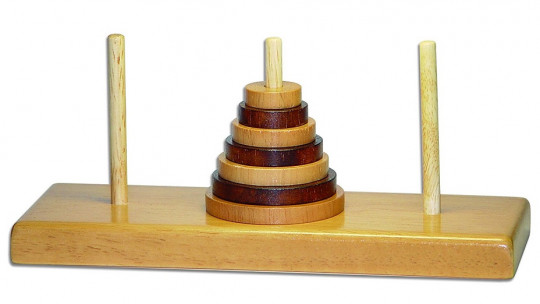
Originally created by French psychologist Edouard Lucas in 1883, the Tower of Hanoi has since evolved to become a standard tool for psychological assessments and research. In its original version, the task involved three rods and a number of disks of different sizes. The objective was to move all the disks from one rod to another, following a set of rules. Although the basic premise remains unchanged, variations of the task have been created to cater to different age groups, cognitive conditions, and research requirements.
The Setup of the Tower of Hanoi
The Tower of Hanoi task is typically presented using a physical or computerized setup, consisting of:
- Three rods or pegs.
- Three to eight disks of different sizes.
The objective is to move all the disks from one rod to another, with the goal of achieving a target arrangement of the disks on the last rod. The rules are simple but lead to complex problem-solving:
- Only one disk can be moved at a time.
- A disk can only be placed on a larger disk or on an empty rod.
The challenge lies in finding the most efficient way to complete the task, which involves both cognitive flexibility and planning skills.
How many of these have you been "meaning to read" for months?


The Cognitive Skills Measured by the Tower of Hanoi
The Tower of Hanoi test primarily evaluates cognitive skills related to executive functioning. Executive function refers to the brain’s ability to manage and control higher-order functions like planning, problem-solving, and decision-making. The task is particularly useful in assessing planning and reasoning abilities, cognitive flexibility, working memory, and impulse control.
Here are some specific cognitive functions the test measures:
1. Planning and Strategy
The primary skill assessed by the Tower of Hanoi is the ability to plan and execute a strategy. Participants must carefully consider the sequence of moves needed to solve the problem, taking into account the limited space on each rod and the constraint that no disk can be placed on top of a smaller disk. This requires an ability to organize steps in a structured manner and anticipate future moves, making it a valuable measure of planning capacity.
2. Problem-Solving Skills
The Tower of Hanoi requires individuals to come up with a solution strategy while navigating complex rules. This involves problem-solving skills, where participants must generate and adjust strategies in real-time to overcome obstacles. The test also measures the flexibility of these strategies, as participants might need to change their approach after encountering challenges.
3. Cognitive Flexibility
Cognitive flexibility refers to the ability to shift between thinking about different concepts or to think about multiple concepts simultaneously. In the Tower of Hanoi, this ability is tested when individuals must adapt their strategy during the task. As the task becomes more complex, participants are forced to modify their approach, demonstrating how well they can adjust their thinking.
4. Working Memory
Working memory is the ability to hold and manipulate information over short periods. While solving the Tower of Hanoi, individuals often need to remember previous moves and plan future steps, which requires maintaining and managing information in working memory. Success in this task is heavily influenced by how well an individual can retain the state of the puzzle and adjust their actions based on that state.
5. Impulse Control
Since the Tower of Hanoi test requires careful planning, individuals are forced to resist the temptation to make impulsive moves. The rules that limit how disks can be stacked on rods demand that participants think several steps ahead. The ability to pause and avoid rash decisions reflects self-regulation and impulse control.
Variations of the Tower of Hanoi Test
While the traditional Tower of Hanoi test uses three rods and a set of disks, variations of the task exist, particularly in clinical settings. These variations may involve changes in:
- The number of disks: In the standard version, there are typically three to seven disks, but in clinical settings, the number of disks may vary to match the cognitive level of the participant.
- Time limits: Some versions of the test impose time constraints to assess not only problem-solving skills but also how efficiently someone can complete a task under pressure.
- Adaptations for specific populations: For children, elderly individuals, or those with cognitive impairments, modified versions of the Tower of Hanoi may be used. These adaptations could involve fewer disks, simplified rules, or a larger time allowance.
- Computerized versions: Modern versions of the Tower of Hanoi are often computerized, allowing for automated scoring and greater control over experimental conditions. Computerized versions may also include features like tracking eye movements or measuring response times.
Clinical Applications of the Tower of Hanoi Test
The Tower of Hanoi test is not just a tool for assessing normal cognitive functioning but also a diagnostic tool in various clinical contexts. It provides insights into how well individuals can plan, solve problems, and manage cognitive tasks. Some of the clinical applications include:
1. Assessing Brain Injuries and Disorders
One of the primary uses of the Tower of Hanoi test is in evaluating executive function deficits in individuals with brain injuries, particularly those involving the prefrontal cortex, the brain region responsible for decision-making, planning, and impulse control. Brain injuries, strokes, and diseases like Alzheimer’s can impair executive function, and the Tower of Hanoi test provides valuable data on cognitive rehabilitation needs.
2. Assessing Neurological Disorders
The Tower of Hanoi test is also used in the diagnosis and treatment of various neurological disorders, including dementia, Parkinson’s disease, and schizophrenia. These disorders often involve problems with executive functions, and performance on the Tower of Hanoi task can offer insights into how cognitive decline might be impacting a person’s daily life and mental processing.
3. Monitoring Cognitive Development
In pediatric psychology, the Tower of Hanoi test is often used to assess cognitive development in children. It helps psychologists evaluate a child’s ability to engage in problem-solving, strategic thinking, and goal-directed behavior. This is especially helpful for children with developmental disorders like ADHD or learning disabilities.
4. Measuring Cognitive Recovery
For individuals undergoing cognitive rehabilitation after a traumatic brain injury (TBI) or stroke, the Tower of Hanoi test serves as an excellent measure of cognitive recovery. Changes in performance can indicate improvements or setbacks in their executive function skills, and the test can be used to tailor treatment plans accordingly.
Scoring the Tower of Hanoi Test
In traditional and computerized versions of the test, participants are scored based on several factors:
- Number of moves: The fewer moves made to complete the puzzle, the higher the score. Efficiency is a critical component.
- Time taken: Although some versions focus solely on moves, others also include the amount of time spent to complete the task, providing additional insight into how quickly a participant can solve the puzzle under pressure.
- Mistakes made: Making incorrect moves may indicate poor planning, memory, or impulsivity.
- Strategy complexity: More sophisticated strategies that involve thinking several moves ahead often correlate with better executive function.
Tower of Hanoi and the Executive Functioning Model
The Tower of Hanoi test is deeply connected to the executive functioning model of cognition, which involves higher-order thinking processes required for goal setting, organizing tasks, working memory, and problem-solving. These skills are essential for daily functioning, and the Tower of Hanoi test serves as a reflection of these cognitive capacities in action.
An individual’s performance on the Tower of Hanoi can reveal a lot about their cognitive strengths and weaknesses, especially in complex, real-life situations that require planning and decision-making.
FAQs about the Tower of Hanoi Test
What does the Tower of Hanoi test measure?
The Tower of Hanoi test measures executive functioning, including skills such as planning, problem-solving, working memory, impulse control, and cognitive flexibility. It evaluates how well a person can strategize and organize their actions to solve a problem.
How is the Tower of Hanoi test scored?
Scoring is based on the number of moves, time taken, mistakes made, and the complexity of the strategy used. The fewer moves and less time it takes to complete the task, the better the score.
Who typically uses the Tower of Hanoi test?
The Tower of Hanoi test is commonly used by neuropsychologists, pediatric psychologists, and rehabilitation specialists to assess cognitive abilities in brain injury patients, children, and individuals with neurological conditions like dementia or Parkinson’s disease.
Can the Tower of Hanoi test be used for children?
Yes, the Tower of Hanoi test is adaptable for children and is often used to assess problem-solving and planning abilities. Modified versions may involve fewer disks and simpler rules.
What is the importance of the Tower of Hanoi test in clinical settings?
The Tower of Hanoi test helps clinicians assess cognitive functions, such as executive functioning and strategic thinking, which are essential for daily life. It is particularly useful in diagnosing and treating conditions that affect the brain, including brain injuries, neurological disorders, and developmental delays.
Use this citation format to reference the article clearly and help readers find the original source.
PsychologyFor. (2025). Tower of Hanoi Test: What is it and What Does it Measure?. PsychologyFor. https://psychologyfor.com/tower-of-hanoi-test-what-is-it-and-what-does-it-measure/