

See more of our articles in your search results.
History is full of important figures who are worth remembering for their contributions in the search for knowledge, whether in the scientific, philosophical, literary or other fields. In this article we will talk about one of these figures, specifically, belonging to the 20th century: the German philosopher, literary critic and translator Walter Benjamin.
In this brief biography of Walter Benjamin we will review his life and some of his most notable contributions throughout his career.
A biography of Walter Benjamin
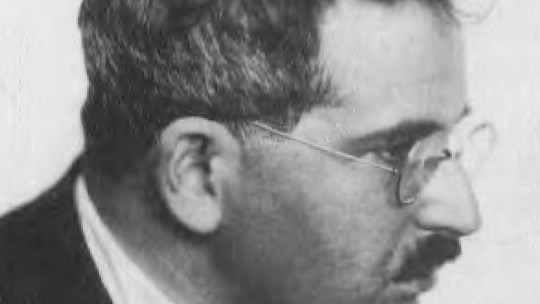
Walter Benjamin, full name Walter Bendix Schönflies Benjamin, He was a philosopher and literary critic, as well as a translator and essayist, of German origin He was born on July 15, 1892 in Berlin (Germany), and died on September 26, 1940 in Portbou (Spain), at the age of 48.
Benjamin’s thought, associated with the Frankfurt School, draws on different disciplines and orientations, such as German idealism, romanticism, historical materialism and Jewish mysticism. His contributions focused mainly on two currents: Western Marxism and aesthetic theory
Thus, Benjamin was a restless philosopher, greatly influenced by Marxism, who drew on different philosophies and currents to develop his own thinking. In addition, he was a great traveler, since he was in different countries learning and training.
How many of these have you been "meaning to read" for months?
- 1
 TarcherThe Artist's Way30th Anniversary EditionListen Free On Audible
 - 2
 New Harbinger PublicationsThe Dialectical Behavior Therapy Skills WorkbookPractical DBT Exercises for Learning Mindfulness, Interpersonal Effectiveness, Emotion Regulation...Listen Free On Audible
 - 3
 New Harbinger PublicationsAdult Children of Emotionally Immature ParentsHow to Heal from Distant, Rejecting, or Self-Involved ParentsListen Free On Audible
Origins and childhood
Walter Benjamin was born in Berlin in 1892, into a wealthy family of Ashkenazi origin (this term refers to Jews settled in Central and Eastern Europe). His family was dedicated to business, and at that time it was fully integrated in Germany
His father was Emil Benjamin, a banker from Paris who had moved to Germany; In Berlin he worked as an antiques dealer. Her mother was Pauline Schönflies, who told her stories at night (this is how Benjamin remembers it, who in fact was inspired by them to develop one of her theories).
Thus, Benjamin reflects on them, focusing on the relationship that they establish between tradition and the current era. Later, in 1905, Benjamin entered a boarding school in a rural area, specifically in Thuringia (Germany). Two years later, in 1907, Benjamin returned to the Berlin school.
Studies, life and career
When he turned twenty, Walter Benjamin began his studies in philosophy at the University of Freiburg (Germany), although he soon moved to the University of Berlin to continue there.
It is at the University of Berlin where he learned about Zionism, a Jewish nationalist political movement and ideology. From there, Benjamin develops a “cultural Zionism”, based on the value of the culture of Jewish mysticism On the other hand, Benjamin, perhaps influenced by his origin, defends Judaism as an essential part of European culture, and especially values its spirituality.
In addition, Walter Benjamin is also interested in educational issues, and in his university years He joins a group called the “Union of Free Students”, where he is chosen as president Thus, he develops for this group some writings that mention the need for reform, both at an educational and cultural level.
Regarding his private life, Walter Benjamin married Dora Pollack in 1917. They had a son, Stefan Raphël (1918-1972). At that time, Benjamin was looking for a theme for his thesis, which ended up focusing on the philosophy of Kant and Plato.
Frankfurt School
We have seen at the beginning of the article how Walter Benjamin’s thought was, to a large extent, associated with the Frankfurt School. Thus, Benjamin was a collaborator of said School, although he was never directly “associated” with it.
For its part, the Frankfurt School, in Germany, was made up of a group of researchers and scholars who followed a series of theories and theoretical orientations, such as those of Freud, Marx and Hegel
Walter Benjamin adopted a Marxist philosophy in his career. Marxist philosophy sought to study the nature and foundations of Marxism, a theoretical explanatory model of reality, formed through the thought of Karl Marx, a German philosopher and revolutionary of Jewish origin. Let us remember that Marx’s contributions had an impact on fields as diverse as economics, law, history and sociology.
References:
: translations and literary criticism
Walter Benjamin, as we have seen, was also a translator and literary critic. Of his translations, those of two important figures stand out: Marcel Proust and Charles Baudelaire. On the other hand, one of Walter Benjamin’s best-known works was The work of the translator (it is an essay), which deals precisely with this literary activity in which I was a participant: translation.
Regarding his literary criticism, his criticism of works such as the novel The elective affinitiesby Goethe, and some works by Franz Kafka, Karl Kraus, Marcel Proust, Charles Baudelaire… He also translated the work into German Les Fleurs du Maland some parts of Proust’s novel The search for lost times.
Death in Spain
In 1940, in the historical context of the occupation of France by the Nazis, Walter Benjamin heads to the United States, crossing Spain But the Spanish police intercept him, along with a group of refugees of which he is also part, as he did not have the documentation (visa) required at that time.
As a result, Benjamin, in a hotel in the Pyrenean border town, swallows a lethal dose of morphine, and commits suicide in Portbou (province of Girona). He was 48 years old and his death occurred on September 26, 1940.
Use this citation format to reference the article clearly and help readers find the original source.
PsychologyFor. (2024). Walter Benjamin: Biography of This German Philosopher. PsychologyFor. https://psychologyfor.com/walter-benjamin-biography-of-this-german-philosopher/