


See more of our articles in your search results.
The term “safe space” has become one of the most politically charged phrases in modern discourse, which is honestly a shame because the underlying psychological concept is both fascinating and genuinely important for human wellbeing. As someone who’s spent the better part of fifteen years studying group dynamics and social psychology, I’ve watched this concept get twisted, weaponized, and misunderstood by people across the political spectrum until it’s barely recognizable from what it actually means in psychological terms politically charged.
Here’s the thing that drives me crazy about most discussions of safe spaces: they’re usually happening between people who’ve never actually studied group psychology or trauma-informed care. You’ve got folks on one side screaming about “snowflakes” and “coddling,” while people on the other side treat safe spaces like some kind of magical cure-all for systemic oppression. Meanwhile, those of us who actually work in this field are sitting here going, “Um, you’re all kind of missing the point” missing the point.
A safe space, in the most basic psychological sense, is simply an environment where people can express themselves authentically without fear of judgment, harassment, or harm. That’s it. Not rocket science, not political indoctrination, not a place where reality gets suspended. It’s a context where the normal social risks of vulnerability are temporarily reduced so that learning, healing, or authentic connection can happen more easily authentic expression.
But like most simple concepts, the devil is absolutely in the details. What makes someone feel safe? How do you balance individual needs with group dynamics? What happens when one person’s sense of safety conflicts with another’s? How do you create genuine psychological safety without inadvertently creating echo chambers or stifling growth? These are the questions that actually matter, and they’re way more complex and nuanced than most people realize complex questions.
I’ve facilitated therapy groups for trauma survivors, led diversity training for corporate teams, taught college courses on sensitive topics, and consulted with organizations trying to create more inclusive environments. In every single one of these contexts, the principles of psychological safety play a crucial role in whether people can actually learn, grow, and heal—or whether they just shut down and disengage. The research on this is crystal clear, even if the public discourse around it is muddy as hell research is clear.
How many of these have you been "meaning to read" for months?
- 1
 TarcherThe Artist's Way30th Anniversary EditionListen Free On Audible
 - 2
 New Harbinger PublicationsThe Dialectical Behavior Therapy Skills WorkbookPractical DBT Exercises for Learning Mindfulness, Interpersonal Effectiveness, Emotion Regulation...Listen Free On Audible
 - 3
 New Harbinger PublicationsAdult Children of Emotionally Immature ParentsHow to Heal from Distant, Rejecting, or Self-Involved ParentsListen Free On Audible
The psychological foundations of what makes spaces feel safe
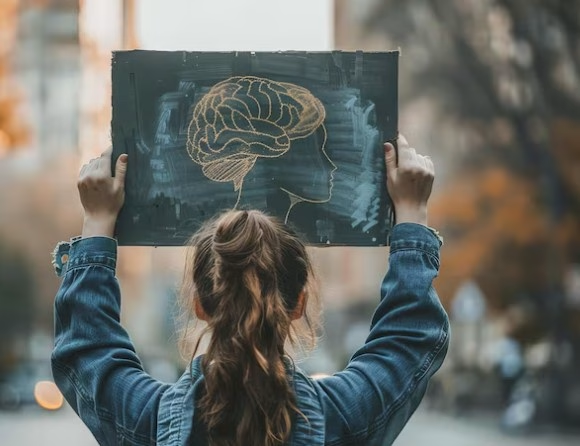
Let’s start with some basic neuroscience, because understanding how our brains respond to threat and safety is crucial for grasping why safe spaces matter. When your nervous system perceives danger—whether physical, social, or psychological—it activates what researchers call the “threat detection system.” Blood flow shifts away from your prefrontal cortex (where critical thinking happens) toward more primitive brain regions focused on survival. Your ability to learn, think creatively, and connect with others literally gets hijacked by your brain’s security system hijacked by security.
This threat response doesn’t just kick in when someone’s physically attacking you. Social threats—like the possibility of being judged, rejected, excluded, or humiliated—can trigger the exact same neurobiological responses. Your brain doesn’t really distinguish between “this person might hurt me” and “this group might reject me.” Both scenarios light up your amygdala and flood your system with stress hormones that make complex thinking nearly impossible social threats.
Now here’s where it gets interesting from a group psychology perspective. Humans are fundamentally social creatures who evolved in small tribal groups where social exclusion literally meant death. Our brains are wired to be exquisitely sensitive to social cues about whether we belong or whether we’re at risk of being cast out. This means that seemingly small things—a dismissive facial expression, a sarcastic comment, an eye roll—can trigger surprisingly intense psychological responses social cues.
Psychological safety, a concept developed by Harvard Business School professor Amy Edmondson, refers to the shared belief that a group is safe for interpersonal risk-taking. When psychological safety is high, people feel comfortable speaking up with questions, concerns, mistakes, or wild ideas without fear of being embarrassed or punished. When it’s low, people self-censor, avoid conflict, and stick to what they think others want to hear interpersonal risk-taking.
The fascinating thing is that psychological safety isn’t just about being nice to each other. Research shows that teams with high psychological safety actually perform better, are more innovative, and make fewer serious errors. Why? Because when people aren’t spending mental energy on self-protection, they can focus that energy on the actual task at hand. They share information more freely, admit mistakes earlier, and take the kinds of creative risks that lead to breakthrough solutions perform better.
But creating psychological safety is trickier than just telling everyone to “be respectful.” Different people feel safe under different conditions, and what feels supportive to one person might feel suffocating or condescending to another. Some folks need explicit rules and structure to feel secure, while others feel constrained by too many guidelines. Some people want their identities acknowledged and celebrated, while others prefer to focus on common ground and shared humanity different conditions.
Different types of safe spaces and their specific purposes
Not all safe spaces are created equal, and frankly, a lot of the confusion around this concept comes from people talking past each other about completely different types of environments. Let me break down some of the main categories I’ve encountered in my work, because understanding these distinctions is crucial for having productive conversations about when and how safe spaces are appropriate crucial distinctions.
Therapeutic safe spaces are probably the most straightforward example. In group therapy, support groups, or counseling settings, creating psychological safety isn’t just helpful—it’s absolutely essential for the work to happen at all. People dealing with trauma, addiction, mental illness, or major life transitions need environments where they can be vulnerable without additional harm. This isn’t about protecting people from reality; it’s about creating conditions where healing can actually occur healing conditions.
I’ve run therapy groups for sexual assault survivors, and let me tell you, there’s nothing “coddling” about the work that happens in those rooms. These are some of the bravest, most resilient people you’ll ever meet, doing incredibly difficult emotional work. But they can only do that work in an environment where they’re not constantly worried about being judged, blamed, or retraumatized. The safety isn’t the end goal—it’s the foundation that makes everything else possible foundation for work.
Educational safe spaces serve a different but related function. When you’re teaching about sensitive topics—racism, sexuality, trauma, controversial historical events—students need some level of psychological safety to engage authentically with the material. If they’re terrified of saying the wrong thing or being attacked for their questions, they’ll either shut down completely or perform whatever position they think is expected engage authentically.
I’ve taught courses on human sexuality, and trust me, if students don’t feel safe asking questions, they’re going to walk away with the same myths and misconceptions they came in with. Creating space for genuine curiosity and confusion doesn’t mean accepting factually incorrect statements or harmful attitudes—it means creating conditions where people can actually learn and grow rather than just parroting back what they think you want to hear genuine curiosity.
Identity-based safe spaces focus on bringing together people who share particular experiences or identities. These might be support groups for LGBTQ+ youth, professional networks for women in male-dominated fields, or cultural organizations for ethnic minorities. The psychological function here is different from therapeutic or educational settings—it’s about finding community, sharing resources, and taking a break from being the only one or constantly explaining yourself finding community.
Critics often ask, “Isn’t this just segregation?” and honestly, that question drives me nuts because it completely misunderstands what’s happening psychologically. When you’re constantly in environments where you’re the minority—whether that’s the only Black person in your graduate program, the only openly gay person in your workplace, or the only woman in your engineering class—you expend enormous mental energy on code-switching, self-monitoring, and managing others’ reactions to your presence mental energy.
Having spaces where you can drop that vigilance and just exist without explanation isn’t about avoiding diversity—it’s about recharging so you can continue engaging in diverse environments without burning out. It’s like how introverts need alone time to recharge before they can handle more social interaction. The safe space isn’t where all of life happens; it’s where you go to refuel for everything else recharge space.
Workplace safe spaces represent yet another category, and they’re becoming increasingly important as organizations grapple with diversity, inclusion, and psychological safety. These might be employee resource groups, diversity training sessions, or just team cultures where people feel comfortable speaking up about problems or proposing new ideas without fear of retaliation workplace safety.
The neuroscience behind why psychological safety actually matters
Let me get a bit more specific about what’s happening in your brain when you feel psychologically safe versus when you feel threatened, because understanding this biology helps explain why safe spaces aren’t just about feelings—they’re about fundamental cognitive functioning fundamental functioning.
When your brain perceives safety, your parasympathetic nervous system is activated. This is sometimes called “rest and digest” mode, and it’s characterized by lower heart rate, deeper breathing, reduced cortisol levels, and increased activity in brain regions associated with learning, memory, and creative thinking. Your prefrontal cortex—the part of your brain responsible for executive functioning, perspective-taking, and complex reasoning—gets optimal blood flow and can do its best work optimal blood flow.
Conversely, when your brain detects threat, your sympathetic nervous system kicks into high gear. This is “fight or flight” mode, and while it’s great for escaping from predators, it’s terrible for pretty much everything else humans need to do in modern life. Stress hormones flood your system, your attention narrows to focus on potential threats, and higher-order thinking gets suppressed in favor of quick, reactive responses higher-order thinking suppressed.
Here’s what’s particularly relevant for understanding safe spaces: your brain’s threat detection system is incredibly sensitive to social cues. A study by UCLA researcher Matthew Lieberman found that social rejection activates the same brain regions as physical pain. When you feel excluded, judged, or at risk of social rejection, your brain literally interprets this as a form of injury social rejection as injury.
This explains why seemingly minor social slights can have such powerful effects on people’s ability to think and function. If someone makes a comment that activates your threat detection system—maybe a microaggression about your race, a dismissive remark about your ideas, or even just a facial expression that suggests judgment—your cognitive resources get diverted away from whatever task you’re supposed to be focused on and toward monitoring for additional threats diverted resources.
The research on this is absolutely fascinating. Studies show that when people from stereotyped groups are reminded of their minority status before taking tests—even just by checking demographic boxes—their performance significantly decreases. This isn’t because they’re less capable; it’s because cognitive resources that should be dedicated to problem-solving are instead being used to manage stereotype threat and social vigilance stereotype threat.
Mirror neurons add another layer to this story. These are brain cells that fire both when you perform an action and when you observe someone else performing the same action. They’re part of what allows us to empathize with others and understand their emotional states. In group settings, mirror neurons mean that emotional states spread rapidly between people. If one person is highly anxious or defensive, others in the group will often start feeling the same way without consciously realizing why emotional contagion.
This is why the emotional tone of a group or environment matters so much for everyone’s cognitive functioning. It’s not just that some people are “sensitive”—it’s that human brains are literally wired to pick up on and mirror the emotional states of others. A group where people feel threatened, judged, or unwelcome creates a neurobiological environment that impairs everyone’s thinking, not just the people who seem most obviously affected impairs everyones thinking.
Common misconceptions and where the controversy comes from
Okay, let’s address the elephant in the room. The whole “safe space” concept has become a cultural battleground, and honestly, most of the arguments I see completely miss what psychological safety actually means. I think a lot of the controversy comes from people conflating different types of safety and making assumptions about motivations that may or may not be accurate cultural battleground.
One of the biggest misconceptions is that safe spaces are designed to protect people from ever encountering challenging or uncomfortable ideas. This fundamentally misunderstands what psychological safety is about. The goal isn’t to eliminate discomfort—it’s to create conditions where people can engage with discomfort productively rather than reactively. When you feel psychologically safe, you’re actually more capable of handling challenging conversations and difficult emotions, not less engage productively.
I’ve seen this play out repeatedly in my work. Students in my classes often have much more honest, nuanced discussions about controversial topics when they feel psychologically safe than when they’re worried about being attacked or judged. When people aren’t spending mental energy on self-protection, they can actually listen to different perspectives and consider ideas that challenge their existing beliefs honest discussions.
Another misconception is that safe spaces are inherently about political correctness or left-wing ideology. This drives me crazy because psychological safety is a basic human need that transcends political affiliation. Conservative students need psychological safety to express their views in predominantly liberal environments just as much as liberal students need it in conservative contexts. Religious people need safety to discuss their faith in secular settings just as much as non-religious people need it in faith-based environments transcends politics.
The research on psychological safety comes from organizational psychology and business schools, not political activism. Companies like Google invest heavily in creating psychologically safe teams because it improves performance and innovation, not because they’re trying to push any particular political agenda. Military units work on psychological safety because it reduces errors and saves lives, not because they’re trying to coddle soldiers improves performance.
There’s also a misconception that requesting psychological safety is a sign of weakness or inability to handle the “real world.” This completely ignores the research showing that psychological safety actually enhances performance rather than diminishing it. When people feel safe to take risks, admit mistakes, and ask questions, they learn faster and perform better. It’s not about being fragile—it’s about optimizing human potential optimizing potential.
The “real world” argument particularly annoys me because it assumes that creating psychologically safe environments is somehow artificial or unrealistic. But plenty of “real world” environments—successful teams, healthy families, effective schools, thriving communities—are characterized by high levels of psychological safety. The idea that the “real world” is inevitably hostile and that people need to toughen up to survive in it is both empirically wrong and counterproductive empirically wrong.
I think some of the controversy also comes from conflating psychological safety with agreement or validation. Creating a safe space doesn’t mean everyone has to agree with each other or that all viewpoints are equally valid. It means creating conditions where disagreement can happen respectfully and productively. Some of the most psychologically safe environments I’ve been in have also been the most intellectually challenging disagreement respectfully.
How to create genuine psychological safety in different contexts
Creating psychological safety isn’t something you can just declare into existence by putting up a poster or making an announcement. It requires intentional effort, ongoing attention, and often some trial and error to figure out what works for particular groups and contexts. The strategies that work in a therapy group won’t necessarily translate to a corporate boardroom or a college classroom intentional effort.
In educational settings, I’ve found that clarity and consistency are absolutely crucial. Students need to understand what the expectations are, what kinds of behavior are and aren’t acceptable, and what will happen if those boundaries are crossed. Ambiguous rules create anxiety because people don’t know how to succeed. But the rules need to be applied fairly and consistently—nothing destroys psychological safety faster than arbitrary or biased enforcement clarity and consistency.
I always start my courses by having explicit conversations about how we want to handle difficult topics, disagreement, and mistakes. We talk about the difference between intent and impact, how to give and receive feedback constructively, and what to do when someone says something that feels harmful or offensive. Having these conversations proactively, before any conflicts arise, creates a framework that people can reference when things get tense proactive conversations.
In workplace contexts, leadership behavior is absolutely critical. Research shows that psychological safety is primarily determined by the actions and attitudes of people in authority positions. If managers respond defensively to questions or criticism, punish people for honest mistakes, or show favoritism in how they treat different team members, psychological safety plummets regardless of what the official policies say leadership critical.
One of the most powerful things leaders can do is model vulnerability and learning. When supervisors admit their own mistakes, ask for feedback, and demonstrate genuine curiosity about different perspectives, it signals to everyone else that these behaviors are safe and valued. Conversely, when leaders present themselves as infallible or defensive, it teaches everyone else to hide their uncertainties and errors model vulnerability.
In therapy and support group contexts, the facilitator’s role is somewhat different but equally important. Here, the focus is on creating emotional safety rather than just intellectual safety. This might involve more explicit attention to trauma triggers, careful management of group dynamics to prevent anyone from being scapegoated or silenced, and clear boundaries around confidentiality and mutual respect emotional safety.
Physical environment matters more than people often realize. Factors like seating arrangements, lighting, noise levels, and even the presence or absence of certain symbols or decorations can affect how safe people feel. I’ve noticed that circular seating arrangements tend to feel more egalitarian than hierarchical setups, and spaces that feel too formal or institutional can inhibit authentic expression for some people physical environment.
Group size is another crucial variable. Very large groups often don’t feel psychologically safe because people worry about being judged by many others and because it’s harder to develop trust and rapport with a large number of people. Very small groups can feel intense in ways that some people find uncomfortable. There’s often a sweet spot somewhere between 6-12 people for maximum psychological safety, though this varies depending on the context and purpose group size matters.

The delicate balance between safety and growth
One of the most challenging aspects of creating psychologically safe environments is figuring out how to balance safety with challenge and growth. This is where a lot of well-meaning efforts go wrong—either by creating environments that are so protective they prevent learning, or by pushing people so hard that they shut down defensively delicate balance.
The key insight from developmental psychology is that learning happens in what researchers call the “zone of proximal development”—the space between what you can do comfortably on your own and what’s so challenging that you can’t handle it even with support. For psychological growth, you need enough safety to take risks and be vulnerable, but you also need enough challenge to stretch beyond your current comfort zone zone of development.
I think of this as the difference between a greenhouse and a gymnasium. A greenhouse provides protection from harsh weather so that delicate plants can grow, but it still exposes them to light and requires them to develop strong root systems. A gymnasium provides safety equipment and trained spotters so that people can lift heavy weights without serious injury, but the whole point is still to stress your muscles so they grow stronger greenhouse versus gymnasium.
Safe spaces should function more like gymnasiums than greenhouses. The safety isn’t an end in itself—it’s what enables people to take the kinds of risks that lead to growth. A psychologically safe classroom should be a place where students feel comfortable asking questions that reveal their ignorance, proposing ideas that might be wrong, or sharing perspectives that others might disagree with. The safety makes these risks possible, but the risks are still necessary for learning safety enables risk.
This means that truly effective safe spaces often involve quite a bit of discomfort. People get challenged on their assumptions, confronted with perspectives they’ve never considered, and pushed to examine their own biases and blind spots. The difference is that this challenging happens in a context where people feel fundamentally respected and supported rather than attacked or dismissed respected and supported.
I’ve observed that the most transformative learning experiences often happen when people feel safe enough to be genuinely vulnerable about their confusion, fear, or uncertainty. When someone can say “I don’t understand this and I’m worried that makes me stupid” or “This topic scares me and I’m not sure why,” they’re in a position to receive help and make real progress. But that level of vulnerability only happens when people trust that their honesty won’t be used against them genuine vulnerability.
The tricky part is that different people need different levels and types of challenge to grow optimally. Some folks thrive on intellectual debate and vigorous disagreement, while others learn better through gentle questioning and collaborative exploration. Some people are energized by having their assumptions challenged directly, while others need time to process and reflect before they can integrate new perspectives different people different needs.
When safe spaces become echo chambers and how to prevent it
One of the legitimate criticisms of some safe spaces is that they can become echo chambers where people only hear perspectives that confirm their existing beliefs. This is a real risk, and it’s something that facilitators and participants need to actively work to prevent. But the solution isn’t to abandon psychological safety—it’s to understand how to maintain safety while still ensuring intellectual diversity and honest dialogue real risk.
Echo chambers typically develop when psychological safety gets confused with agreement or when the desire to maintain group harmony overrides the commitment to truth-seeking. This can happen in any group, regardless of political orientation. Conservative groups can become echo chambers just as easily as liberal ones, religious groups just as easily as secular ones, and professional groups just as easily as activist ones any group.
The key to preventing echo chambers is to distinguish between emotional safety and intellectual comfort. People should feel emotionally safe—respected, valued, not at risk of personal attack—while still being intellectually challenged. This means creating norms that separate critique of ideas from critique of people, and that encourage curiosity and question-asking even when it leads to uncomfortable territory separate critique.
I’ve found that explicitly naming the echo chamber risk and making it a shared responsibility to prevent it can be really helpful. When groups commit to actively seeking out dissenting views, playing devil’s advocate with popular ideas, and regularly examining their own assumptions, they’re much less likely to fall into groupthink patterns shared responsibility.
Bringing in outside perspectives on a regular basis is another important strategy. This might mean inviting guest speakers with different viewpoints, reading materials that challenge the group’s dominant perspective, or simply encouraging members to seek out diverse information sources and bring back what they’ve learned outside perspectives.
It’s also important to distinguish between safe spaces that are temporary or context-specific and those that become all-consuming. A support group for people dealing with depression might appropriately focus on validation and emotional support rather than intellectual challenge. But if that same group becomes someone’s only social context, it could become problematic by preventing exposure to different perspectives and experiences temporary versus consuming.
The healthiest approach I’ve seen involves people participating in multiple communities with different purposes and cultures. Someone might be part of an identity-based support group that provides emotional safety and community, a professional network that challenges them intellectually, a hobby group that’s purely fun and social, and a volunteer organization that exposes them to different socioeconomic backgrounds. Each space serves different psychological needs multiple communities.

Cultural and generational differences in safety needs
One of the things that makes discussions about safe spaces so contentious is that different generations and cultural groups have genuinely different relationships to concepts like authority, conflict, vulnerability, and emotional expression. What feels supportive to one group might feel infantilizing or artificial to another, and what feels appropriately challenging to one generation might feel traumatizing to another different relationships.
Older generations often grew up in contexts where emotional vulnerability was seen as weakness and where “toughening up” through exposure to harsh treatment was considered character-building. For people with this background, requests for psychological safety can feel like evidence that younger people are weak or overly sensitive. But this perspective often ignores the different challenges that younger generations face different challenges.
Younger people today are dealing with levels of anxiety, depression, and social isolation that are genuinely unprecedented. They’re navigating social media environments that amplify social comparison and rejection in ways that didn’t exist before. They’re facing economic uncertainties and environmental threats that create ongoing stress. In this context, attention to psychological safety isn’t weakness—it’s a necessary adaptation to genuinely challenging circumstances necessary adaptation.
Cultural differences in communication styles also affect how people experience safety. Some cultures value direct communication and vigorous debate, while others prioritize harmony and face-saving. Some cultures encourage individual expression and standing out, while others emphasize group cohesion and fitting in. When people from these different cultural backgrounds come together, what feels like healthy challenge to one person might feel like disrespectful attack to another cultural communication.
I’ve learned to be much more explicit about these differences when I’m working with diverse groups. Rather than assuming everyone has the same definition of respectful communication or productive conflict, I ask people to share their preferences and work together to find approaches that honor different cultural styles while still allowing for authentic interaction explicit about differences.
Gender differences also play a role, though they’re more complex and varied than simple stereotypes suggest. Research shows that women often face different social risks than men when they speak up in groups—they’re more likely to be seen as aggressive or unlikeable if they’re assertive, but also more likely to be ignored or dismissed if they’re not. This can make psychological safety particularly important for women’s participation, but the specific conditions that create safety may vary different social risks.
Similarly, people from marginalized racial or ethnic groups often need psychological safety to participate authentically in predominantly white environments, but they may also need to be able to express anger, frustration, or criticism that makes others uncomfortable. Creating safety for these expressions without shutting down difficult conversations requires a lot of skill and intentionality express anger.
The role of conflict and disagreement in healthy safe spaces
Here’s something that might surprise people: some of the most psychologically safe environments I’ve experienced have also involved significant amounts of conflict and disagreement. The difference is that the conflict was handled constructively rather than destructively, and people felt safe to engage in it rather than needing to avoid it constructive conflict.
Healthy conflict in safe spaces is characterized by several key elements. First, it focuses on ideas, behaviors, or systems rather than personal character. Instead of “you’re wrong” or “you’re being racist,” the focus is on “I see this differently” or “that comment had a harmful impact.” This allows people to disagree strongly without feeling personally attacked focus on ideas.
Second, healthy conflict includes genuine curiosity about different perspectives. People ask questions to understand, not just to poke holes in others’ arguments. They acknowledge complexity and uncertainty rather than claiming absolute truth. They’re willing to change their minds when presented with compelling evidence or reasoning genuine curiosity.
Third, healthy conflict is conducted with emotional regulation and respect. People can express strong feelings without becoming abusive or manipulative. They take breaks when emotions are running too high for productive dialogue. They repair relationships when things get heated and someone gets hurt emotional regulation.
The absence of conflict in a group often signals that psychological safety is actually quite low, not high. When people are afraid to disagree, express concerns, or challenge ideas, it usually means they don’t feel safe enough to risk potential backlash. True psychological safety allows for vigorous disagreement because people trust that conflict won’t destroy relationships or lead to retaliation absence signals low safety.
I’ve noticed that groups often go through predictable stages in developing their ability to handle conflict safely. Early on, people are usually polite and superficial, avoiding anything that might create tension. As psychological safety increases, minor disagreements start to emerge. If these are handled well, people become more willing to engage in substantial conflicts. If they’re handled poorly, the group often regresses to artificial politeness predictable stages.
Teaching conflict skills explicitly can be incredibly helpful for groups that want to maintain psychological safety while still engaging in challenging conversations. This might include techniques for giving feedback constructively, strategies for managing emotional triggers, and frameworks for working through disagreements systematically rather than getting stuck in repetitive arguments conflict skills.

Practical strategies for individuals navigating different spaces
Since most people move between multiple social contexts throughout their lives—some more psychologically safe than others—it’s important to develop personal strategies for managing these transitions and advocating for your own needs appropriately multiple contexts.
First, it’s helpful to develop your own internal sense of psychological safety that doesn’t depend entirely on external conditions. This involves building self-compassion, emotional regulation skills, and the ability to maintain your values and sense of self even in challenging environments. When you have a strong internal foundation, you’re less dependent on others for validation and more resilient in difficult situations internal foundation.
Learning to assess the psychological safety of different environments quickly can help you adjust your behavior appropriately. In high-safety contexts, you might be more willing to take risks, share vulnerabilities, or challenge others’ ideas. In low-safety contexts, you might focus more on observation, building relationships gradually, and finding smaller ways to contribute authentically assess quickly.
It’s also important to develop skills for creating micro-moments of safety within larger unsafe environments. This might involve finding allies who share your values, creating small subgroups for more honest conversation, or simply being the person who models the kind of respectful dialogue you want to see. You can’t always change entire cultures, but you can often influence the immediate environment around you micro-moments.
Advocacy skills are crucial for people who regularly find themselves in environments that don’t naturally feel safe. This involves learning how to articulate your needs clearly, propose specific changes rather than just complaining about problems, and build coalitions with others who share similar concerns. Effective advocacy often requires patience and strategic thinking rather than just emotional expression advocacy skills.
At the same time, it’s important to recognize when environments are genuinely toxic and unlikely to change, and to develop exit strategies for those situations. Not every space can or should be made psychologically safe, and sometimes the healthiest option is to limit your exposure or find alternatives rather than trying to fix unfixable situations exit strategies.
Building a diverse network of relationships and communities can provide backup sources of safety and support when particular environments become challenging. Having multiple places where you feel understood and valued makes you less vulnerable to the dynamics in any single context diverse network.
The future of safe spaces in an increasingly connected world
As our social interactions become increasingly digital and global, the dynamics of psychological safety are evolving in interesting and sometimes concerning ways. Online environments present unique challenges for creating safety because of factors like anonymity, physical distance, asynchronous communication, and the permanent nature of digital records unique challenges.
Social media platforms have struggled enormously with balancing free expression and psychological safety. The same features that allow for diverse voices and democratic participation also enable harassment, trolling, and the rapid spread of harmful content. Different platforms have tried various approaches—content moderation, community guidelines, reporting systems, blocking features—but none have fully solved the problem platforms struggled.
Virtual reality and augmented reality technologies will likely create new forms of safe spaces as they become more prevalent. These technologies could allow for immersive experiences that feel more emotionally real than traditional online interactions while still providing some of the safety benefits of digital distance. They could also create new forms of harassment and boundary violations that we’re only beginning to understand new forms.
The increasing political polarization in many societies makes conversations about safe spaces more complicated. When different groups have fundamentally different values and worldviews, creating spaces that feel safe to everyone becomes nearly impossible. This has led to more specialized and segregated communities, which can provide safety and belonging for their members but may also contribute to broader social fragmentation political polarization.
Artificial intelligence will likely play an increasingly important role in moderating online interactions and identifying potential safety issues. AI systems could potentially detect harassment, hate speech, or other harmful behaviors more quickly and consistently than human moderators. However, these systems also raise concerns about bias, censorship, and the outsourcing of human judgment to algorithmic decision-making AI moderation.
The globalization of communication means that people from very different cultural backgrounds are interacting in shared digital spaces more frequently. This creates opportunities for learning and connection but also increases the likelihood of misunderstandings and conflicts based on different cultural norms around communication, respect, and appropriate behavior cultural backgrounds.
FAQs about What Are Safe Spaces?
Are safe spaces just for people who can’t handle the real world?
No—research shows that psychological safety actually enhances performance and resilience rather than diminishing it. Safe spaces help people develop skills and confidence that they can then apply in more challenging environments enhances performance.
Don’t safe spaces create echo chambers that prevent intellectual growth?
They can if poorly designed, but well-facilitated safe spaces actually encourage more honest dialogue and intellectual risk-taking. The key is distinguishing between emotional safety and intellectual comfort encourage dialogue.
Why do some people need safe spaces while others don’t seem to?
Everyone benefits from psychological safety, but people from marginalized groups often face additional social risks and stressors that make intentional safety measures more necessary for basic participation additional risks.
How do you balance creating safety for some people without silencing others?
This requires clear guidelines that focus on respectful communication rather than restricting particular viewpoints, plus skilled facilitation that can help navigate conflicts when they arise clear guidelines.
Can safe spaces exist in competitive environments like workplaces or schools?
Absolutely—research shows that teams with high psychological safety often outperform those without it because people are more willing to take risks, admit mistakes, and collaborate effectively outperform others.
What’s the difference between safe spaces and censorship?
Safe spaces focus on creating respectful communication norms and emotional safety, while censorship restricts particular ideas or content. You can have vigorous intellectual debate within a psychologically safe environment respectful norms.
How do you know if a space is genuinely safe or just superficially polite?
Genuine psychological safety allows for productive conflict and honest disagreement, while superficial politeness often masks underlying tensions and prevents authentic interaction productive conflict.
Are there any downsides to creating too much psychological safety?
Potential downsides include reduced resilience if people become overly dependent on external safety, or stagnation if safety becomes more important than growth and challenge reduced resilience.
How can someone advocate for more psychological safety in their workplace or school?
Start by building relationships and demonstrating the benefits through your own behavior, then propose specific changes with clear rationales focused on improved outcomes rather than just personal comfort specific changes.
Do safe spaces work the same way across different cultures?
No—different cultures have varying norms around communication, conflict, hierarchy, and emotional expression, so safe spaces need to be adapted to honor these differences while still protecting against genuine harm cultural adaptation.
Use this citation format to reference the article clearly and help readers find the original source.
PsychologyFor. (2025). What Are Safe Spaces?. PsychologyFor. https://psychologyfor.com/what-are-safe-spaces/