

See more of our articles in your search results.
The concept of assertiveness refers to the ability to communicate to the people around us our feelings and needs but avoiding hurting and offending others. However, to know even more in depth what assertiveness is, we need to make a correct definition according to psychology.
There are those who consider that assertiveness and social skills are synonymous terms. But it is important to keep in mind that assertiveness is only one part of social skills, one that brings together the behaviors and thoughts that allow us to defend each other’s rights without attacking or being attacked.
Keep reading that PsychologyFor article if you want to answer the question of what is assertiveness with examples so that you better understand what this social and personal skill consists of.
How many of these have you been "meaning to read" for months?
- 1
 S&S/Simon ElementProtocolsAn Operating Manual for the Human BodyListen Free On Audible
 - 2
 Undercover Publishing HouseStop Letting Everything Affect YouHow to break free from overthinking, emotional chaos, and self-sabotage.Listen Free On Audible
 - 3
 Grand Central PublishingIn the Shadow of EightSurviving the Reality of My ChildhoodListen Free On Audible
What is assertiveness
First of all, it is very important to know what assertiveness means, what it means to be assertive and why it is so important to cultivate this element of our personality. The first characteristic that we must take into account is that assertiveness can be observed in our social and personal relationships, while there are people who communicate aggressively and even passively, the key to social skills is knowing how to communicate with assertiveness and empathy. For example, assertiveness at work is very useful, as it allows you to reach agreements more easily and obtain the benefits of a good work environment.
Meaning of assertiveness
The meaning of assertiveness according to the Royal Spanish Academy (RAE) is: “Express your opinion firmly.”
The definition of assertiveness It consists of a social capacity in which we learn to express our feelings, emotions, we discover the way to respect ourselves but without acting aggressively< What does it mean to be assertive? Therefore, the meaning of assertive is the person who uses assertiveness to communicate, that is, his or her behavior is based on respect both for others and for himself or herself.
Examples of assertiveness
Next, with these examples of assertiveness and assertive communication, we show you what assertiveness is with examples so that you better understand this situation.
Let’s put the following situation: you sit in a restaurant to have dinner. When the waiter brings you what you ordered, you realize that the glass is dirty, with marks from someone else’s lipstick. In this situation you could:
- Don’t say anything and use the dirty cup even if you don’t like it.
- make a big fuss in the establishment and tell the waiter that you will never go to that establishment again.
- Call the waiter and ask you please I changed your glass.
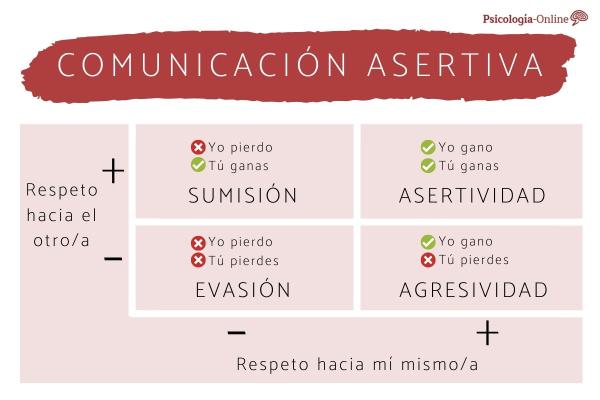
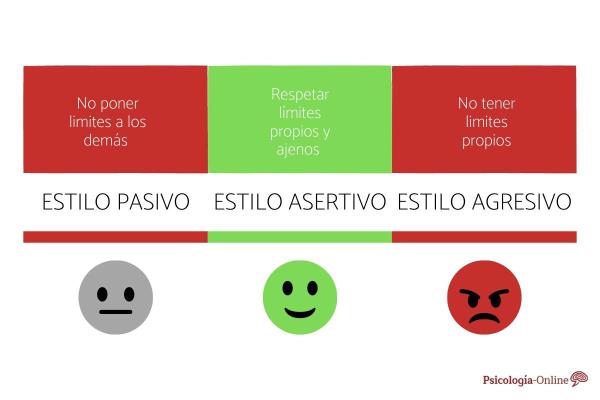
What would you do? Neither the first nor the second option are appropriate behaviors or characteristics of assertive communication. In that situation, if what we want is to reduce our stress and treat other people with respect, the third option is the most assertive you can do. Therefore, the third option is an example of assertive behavior, while the first alternative is an example of passive behavior and the second option refers to aggressive behavior.
Another example of assertiveness would be in the situation in which we want to request a salary increase. To make requests correctly, it is also important to use assertiveness. In this way, we are defending our rights, also recognizing and respecting the rights of others.
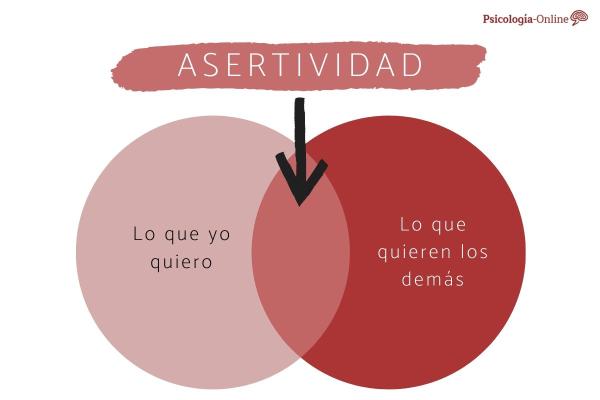
Below, we attach a diagram so that you better understand what assertiveness is.
Assertiveness test
Once you know the concept of assertiveness and know the definition of assertiveness, you may ask yourself: “Am I an assertive person?” To know the answer and know if you are assertive, you must analyze your way of relating and communicating with others in different scenarios, which will indicate what skills related to assertiveness you possess and which ones you lack. If you want to know if you are an assertive person, you can take this assertiveness test with results to assess your assertive ability.
Assertiveness techniques
The most common assertiveness techniques to enhance assertive behavior are:
- The scratched record technique: Maintain your posture and repeat the same argument calmly.
- Self-revelation: explain in first person how one feels or what one thinks.
- Objective description: describe the situation as objectively as possible.
- Ask: take nothing for granted, ask the other what they think, what they feel and what they want.
- fog bank: agree or simply not deny or confront criticism.
In the following article you will find Techniques to develop the capacity for assertiveness. We can also perform relaxation techniques for adults in case we want to learn to communicate calmly and without raising our voice.
Psychological tips to be more assertive
Now that we know what assertiveness is, it’s time to learn to be assertive. To do this, we can follow the advice that cognitive and social psychology gives us. When we are not assertive people, we can have problems with our friends, partner, family.. and conflicts are not usually resolved quickly and effectively.
He assertive training It is not something simple and we may make some mistakes during the process, however, like any other behavior, it is something that can be learned with practice.
There are two reasons why a person is not assertive:
- They think they are not entitled to their beliefs, rights or opinions.
- They believe that their rights must be defended above those of others, with anger and aggression.
In the first case, assertive training does not consist of turning submissive people into complainers and accusers, but rather teaching that people have the right to defend their rights in situations that are clearly unfair.
Let’s expose here a series of false ideas that people who are not very passive usually have:
- You should never interrupt people. FAKE: We have the right to interrupt your interlocutor to ask for an explanation.
- Your problems are of no interest to anyone else and you should not waste their time listening to them. FAKE: We have the right to ask for help or emotional support.
- We have to adapt to others, otherwise we risk losing a friendship. FAKE: We have the right to say “NO”.
- When someone has a problem you have to help them. FAKE: We have the right to decide when to help others and when not to.
Cases in which unassertive people become violent and reactive it is important to carry out assertive training, strengthening empathy and showing the importance of the feelings and rights of the people around us.
Examples of assertiveness in communication
Now that you know what assertiveness is, you have to know that there are many techniques to be assertive.
One of the techniques that works best is disarm the other first with a compliment or recognition of their work of their person or their task, and then go on to express what we need.
We’ll see an illustrative example of assertive behavior:
- Women: “José, could you go pick up the children from school? I still have to prepare the lesson for tomorrow and I don’t think I will have time.“
- Husband: “I’m sorry Maria, but I just got back from work and I’m very tired, go ahead“
- Women: “I know you are very tired, normal because you put a lot of effort into your work. Your boss should realize that and not burden you with so many tasks. But I ask you to please pick up the children, since I have to do this work for tomorrow. Then we can rest“
In this last example, one’s own rights are defended (the right to ask for help and express opinions) without violating the rights of the other, since there is no type of order, contempt or aggressiveness towards the other person.
In short: being assertive is express our views respecting that of others.
Remember to be assertive It doesn’t mean always wanting to be right, but to express our opinions and points of view, whether they are correct or not. We all also have the right to make mistakes and not be judged excessively for them.
If you are interested in applying assertive communication in the workplace, you may be interested in the following article on How to be assertive at work.
Assertiveness and empathy: relationship and difference
Empathy is the ability to “put ourselves in the shoes of another” that is, to feel the emotions of others as our own and act taking into account the people around us.
Empathy is a very important characteristic of emotional intelligence and is often directly related to assertiveness. This occurs because in order to be assertive, we need to develop empathy.
What is the difference between assertiveness and empathy?
The main difference between assertiveness and empathy is that assertiveness is focused on expressing something about ourselves to others, while empathy is just the opposite: empathy is a channel from the outside in, towards our own emotional processing. However, assertive behavior includes having empathy. For more information, you can consult the following article on the differences between assertiveness and empathy.
This article is merely informative, at PsychologyFor we do not have the power to make a diagnosis or recommend a treatment. We invite you to go to a psychologist to treat your particular case.
If you want to read more articles similar to What is assertiveness and examples we recommend that you enter our Cognitive Psychology category.
Bibliography
- Caballo, VE (1983). Assertiveness: definitions and dimensions
- Mayer-Spiess, O. C. (1996). Assertiveness: expression of healthy self-esteem
Use this citation format to reference the article clearly and help readers find the original source.
PsychologyFor. (2023). What is Assertiveness and Examples. PsychologyFor. https://psychologyfor.com/what-is-assertiveness-and-examples/