

See more of our articles in your search results.
Imagine freezing mid-sentence during a presentation, heart pounding, mind suddenly blank, even though you rehearsed the material for weeks. Many people describe this feeling as their brain “shutting down,” and popular psychology often blames it on something called the reptilian brain, a term used to describe the oldest, most instinct-driven part of the human nervous system. The idea suggests that beneath our capacity for language and reasoning sits a more primitive structure responsible for survival reflexes like fight, flight, or freeze. It is a compelling image, and it shows up constantly in books, workplace training, and social media explanations of anxiety. But the science behind it is more nuanced than the popular version suggests.
Part of the confusion comes from how the concept was originally packaged decades ago as a simple, three-layer model of the brain, one that modern neuroscience has since complicated considerably. People often want a tidy explanation for why they overreact under pressure, and the reptilian brain offers exactly that kind of tidy story. The trouble is that real brainstem function does not map neatly onto a single “primitive” module sitting underneath a more evolved human brain. Understanding what the term actually refers to, and where the science supports or challenges it, matters if you want a genuinely accurate picture of your own stress responses rather than a comforting oversimplification.
So what is actually happening in your skull when instinct seems to override thought? The answer involves real anatomy, contested theory, and a great deal of popular misunderstanding.
This article breaks down what the reptilian brain concept refers to, which brain structures it is usually associated with, and what current neuroscience says about its accuracy and limitations.

How many of these have you been "meaning to read" for months?
- 1
 TyndaleThe Life-Changing Art of Self-Brain SurgeryConnecting Neuroscience and Faith to Radically Transform Your LifeListen Free On Audible
 - 2
 American Psychiatric AssociationDiagnostic and Statistical Manual of Mental Disorders, Text Revision Dsm-5-trGeneric jeufunListen Free On Audible
 - 3
 Ballantine BooksHollow BonesA NovelListen Free On Audible
What is the reptilian brain in psychology?
The reptilian brain is a popular psychology term describing the brainstem and related deep brain structures thought to control automatic survival functions like breathing, heart rate, and basic threat reactions. It is often presented as the oldest evolutionary layer of the human brain.
The phrase originates from the triune brain theory, a model proposed in the mid-twentieth century that divided the brain into three evolutionary layers: a reptilian layer, a limbic layer, and a neocortical layer. The idea was that human brains essentially built newer structures on top of older ones over millions of years of evolution, much like adding floors onto an existing building rather than starting from scratch. This layered image made the concept intuitive and easy to teach, which is a major reason it spread so widely into psychology textbooks, self-help books, and management seminars.
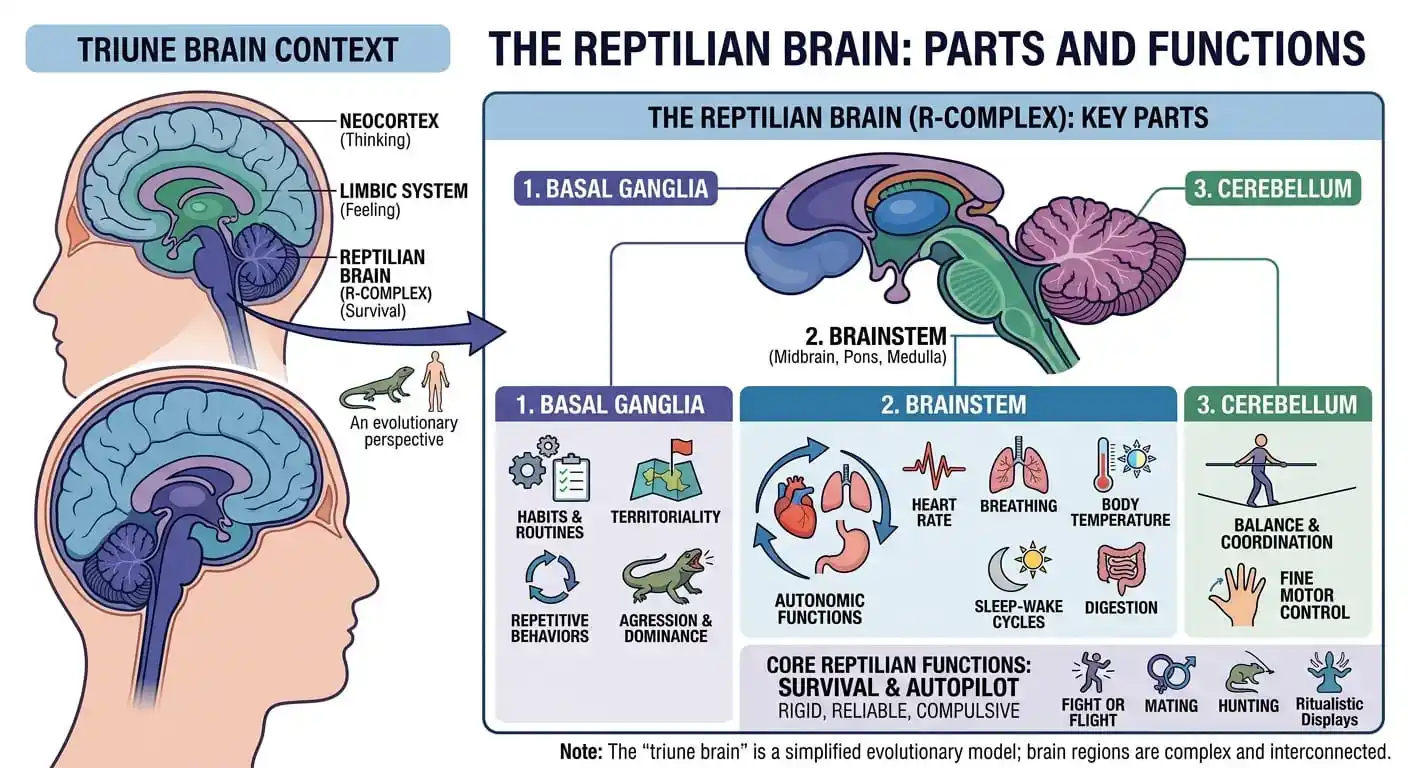
In practice, when writers use the term “reptilian brain,” they are usually referring loosely to the brainstem and sometimes the basal ganglia, structures involved in regulating heartbeat, breathing, temperature, and reflexive movement. These functions genuinely are ancient in evolutionary terms, and they do operate largely outside conscious awareness. Where the popular narrative overreaches is in treating this region as a separate, self-contained “reptile” sitting inside a human skull, rather than one deeply interconnected part of a single, integrated nervous system.
It helps to hold two truths at once here. The underlying anatomy is real and important. The tidy evolutionary story wrapped around it is considerably oversimplified, a distinction worth keeping in mind throughout the rest of this discussion.
What are the main parts of the reptilian brain?
The structures typically grouped under the “reptilian brain” label include the brainstem, the cerebellum, and sometimes the basal ganglia, all of which sit at the base and center of the brain. These regions manage core physiological processes rather than complex thought or emotion.
The brainstem itself is usually divided into three parts: the midbrain, the pons, and the medulla oblongata. The medulla oblongata regulates some of the most fundamental survival functions in the body, including heartbeat, breathing rate, and blood pressure, which is why severe damage to this small region can be life-threatening. The pons helps relay signals between the brainstem and higher brain regions and plays a role in sleep cycles, while the midbrain contributes to reflexive eye movement and some early processing of sensory information.
The cerebellum, tucked beneath the back of the brain, is sometimes included in reptilian brain diagrams because of its ancient evolutionary origins. Its primary job involves coordinating movement, balance, and posture rather than instinctive emotional reactions, which is a detail frequently left out of simplified explanations. The basal ganglia, a cluster of structures near the base of the forebrain, contribute to habit formation and the initiation of voluntary movement, and they interact closely with reward circuitry throughout the brain.
| Brain structure | Primary function |
|---|---|
| Medulla oblongata | Regulates heartbeat, breathing, and blood pressure automatically. |
| Pons | Relays signals between brain regions and supports sleep regulation. |
| Midbrain | Processes reflexive eye movement and early sensory signals. |
| Cerebellum | Coordinates balance, posture, and fine motor movement. |
None of these structures act alone. They constantly exchange signals with the limbic system and the cortex above them, which is precisely why treating the “reptilian brain” as an isolated unit misrepresents how the nervous system actually functions moment to moment.
What functions does the reptilian brain control?
The structures associated with the reptilian brain primarily control automatic survival functions, including heart rate, breathing, temperature regulation, reflexive movement, and basic arousal responses to threat. These processes generally occur without conscious effort or awareness.
Breathing offers a clear example of this automatic control. You rarely think about each breath you take, yet the rate adjusts constantly based on oxygen levels, physical exertion, and even emotional state, all coordinated largely through brainstem circuitry rather than deliberate thought. Heart rate follows a similar pattern, speeding up during a startling noise before you have consciously registered what happened. This is the “primitive” quality people usually mean when describing reptilian brain function: fast, automatic, and independent of reasoning.
Reflexive threat responses also originate partly from this region, working closely alongside the amygdala to trigger the earliest physical stages of a stress reaction. A sudden loud sound might cause you to flinch half a second before you consciously identify the source, a delay that reflects real survival value across evolutionary history. Speed matters more than accuracy in a genuine emergency, which is likely why these circuits evolved to react before slower, more deliberate brain regions finish processing the situation.
- Cardiovascular regulation keeps heart rate and blood pressure adjusted to current physical demands.
- Respiratory control continuously adjusts breathing rate based on oxygen and carbon dioxide levels.
- Reflexive movement allows quick, automatic reactions to sudden sensory input.
- Arousal regulation helps maintain wakefulness and basic alertness throughout the day.
It is worth remembering that these are physiological, not psychological, functions in the strictest sense. Fear, anxiety, and complex emotional reactions involve much more than this region alone, a point the next several sections explore in more depth.

How does the reptilian brain relate to the triune brain theory?
The reptilian brain is one of three layers in the triune brain theory, a model proposed by neuroscientist Paul MacLean that divides the brain into reptilian, limbic, and neocortical regions based on assumed evolutionary sequence. Each layer was thought to add a new kind of mental capacity.
MacLean proposed this framework in the 1960s and developed it further over subsequent decades, describing the reptilian complex as responsible for basic survival instincts, the limbic system as the seat of emotion, and the neocortex as the region enabling language, planning, and abstract reasoning. The framework gained enormous popularity partly through the writing of astronomer and science communicator Carl Sagan, whose bestselling book on human cognitive evolution introduced the triune brain concept to a broad general audience far beyond academic neuroscience.
The theory’s appeal is easy to understand. It offers a simple, almost narrative structure for a wildly complex organ, and it gives non-specialists a mental shortcut for talking about impulsive versus rational behavior. A manager might describe an employee’s outburst as their “reptilian brain taking over,” and everyone in the room instantly understands the intended meaning, even if the underlying neuroscience is being stretched considerably.
That intuitive appeal, however, does not automatically make the model an accurate description of how brains actually evolved or function. The next section addresses that gap directly, because the popularity of an idea and its scientific accuracy are two very different things.
Is the triune brain theory scientifically accurate?
The triune brain theory is now considered largely outdated by mainstream neuroscience, since modern comparative brain research does not support the idea of three distinct, sequentially evolved layers. Contemporary evidence suggests brain evolution is far more gradual and interconnected than the model implies.
Neuroscientist Joseph LeDoux, known for decades of research on fear circuitry and the amygdala, has argued explicitly against treating emotional processing as confined to a separate “limbic” layer sitting neatly above a reptilian one. His work shows that structures once assumed to be purely emotional, like the amygdala, also interact extensively with cortical regions involved in learning, memory, and conscious appraisal. Emotion and cognition, in other words, are far more intertwined than the triune model suggests, which undermines the theory’s tidy separation of instinct from thought.
Comparative anatomy research has also complicated the evolutionary story at the heart of the model. Reptiles themselves possess more complex neural structures than the original theory assumed, and many non-mammalian species show forms of learning, memory, and even basic emotional behavior that the strict triune framework does not easily accommodate. Short version: brains did not evolve in three clean layers stacked like sediment.
None of this means the underlying anatomy described by the theory is fictional. The brainstem, limbic structures, and cortex genuinely exist and genuinely perform different, specialized functions. What has not held up well is the specific evolutionary narrative and the strict functional separation the triune brain theory proposed, which is why most contemporary neuroscientists treat it as a useful teaching metaphor rather than an accurate scientific model.

How does the reptilian brain interact with the limbic system and neocortex?
The brainstem structures often labeled the reptilian brain constantly exchange signals with the limbic system and neocortex rather than operating as an independent unit, forming one continuously integrated network responsible for perception, emotion, and behavior together.
The limbic system, which includes structures like the amygdala and hippocampus, receives sensory information relayed partly through brainstem pathways and adds emotional weight and contextual memory to that raw input. A sudden noise processed initially by brainstem circuits might trigger a reflexive startle, but the amygdala quickly determines whether that noise represents genuine danger based on stored memories and learned associations. Neuroscientist Antonio Damasio, whose research connects emotion directly to reasoning and decision-making, has demonstrated that this emotional processing actually supports rational judgment rather than simply interfering with it.
The neocortex then layers additional interpretation onto this emotional signal, drawing on language, memory, and social context to shape a final response. If you hear a loud bang at a fireworks display, your neocortex quickly supplies context that overrides the initial startle reflex, letting you relax within seconds. Remove that contextual information, say, the same bang occurring somewhere unexpected, and the response can look completely different, illustrating how tightly connected these systems truly are.
- Sensory input arrives and is initially processed through brainstem and sensory relay structures.
- Emotional tagging occurs as limbic structures like the amygdala assess potential threat or reward.
- Contextual interpretation follows as the neocortex applies memory, language, and reasoning.
- An integrated response emerges, blending automatic reflex with learned judgment rather than relying on either alone.
What happens when the reptilian brain dominates behavior?
When brainstem-driven survival responses override slower cortical processing, behavior tends to become reflexive, impulsive, and focused narrowly on immediate safety rather than long-term consequences. This pattern is often described informally as the reptilian brain “taking over.”
This dynamic shows up clearly during acute stress or perceived danger, when the body prioritizes speed over nuance. Heart rate spikes. Breathing quickens. Attention narrows sharply onto the perceived threat, sometimes at the expense of noticing other relevant details in the environment, a phenomenon researchers sometimes call attentional narrowing under stress. People frequently describe this state using phrases like “acting without thinking,” which captures the experience reasonably well even if the underlying neuroscience is more distributed than a single brain region switching on.
Neuroscientist and researcher Robert Sapolsky, whose extensive work covers the biology of stress, has documented how prolonged activation of these survival circuits can affect decision-making, memory, and even physical health over time. Chronic stress does not simply produce occasional reflexive reactions; it can gradually shift how the entire nervous system calibrates threat, making a person more prone to reactive behavior even in relatively low-stakes situations. That gradual shift matters enormously for anyone trying to understand recurring patterns of overreaction rather than isolated incidents.
- Impulsive reactions can override planned or considered responses during moments of acute stress.
- Narrowed attention may cause someone to miss important contextual details during a perceived threat.
- Physical arousal symptoms such as rapid heartbeat often accompany this reflexive activation.
- Reduced verbal fluency sometimes occurs, since stress can temporarily interfere with cortical language processing.

How does the reptilian brain influence stress and survival responses?
Brainstem and related deep brain structures help initiate the body’s earliest physical stress responses, working alongside the sympathetic nervous system to prepare the body for rapid action before conscious evaluation is complete. This groundwork happens in a fraction of a second.
The classic fight, flight, or freeze response depends heavily on this rapid, largely automatic activation. Psychiatrist and researcher Stephen Porges, known for developing polyvagal theory, has expanded understanding of this system considerably by describing how the vagus nerve helps regulate shifts between calm engagement, active defense, and shutdown states. His research suggests that freezing is not simply a failure to act but a distinct, biologically organized survival strategy that emerges under specific conditions, particularly when neither fighting nor fleeing seems viable.
This has practical implications for how people understand their own reactions under pressure. Someone who freezes during a stressful confrontation is not being weak or incompetent; their nervous system is executing a genuinely old survival pattern shaped by circumstances the conscious mind may not have fully registered yet. Recognizing this can reduce unnecessary shame around reactions that feel embarrassing in hindsight but made physiological sense in the moment.
Affective neuroscience researcher Jaak Panksepp identified several basic emotional systems shared across many mammalian species, including systems governing fear, seeking, and care, which further complicates the idea that survival instincts and emotion occupy entirely separate brain layers. His work reinforces a theme running through current neuroscience: instinct and emotion are woven together far more tightly than the old three-layer model ever suggested.
Can you consciously regulate reptilian brain responses?
You cannot directly control automatic brainstem functions like heart rate through willpower alone, but you can influence the broader nervous system state that shapes these reflexive responses using specific behavioral and physiological strategies. Regulation happens indirectly, not through direct override.
Slow, deliberate breathing is one of the most well-supported approaches, since controlled breathing patterns can shift activity in the vagus nerve and gradually reduce the intensity of a stress response. This does not stop the initial reflex from occurring; it changes what happens afterward, helping the nervous system return to a calmer baseline more quickly than it otherwise would. Grounding techniques, which redirect attention toward concrete sensory details in the immediate environment, work through a related mechanism, giving the neocortex something specific to engage with rather than leaving attention locked onto a perceived threat.
Physical movement can help as well, since the body’s stress response was originally built to be resolved through action, not stillness. A short walk, gentle stretching, or even shaking out tension in the hands and shoulders can help discharge some of the physiological arousal generated by a stressful encounter. None of these strategies eliminate the reflex itself, since that reflex serves a genuine protective purpose, but they can shorten its duration and intensity considerably.
It is worth being honest here: no single technique works identically for everyone, and persistent, overwhelming stress reactions sometimes benefit from support beyond self-directed strategies. A licensed mental health professional can offer individualized assessment and evidence-based approaches, such as structured relaxation training or trauma-informed therapy, tailored to a specific person’s history and nervous system patterns.

What are common myths about the reptilian brain?
The most common myth is that the reptilian brain functions as a fully separate, self-contained module that periodically “takes over” the rest of the brain during stress. In reality, brainstem structures constantly interact with limbic and cortical regions rather than operating in isolation.
A second widespread myth treats the triune brain theory as settled neuroscience rather than a historically influential but scientifically outdated model. While the metaphor remains useful for basic teaching purposes, presenting it as an accurate account of brain evolution misrepresents decades of subsequent comparative and developmental research. Textbooks and casual explainers sometimes skip this nuance entirely, which understandably leaves readers with an oversimplified picture.
Another persistent misconception suggests that “reptilian brain” responses are entirely irrational or primitive in a negative sense. Fast, automatic threat responses evolved because they were adaptive, often lifesaving, across long stretches of evolutionary history. Calling them primitive is not inaccurate in an evolutionary sense, but it can unfairly imply that these responses are flawed or embarrassing rather than functional, even when they occasionally misfire in modern, low-danger situations like public speaking or difficult conversations.
Finally, some popular sources imply that people can simply “override” these responses through willpower or positive thinking alone. Real change tends to come through consistent practice, physiological regulation strategies, and sometimes professional support, not a single decision to think differently. Quick fixes rarely match the complexity of the underlying biology.
FAQs about the reptilian brain
What is the reptilian brain in simple terms?
In simple terms, the reptilian brain is a popular way of describing the brainstem and some closely related structures at the base of the brain, which handle automatic survival functions like breathing, heart rate, and quick reflexive reactions to danger. The name comes from an older theory suggesting this region resembles the entire brain of reptiles and represents the oldest evolutionary layer of the human brain. Modern neuroscience views this framing as an oversimplification, since these structures work in constant coordination with emotional and thinking regions of the brain rather than functioning as an isolated unit. Still, the underlying idea that some brain functions are fast, automatic, and largely outside conscious control is genuinely accurate, even if the specific evolutionary story behind the term has not held up well under closer scientific scrutiny.
Is the reptilian brain a real anatomical structure?
Not exactly. There is no single, clearly bordered brain structure formally labeled the reptilian brain in modern neuroanatomy textbooks. The term is a popular shorthand that usually refers to the brainstem, and sometimes the cerebellum or basal ganglia, structures that genuinely exist and genuinely handle many automatic bodily functions. The confusion arises because the term originated from a broader theoretical model rather than from a precise anatomical description, which is why neuroscientists tend to prefer more specific terms like brainstem, medulla, or basal ganglia when discussing these functions. Understanding this distinction helps separate a useful teaching metaphor from an accurate description of actual brain structure.
Why do people say the reptilian brain causes anxiety?
People often use this phrase to describe how anxiety can trigger fast physical symptoms, like a racing heart or shallow breathing, that occur before a person consciously processes why they feel anxious. This physical immediacy resembles the automatic, reflexive quality associated with brainstem function, which is why the phrase gets applied to anxiety so often in casual conversation. In reality, anxiety involves a much wider network, including the amygdala, prefrontal cortex, and various neurotransmitter systems, working together rather than one isolated brain region acting alone. Describing anxiety as purely a reptilian brain response oversimplifies a genuinely complex process that involves learned associations, current context, and individual differences in nervous system regulation, not just an ancient survival reflex firing on its own.
Does everyone have the same reptilian brain response to stress?
No, individual stress responses vary considerably based on genetics, past experiences, current health, and learned coping patterns. While the basic physiological machinery involved in a stress response is similar across people, the intensity, duration, and triggers for that response differ significantly from person to person. Someone with a history of repeated stressful experiences may have a more easily triggered response than someone without that history, reflecting how the nervous system adapts over time based on lived experience. This variation is one reason generalized stress management advice does not work equally well for everyone, and why individualized support from a qualified professional can be genuinely valuable for people struggling with persistent or overwhelming stress reactions.
How is the reptilian brain different from the limbic system?
The reptilian brain, as popularly defined, typically refers to the brainstem and related structures controlling basic physiological survival functions like heartbeat and breathing. The limbic system, by contrast, refers to a separate set of structures, including the amygdala and hippocampus, primarily associated with emotion, memory, and motivation. In the original triune brain theory, these were presented as two distinct evolutionary layers stacked on top of each other. Current neuroscience views this separation as considerably less clean, since the structures involved constantly exchange signals and influence each other’s activity. Rather than two independent systems, most researchers now describe an integrated network in which physiological regulation, emotional processing, and higher reasoning continuously interact rather than operating as separate, self-contained modules.
Can therapy help with reptilian brain reactions like freezing?
Yes, several therapeutic approaches are specifically designed to address automatic survival responses like freezing, fighting, or fleeing. Trauma-informed therapies, for example, often focus on gradually helping the nervous system recognize safety more accurately, reducing the frequency or intensity of reflexive reactions triggered by situations that resemble past distressing experiences. Techniques like controlled breathing, grounding exercises, and gradual exposure are frequently used within these approaches, sometimes alongside other therapeutic methods tailored to an individual’s specific history and needs. It is worth noting that freezing or other reflexive reactions are not signs of weakness or failure; they reflect a biologically organized survival response. A licensed mental health professional can help someone understand their particular patterns and develop personalized strategies for managing them more effectively over time.
Is the triune brain theory still taught in psychology courses?
It is still referenced in many introductory psychology courses and popular science writing, largely because it offers an accessible, memorable way to introduce the idea that the brain contains regions specialized for different functions. However, most contemporary neuroscience courses now present it with significant caveats, noting that the strict three-layer evolutionary sequence it proposes does not match current comparative brain research. Many instructors use it as a simplified starting point before introducing more accurate, integrated models of brain function. If you encounter the theory in a textbook or online explainer without any mention of its limitations, it is worth seeking out more current sources, since neuroscience has moved considerably beyond the original framework since it was first proposed decades ago.
What triggers a reptilian brain response in everyday life?
Common everyday triggers include sudden loud noises, unexpected physical movement toward you, perceived social threats like public criticism, and situations resembling past distressing experiences, even when there is no actual danger present. These triggers activate rapid physiological changes, including increased heart rate and heightened alertness, often before a person has consciously identified what caused the reaction. Because this system evolved to prioritize speed over accuracy, it sometimes responds strongly to situations that feel threatening but are not actually dangerous, such as an unexpected email from a supervisor or an awkward silence during a conversation. Recognizing these triggers can help someone understand why a seemingly minor event produced an outsized physical or emotional reaction, which is often the first step toward developing more effective coping strategies.
Why do some people freeze instead of fighting or fleeing under stress?
Freezing tends to occur when the nervous system assesses that neither fighting nor fleeing offers a viable path to safety, making stillness the option most likely to reduce immediate risk. This response draws on older survival circuitry shared across many species, where remaining motionless can reduce the chance of detection or escalation in certain dangerous situations. Freezing is not a conscious choice, and it is not a sign of poor character or weak willpower, even though people sometimes feel embarrassed or confused about their own reaction afterward. Individual differences, including past experiences with similar situations, can influence how quickly someone shifts between fight, flight, and freeze responses. Understanding freezing as a biologically organized survival strategy, rather than a personal failure, tends to reduce unnecessary shame around this common and involuntary reaction.
Bibliography
- MacLean, P. D. (1990). The Triune Brain in Evolution: Role in Paleocerebral Functions. Springer.
- Sagan, C. (1977). The Dragons of Eden: Speculations on the Evolution of Human Intelligence. Random House.
- LeDoux, J. (2015). Anxious: Using the Brain to Understand and Treat Fear and Anxiety. Viking.
- Damasio, A. (1994). Descartes’ Error: Emotion, Reason, and the Human Brain. Putnam.
- Panksepp, J. (1998). Affective Neuroscience: The Foundations of Human and Animal Emotions. Oxford University Press.
- Porges, S. W. (2011). The Polyvagal Theory: Neurophysiological Foundations of Emotions, Attachment, Communication, and Self-Regulation. Norton.
- Sapolsky, R. M. (2004). Why Zebras Don’t Get Ulcers. Holt Paperbacks.
- National Institute of Mental Health. Brain basics and the biology of stress. NIMH.
- American Psychological Association. Understanding the stress response. APA.
Use this citation format to reference the article clearly and help readers find the original source.
PsychologyFor. (2026). What is the Reptilian Brain: Parts and Functions. PsychologyFor. https://psychologyfor.com/what-is-the-reptilian-brain-parts-and-functions/