

See more of our articles in your search results.
The human body (like so many things) deserves a history apart from the official one, since different ideologies and cultures have materialized in it. Throughout the history of humanity, the body has received various interpretations that, much more often than we believe, have been frankly contradictory.
This is the case of the vision that was had of him in the Middle Ages, probably one of the most contradictory times that ever existed. Source of sin and prison of the soul, but also shining with divine beauty (for let us remember that it was created in the image and likeness of God); worthy of admiration and praise, but, at the same time, recipient of the harshest and most terrible punishments for the purification of the soul. What exactly was the body for humans in the Middle Ages?
The vision of the human body in the Middle Ages: a fascinating contradiction
In the 7th century, Pope Gregory the Great (d. 604) commented that the body was the “abominable prison of the soul.” However, several centuries later, Saint Bonaventure (1221-1274) praises him for his upright position, which raises him towards heaven (and therefore towards God), and his (almost) contemporary Saint Francis of Assisi (m . 1226) refers to him as “brother body.”
First, we must bear in mind that the Middle Ages is a completely arbitrarily delimited period, spanning no less than ten centuries. It is logical to think, therefore, that in 1,000 years of history the consideration towards the human body varied significantly, and what Gregory the Great thought in the 7th century would hardly have the same validity at the end of the 13th century.
Second, medieval society, like any other society, was composed of groups, and these, in turn, of people, so, again, the “general” conception did not have to be shared by all members of this society. society.
How many of these have you been "meaning to read" for months?
- 1
 TarcherThe Artist's Way30th Anniversary EditionListen Free On Audible
 - 2
 New Harbinger PublicationsThe Dialectical Behavior Therapy Skills WorkbookPractical DBT Exercises for Learning Mindfulness, Interpersonal Effectiveness, Emotion Regulation...Listen Free On Audible
 - 3
 New Harbinger PublicationsAdult Children of Emotionally Immature ParentsHow to Heal from Distant, Rejecting, or Self-Involved ParentsListen Free On Audible
Given this (and despite it), we witness a fascinating contradiction as far as the medieval consideration of the body is concerned. It is precisely the intention of this article to briefly outline this contradiction, so that the reader can have a global vision of how they saw the body in the Middle Ages and can verify, once again, that many of the ideas we have about it are simple. topics.
The body as a prison for the soul
If we look at it in its context, we will realize that the quote from Gregory the Great belongs to a time when the idea of monasticism was beginning to form in the West. Although the retreat for an isolated and contemplative life has its roots in the East and emerged in the first centuries of Christianity, it was around the 7th century that this ideal of life was consolidated in Europe, at the hands of the newly created Benedictine order.
Monasticism, as its name clearly indicates (monacus, in Latin, means alone) implied the isolation of the hermit, who thus renounced life in the world and devoted himself to fasting and prayer. At first, these hermits lived in solitude, but soon, probably for survival reasons, they began to group together in very humble monasteries. It is the germ of the monasteries, one of the fundamental pillars of the first medieval centuries.
For these men and women, the body was worth little; It was just a receptacle of the soul, something that was “passing through” and, furthermore, the origin of desires and temptations and, therefore, of sin. It was not at all strange, then, that these monks and nuns mortified their bodies not only with fasting, but also with extreme living conditions. such as the case of Santa Oria, the girl who, according to legend, voluntarily walled herself up in the Monastery of Suso, in La Rioja (Spain).
The resurrection of the bodies
And here is one of the first contradictions: if the body was something so detestable (a “prison of the soul”, let us remember), why does Christian dogma affirm that, on the day of the Last Judgment, the dead will be resurrected in “body and soul?” ”? It is, as Jacques Le Goff and Nicolas Truong point out in the magnificent A History of the Body in the Middle Ages (see bibliography), something unique in post-mortem mythology.
The logical thing, for a religion that exacerbated the importance of the soul above the body, would have been for the resurrection at the end of days to leave aside the body, a “useless” and “dispensable” remains. But not; According to the Christian faith, the dead will rise from their graves and go to Judgment in body and soul. The sinners, after being judged, will descend to Hell with the complete body, which will receive all the competent punishments; but also the Blessed, that is, those who have behaved piously, will go up to Paradise dressed in the flesh they left on earth.
This is an unmistakable sign that, although the Church authorized and even encouraged bodily “mistreatment,” it did not disdain the carnal sheath completely. After all, the body was something created by God in his image and likeness, and Adam and Eve, the parents of humanity, lived naked in Eden before sinning.
Nudity as purity
This brings us to the concept that was so important in the Middle Ages of nudity as an idea of purity. We are daughters and sons of the Enlightenment and the 19th century, and our concept of nudity is very different from that of medieval men and women. Even today, in a supposedly “modern” century, scandals regarding the naked body persist, such as that notorious news story about a school in the United States that raised eyebrows because the art teacher showed her naked body “with impunity.” of Michelangelo’s David.
No, in the Middle Ages this was not like that. Although the Church, as we have already said, encouraged the “mortification” of the flesh for the purification of the soul, nudity was not seen by the various social strata as something shameful. In public baths, for example, men and women bathed naked (something that would be unthinkable today), and in many Romanesque capitals we find scenes of nudity and sex, as the historian Isabel Mellén has pointed out in her formidable study El sex in Romanesque times (see bibliography).
The naked body was a symbol of virtue, since newborns are born without clothes, and without clothes the fathers of humanity wandered through Eden. It was precisely after the original sin that both realized their nakedness and were ashamed of it, which is why clothing is seen, in the Middle Ages, as the consequence of sin.
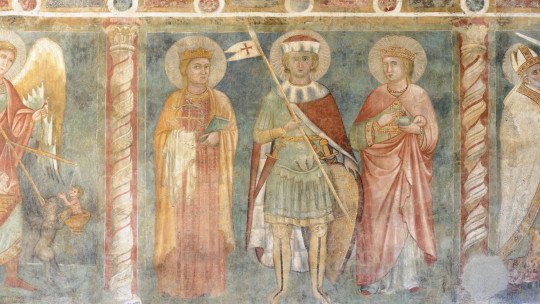
If we look at the wall paintings of the period in which the Last Judgment is represented, we will see that the souls are represented without clothes. In medieval iconography there are countless representations of nudes that, precisely, were considered sinful in the 19th and 20th centuries; Many of them, by the way, were brutally mutilated to hide their “shame.”.
The exaltation of blood
In reality, if we consider it carefully, it would be incongruous for a Christian civilization like the medieval one to denigrate the body and its fluids, when, precisely, Christianity focuses on a God who becomes man and sheds his blood to save humanity.
Indeed, the Eucharist itself is a hymn to bodily dignity, since the blood of Christ is magnified (although this is, unlike that of mortals, the Precious Blood). During the liturgy, the faithful drink the blood shed by Jesus on the cross and eat his body, so the matter becomes the redeeming object par excellence.
Blood, on the other hand, is what distinguishes one man from another, because lineages perpetuate blood. Thus, a nobleman did not have the same blood as a commoner, and that is where his honor lay. The women of the clans were responsible for reproducing this blood in their wombs, the only guarantee of the continuity of the lineage. That is one of the reasons, according to historian Isabel Mellén, that we find a great profusion of representations of intercourse and women showing their vulvas in privately financed medieval churches. A true hymn to the perpetuation of blood.
Corpses and relics
Related to this, it is necessary to talk about the relics, which in the Middle Ages acquired unusual importance. Relics are fragments of the body of a saint or an object that has been touched by him, whose veneration was encouraged (economic reasons aside) because it was believed that it served as an intercessor between the faithful and God. This veneration of the body parts of a saint is linked to the praise that was given to the body in the Middle Ages and its importance in salvation.
A series of rituals were also performed on the “common” deceased and their remains were preserved. The desecration of graves was severely persecuted, although the dissection of corpses was not (contrary to what is commonly believed). The Church did not prohibit this practice at any time, and, in fact, in some of the most prestigious medical universities of the time (such as Bologna, whose first dissections date back to the 13th century), dissection was used as a teaching method. and study.
Body and soul were not separated, as they would be for the classicist thinkers of the Modern Age. Medieval medicine enhanced the relationship between the physical and the spiritual, and only complete harmony between the two could lead to good health. From this it follows, of course, that many diseases were seen as the fruit of sin and bad habits.
The extraordinary eroticism of courtly love
We cannot finish this brief tour of the vision of the body in the Middle Ages without mentioning the 12th century and, therefore, courtly love. So called because it appeared and grew in the various European courts, courtly love was sung by troubadours and was clothed in extraordinary refinement. The troubadour sang to a lady, usually married (and therefore supposedly inaccessible), and praised her beauty, her grace and her distinction.
Through the poetic compositions of the time and the also recurring novels of chivalry, we can discern what was considered a beautiful body during these central centuries of the Middle Ages. Focused mostly on feminine beauty, these compositions praise white, spotless skin, long blonde hair, and extremely rosy cheeks, a “drop of blood in the snow,” as the chivalric novel Percival or The Tale puts it. of the Grail, by Chrétien de Troyes (b. 1135).
Consequently, wealthy ladies dedicated much of their time to washing, grooming and beautifying their bodies, as can be seen from the large number of beauty treatises that have come down to us. The body, as a divine creation, was susceptible to being admired and loved.
The vision of the body in the Middle Ages is contradictory; First, because such a long period must necessarily present different points of view on the same point (even if we strive to artificially homogenize it). And second, because The different social groups that lived in the medieval centuries had their own vision of what the human body represented.
During the first centuries of the Middle Ages, there was a strong tendency towards monasticism and, therefore, towards mortification of the flesh, which did not always have to be violent. In general, monks and nuns observed chastity and intermittent fasting, so the result was more of a control of passions.
Faced with this vision of the body as “prison of the soul” we find another vision, completely contemporary to that, which sees the human body as a microcosm in which the work of God is reflected. In fact, The valuation of the body reaches the point that, according to the prevailing dogma, during the Final Judgment the souls and bodies will rise and, thus united, they will enter either Hell or Paradise.
Finally, and parallel to the ascetic will and the chilling cases of medieval “sandwiches”, we find a whole universe of eroticism and beauty, especially in the centuries of courtly love, in which the beauty of the body is sung and in the that nudity is not only not sinful, but is a return to the purity of Eden.
Use this citation format to reference the article clearly and help readers find the original source.
PsychologyFor. (2024). What View Was There of the Human Body in the Middle Ages?. PsychologyFor. https://psychologyfor.com/what-view-was-there-of-the-human-body-in-the-middle-ages/