


See more of our articles in your search results.
The message lands at 9:14 a.m.: your proposal got approved. For forty minutes you’re buoyant, humming in the elevator, telling a near-stranger at the coffee machine about it. Then, somewhere around lunch, the air goes out of you. Nobody said anything sharp. Nothing went wrong. You’re staring at a limp sandwich with a heavy, gray quiet sitting on your chest, and you can’t find the door the good feeling left through. It’s disorienting, and a little embarrassing, like laughing hard at a party and realizing ten minutes later that you’re near tears in the hallway with your coat half on. The whole episode takes maybe an hour, and you spend the rest of the afternoon working out whether something is wrong with you.
Most explanations of feeling happy and then sad jump straight to a diagnosis, which is unhelpful and often wrong. Everyday mood shifts come from sleep debt, blood sugar, stress hormones, the way your brain predicts and then reacts to good news, and now and then from a real condition worth checking. The trouble is that a feeling arrives without a label attached. So people label it themselves: “I’m broken,” “I’m ungrateful,” “I must be bipolar.” Those verdicts cost more than the mood swing does. They turn a passing wave into a story about who you are, and the story lingers long after the wave has gone. Meanwhile the people around you, who saw the smile at ten and the silence at two, start wondering too.
Feelings move. That’s their job.
This article explains why you go from happy to sad so fast, when it counts as normal, and what to do when it doesn’t.
Why do I feel happy one minute and sad the next?
Because emotions aren’t fixed states; they’re moment-to-moment estimates your brain makes from your body, your surroundings and your recent past. When any of those inputs change, the estimate changes. Sudden happy-to-sad mood swings are usually the visible edge of something quieter: a poor night of sleep, a skipped meal, a hormone shift, a stressor you’ve been ignoring, or a good event that has already faded.
How many of these have you been "meaning to read" for months?
- 1
 TarcherThe Artist's Way30th Anniversary EditionListen Free On Audible
 - 2
 New Harbinger PublicationsThe Dialectical Behavior Therapy Skills WorkbookPractical DBT Exercises for Learning Mindfulness, Interpersonal Effectiveness, Emotion Regulation...Listen Free On Audible
 - 3
 New Harbinger PublicationsAdult Children of Emotionally Immature ParentsHow to Heal from Distant, Rejecting, or Self-Involved ParentsListen Free On Audible
The Cleveland Clinic describes mood swings as sudden changes in how you feel, tied to shifting brain chemicals, and points out that pretty much everyone has them. That’s a comfortable sentence, and it’s true, but it’s also a bit shallow. “Brain chemicals” tells you nothing you can act on. What helps is sorting the likely causes by how quickly they act and how easily you can test them.
Here are the usual suspects, roughly from most to least common in the general population:
- Short or broken sleep, which makes the emotional brain louder and the braking system quieter.
- Blood sugar dips after long gaps between meals or a heavy dose of refined carbs.
- Chronic stress and the cortisol swings that come with it; the body stays braced even when the mind has moved on.
- Hormonal shifts across the menstrual cycle, pregnancy, perimenopause, or thyroid problems. Both an overactive and an underactive thyroid can push mood around.
- Caffeine, alcohol, nicotine and medications, including corticosteroids and some hormonal treatments, which can lift you briefly and then let you drop.
- Psychological patterns such as anxiety, depression, ADHD, trauma reactions, and the letdown that follows excitement.
Notice what’s missing from that list: weakness, ingratitude, being “too sensitive.” None of those are causes. They’re the insults people use when they don’t have a cause yet.
Take Dana, an illustrative composite. She gets a lovely text from her sister at 8 a.m., feels warm all morning, then crashes at 2 p.m. after a lunch of two coffees and a granola bar, having slept five hours. Her mood didn’t betray her. Her physiology ran out of runway.
Which of the six do you think fits your last bad afternoon?
How does your brain build a mood so quickly?
Picture a commuter train packed at 8:05, everyone tense, someone’s elbow in your ribs. You feel irritable, maybe faintly sad. Ten minutes later the doors open onto sunlight and you feel fine. Same body, same day, different feeling.
The reason is that emotions are constructed, not triggered. That’s the central claim of the theory of constructed emotion, developed by neuroscientist Lisa Feldman Barrett. Her argument, laid out in How Emotions Are Made, is that the brain doesn’t wait for the world to press an emotional button. It constantly predicts what your body needs next, uses past experience to guess what the signals mean, and then labels the result: excited, anxious, sad, tired. Barrett also stresses interoception, the brain’s ongoing tracking of internal sensations like heartbeat, breathing and gut tension, as raw material for those predictions.
What does that mean in practice? A racing heart after coffee can be read as excitement at 10 a.m. and as dread at 4 p.m. If you’re depleted, a flat body signal can be read as sadness.
It also explains why mood can flip without any event. Your brain isn’t reacting to the sandwich, the email or the weather. It’s reacting to its own best guess about a body that changed slightly. Small shifts in energy, temperature, posture or hunger become “I feel down” because that’s the nearest category available.
I like this framework for one reason above the rest: it’s honest about the limits of introspection. Barrett’s ideas are influential but not universally accepted, and some emotion researchers still favor the older view that basic emotions have distinct biological signatures. The evidence isn’t settled. Still, for practical purposes, the constructed view gives you something classic models don’t, which is a lever. If a feeling is partly a guess, you can feed the guess better data.
Drink water. Eat something with protein. Stand up, look at a far wall, let your breathing slow down for two minutes. You’re not tricking yourself; you’re changing the inputs that the guess depends on.
This is also why emotional granularity matters. People who can tell “drained” from “lonely” from “disappointed” tend to have more options for responding. “Sad” is a big, blunt word. A sharper word points to a smaller, fixable problem.

Why does happiness fade so fast?
Myth: a good feeling should last as long as the good thing does. Fact: the brain adjusts to nearly everything, pleasant or not, and the lift shrinks over time. Psychologists call this hedonic adaptation, the tendency for emotional responses to a changed circumstance to weaken as the change becomes normal.
The new job, the new apartment, the compliment, the promotion: each one brings a spike, and then the baseline creeps back. Researchers Sonja Lyubomirsky and Kennon Sheldon proposed the Hedonic Adaptation Prevention model to explain how people can slow that fade. It describes two routes by which gains erode. One is bottom-up: the positive emotions generated by the change simply decline as it gets familiar. The other is top-down: aspirations rise, so what once felt like a triumph now feels like the minimum.
That second route is sneaky. You get the thing, you enjoy it for a day, and by Thursday you’re already scanning for the next thing. The sadness that follows isn’t about the thing at all. It’s the gap between where you are and the bar you quietly raised.
Sheldon and Lyubomirsky’s work suggests that variety, appreciation and fresh, surprising experiences can keep positive emotions from flattening out. I’d add a caveat that the research is largely based on self-report and on relatively small experimental samples, so the size of the effect in ordinary life is probably smaller than the tidy models imply.
Consider Mateo, another composite. He finally books the trip he’d wanted for years, floats for a week, then finds himself weirdly flat on the plane. He’d assumed the trip would deliver happiness. Instead, the anticipation had been doing most of the work.
Some practical ways to slow the fade: space out good things instead of stacking them; notice specific details of a win while it’s happening, like the smell of the room or who was there; tell someone about it, since savoring out loud seems to last longer than savoring alone; and resist the urge to raise the target the moment you hit it.
None of this stops adaptation. It just makes the slope gentler, and a gentler slope feels less like a crash.
Why do I feel sad right after something good happens?
Because your brain oversold the event. You expected the high to be bigger and to last longer than it did, and the shortfall lands as a low. The mismatch has a name: affective forecasting error.
Psychologists Timothy Wilson and Daniel Gilbert have spent years showing that people are poor at predicting how they’ll feel in the future. Their research on affective forecasting points to a pattern known as the impact bias: we overestimate how intense and how durable our emotional reactions to future events will be, for good outcomes and bad ones alike. We also forget how quickly we make sense of things and move on.
So you plan a wedding, a launch, a graduation, a big holiday dinner. You picture the day as a peak. Then it arrives, it’s lovely, it’s over by ten p.m., and the next morning the dishes are still there. That drop has several names in casual talk: post-event blues, post-vacation blues, post-holiday letdown. None of them are formal diagnoses, but the experience is real and common.
Two other things stack on top. First, adrenaline and excitement are physical states. When they end, the body settles below its baseline for a while, just as it does after a hard workout. Second, a big goal gives days structure. When it’s gone you’re left with an empty calendar and a question mark.
A blunt claim, then: the sadness after a win isn’t proof that the win was fake, or that you’re hard to please. It’s proof you had a target that organized your energy.
What to do with it? Plan something small for the days after the big thing, not another huge thing. Book a Tuesday dinner with a friend. Schedule a walk. Decide in advance what the next modest project is.
And expect the dip. Just naming it (“this is the letdown, it usually lasts a few days”) takes away the alarm, which is often the worst part.

Can sleep, food and hormones really swing your mood?
Yes, and more than most people want to admit. The body is not a neutral platform for the mind; it’s more like the weather the mind lives in.
Sleep is the biggest lever. Neuroscientist Matthew Walker argues in Why We Sleep that short sleep leaves the brain’s emotional reactivity elevated while weakening the regulation that normally keeps it in proportion. Brain imaging work from his lab, published in 2007, found that sleep-deprived people showed a stronger amygdala response to negative images and weaker connection to the prefrontal cortex. Some of Walker’s broader claims about sleep have drawn criticism from other scientists, so treat the strongest statements with some salt. The basic finding, that tired people feel worse and react harder, is well supported.
Now the practical side. Here is what tends to matter, with a rough sense of how to test each one:
- Sleep under about six hours for several nights. Fix it for a full week before judging your mood.
- Long gaps without food. Eat something with protein every three to four hours for a few days and see whether the 3 p.m. slump softens.
- Caffeine timing. A big coffee on an empty stomach can produce jitters that your brain reads as anxiety, then a crash that reads as sadness.
- Alcohol, including one or two drinks. It sedates first and then rebounds, fragmenting sleep and lowering mood the next day.
- Menstrual cycle phase. Track mood against the cycle for two to three months; a reliable pre-period dip may point to premenstrual syndrome or the more severe premenstrual dysphoric disorder.
- Medications. Corticosteroids, some hormonal therapies and certain antidepressants can shift mood; never stop a prescription on your own, but do tell the prescriber.
- Thyroid function. Ask your primary care doctor about a simple blood test if mood swings come with unusual fatigue, weight change or feeling too hot or cold.
Ask yourself a dull question before an interesting one: when did I last sleep properly, eat properly and stop drinking coffee? Most days that dull question does more work than an hour of introspection.
Is it normal, or could it be bipolar disorder?
Usually it’s normal. Bipolar disorder isn’t defined by moods that change during a day; it’s defined by distinct episodes of mania or hypomania and depression that last days to weeks and change sleep, energy and behavior. Feeling happy at breakfast and low by dinner, in reaction to your day, does not fit that pattern.
Clinical psychologist and author Kay Redfield Jamison, who has bipolar disorder herself, describes in her memoir An Unquiet Mind what the real thing looks like from inside: expansive, racing highs with little need for sleep, followed by prolonged and severe depressive stretches. Reading her account makes the gap plain. An episode takes over life. A bad afternoon doesn’t.
The Mayo Clinic notes that bipolar disorders feature emotional highs called manic or hypomanic episodes and lows called depressive episodes. Consider the contrast in the table below, which simplifies things quite a bit; only a clinician can sort out real cases.
| Pattern | Typical timescale | What it looks like |
|---|---|---|
| Ordinary mood fluctuation | Minutes to hours | Reactive to events, sleep or hunger; life carries on |
| Emotional lability | Minutes to hours, many times a day | Rapid, intense shifts that feel out of proportion; often linked to a neurological or psychiatric cause |
| Cyclothymia | Weeks to months | Milder highs and lows that never reach full episodes but persist for at least two years |
| Bipolar I or II | Days to weeks per episode | Clear manic or hypomanic episodes and depressive episodes, with changes in sleep, energy and behavior |
| Borderline personality disorder | Hours, triggered by interpersonal events | Intense shifts, often anger, anxiety or despair, tied to fear of rejection |
One caution about the internet. Search results are full of people confidently declaring that mood swings equal bipolar. That’s a bad habit. Bipolar disorder is often missed or misdiagnosed for years, yes, but the reverse also happens: ordinary emotional volatility gets stamped with a serious label after a ten-minute quiz.
Warning signs that deserve a proper assessment include several days of sharply reduced need for sleep with high energy, unusually risky spending or behavior, racing thoughts, or a low mood that lasts more than two weeks. A first-degree relative with bipolar disorder raises the odds, too.
Short version: rapid, reactive swings within a day suggest one set of causes; sustained, life-altering episodes suggest another. Those two need different responses.
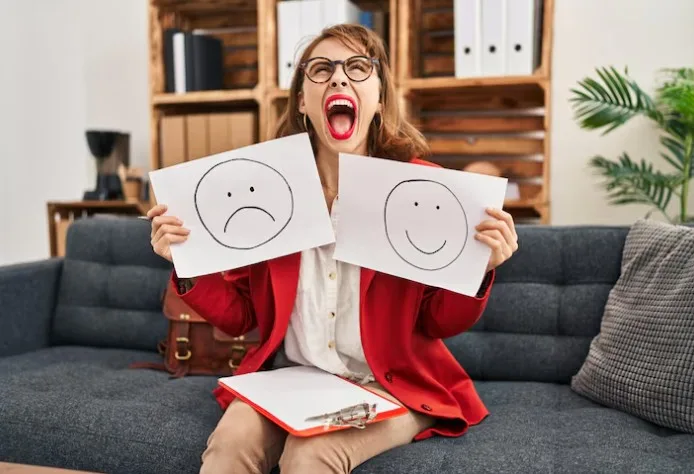
What is emotional dysregulation, and do I have it?
Emotional dysregulation is a pattern where feelings arrive fast, hit hard, and take a long time to settle, so that your reactions regularly outrun what the situation seems to call for. It’s not a diagnosis by itself. It’s a feature that shows up in several conditions.
Psychologist Marsha Linehan, who created dialectical behavior therapy (DBT), built her model around a simple idea: some people are born with high emotional sensitivity and a slow return to baseline, and when that meets an environment that dismisses or punishes their feelings, the result is chronic difficulty regulating emotion. She first developed DBT for borderline personality disorder. Since then it has been adapted for other problems where emotion runs hot.
Which conditions travel with dysregulation? ADHD is a big one, and it’s badly under-recognized in adults, particularly women. Post-traumatic stress disorder, complex trauma, borderline personality disorder, anxiety disorders, and depression all can. Brain injury and stroke may produce a distinct phenomenon in which emotional expression is abrupt and disconnected from actual mood.
Consider Priya, an illustrative composite. She’s 34, an accountant, and describes her inner life as a smoke alarm that goes off when someone burns toast. A delayed reply from a friend turns her stomach; an hour later a joke has her lighter than air; by evening she’s raw again. She isn’t dramatic. She’s running an emotion system with the sensitivity turned all the way up and no easy way to bring it down.
Signs that this is more than an off week: intense swings several times a week for months or years, recovery that takes hours or days instead of minutes, relationships or work taking repeated damage, and impulsive acts such as blowing up, quitting, spending or drinking after the peaks.
If several of these apply, a psychologist or psychiatrist can assess for ADHD, trauma-related conditions and personality-related patterns. DBT skills work well even without a formal diagnosis, and group programs are widely available.
Here’s my strong opinion: getting the right label matters less than getting the right skills. But the label often points to the right skills faster.
How can you calm a mood swing while it’s happening?
Start with the body, then work on the thought. When a mood is flipping, the reasoning part of your brain is running on low power, so body-first tools land faster than argument does. Here’s a sequence that fits into about ten minutes.
- Name it precisely. Swap “I feel awful” for “I feel deflated and a bit lonely.” Labeling the feeling tends to reduce its intensity.
- Change your physiology. Splash cold water on your face, do slow breathing with a longer exhale than inhale, or walk around the block. Marsha Linehan’s DBT toolkit includes cold-water exposure and paced breathing for exactly this reason.
- Check the basics. Have you eaten, had water, slept? Fix whichever is missing first.
- Do the opposite of the urge, gently. This is opposite action, another DBT skill: if sadness tells you to hide, text one person or step outside for five minutes.
- Delay big decisions. Don’t send the resignation email, the breakup text, or the long message at 11 p.m. Wait until tomorrow.
Why does this order work? Stanford psychologist James Gross proposed the process model of emotion regulation, which lays out where you can intervene as an emotion unfolds: choosing or changing the situation, shifting attention, reframing the meaning, or altering the response after the feeling has already begun. His research found that intervening early, especially through cognitive reappraisal (reinterpreting what a situation means), generally works better than suppression, which means holding the feeling in and hiding it. Suppression tends to keep the physical arousal going and can make the moment costlier.
A caveat that people rarely mention. Reappraisal is not “look on the bright side.” Telling yourself that everything happens for a reason while your chest is tight is only suppression in a sweater. Real reappraisal is more like: “This is a letdown after a big week, and letdowns pass.”
Practice these skills when you’re calm. Skills you’ve never rehearsed are useless at 4 p.m. on a bad day; a fire drill works because nobody’s on fire.

How do you track mood swings to find the pattern?
Keep a two-week mood log with four columns: time, mood (one or two words), what happened in the previous hour, and body state (sleep, food, caffeine, cycle day). Patterns that are invisible in memory tend to jump out on paper.
Memory is a lousy witness. When you feel low, you remember the whole day as low. When you feel fine, you forget the crash. A log fixes this by capturing the moment instead of the story you tell afterward.
What to record: a quick mood rating from 1 to 10 at least twice a day, hours slept and how you woke, meals, caffeine, alcohol and medications with times, any big trigger such as an argument, message or deadline, and menstrual cycle day if relevant.
After two weeks, read it like a detective, not a judge. Do dips cluster around 3 p.m.? Around days after poor sleep? On Sunday nights? Around specific people? If you see a pattern like “always low two days after a big social event,” that points to a recovery need after socializing or a post-event letdown, not a defect.
A paper notebook works. So does a notes app. Some apps add graphs, but the graph isn’t the point; the noticing is.
There’s a limit here, though. Tracking helps most people, but for some it feeds anxiety, turning every twinge into data to check. If you notice yourself rating your mood every hour and feeling worse for it, cut back to once at night.
Bring the log to an appointment if you do seek help. A clinician can do much more with “here’s what happened over fourteen days” than with “I’ve been up and down lately.” It makes the conversation faster, and it protects you from being misread.
When should you talk to a professional about mood shifts?
See a professional if swings last more than about two weeks, keep disrupting work, relationships or sleep, or come with any of the warning signs below. You don’t have to wait for a crisis; earlier is easier.
Warning signs worth acting on:
- Low mood most of the day for two weeks or longer, or losing interest in things you normally enjoy.
- Days of very little sleep without feeling tired, alongside racing thoughts or unusual risk-taking.
- Intense swings that damage relationships or lead to impulsive, harmful choices.
- Substance use that’s rising to manage how you feel.
- Thoughts of self-harm or suicide, which need attention right away.
Start with your primary care doctor (a GP in the UK, Ireland, Australia and New Zealand). They can check for thyroid problems, anemia, medication effects and other physical causes, and refer you to a psychologist, psychiatrist or licensed counselor. Bring your mood log.
Evidence-based treatments include cognitive behavioral therapy for anxiety- or depression-related swings, DBT for intense emotional dysregulation, and medication when a mood disorder or ADHD is diagnosed. Treatment depends on cause, which is why the physical check matters.
If you are thinking about harming yourself, reach out now. In the US, call or text 988 (Suicide & Crisis Lifeline); in Canada, call or text 9-8-8. In the UK and Ireland, Samaritans is 116 123; in Ireland you can also call Pieta on 1800 247 247. In Australia, Lifeline is 13 11 14, and in New Zealand you can call or text 1737. For immediate danger, call your local emergency number: 911 in the US and Canada, 999 in the UK, 112 or 999 in Ireland, 000 in Australia, 111 in New Zealand.
Most people who get an assessment for mood swings discover something ordinary and fixable, like poor sleep or a thyroid issue, and that’s a fine outcome.
You asked why you’re happy and then sad. The honest answer is usually “for reasons you can find,” and finding them is very doable.
FAQs about Feeling Happy Then Sad
Is it normal to feel happy and then suddenly sad?
Yes. Brief shifts in feeling over a day are a normal part of being human, and most are tied to sleep, hunger, stress, hormones or a reaction to something that happened. What matters is how much the shifts interfere with your life. If you bounce back within minutes to hours and function reasonably well, that’s typically within the usual range. If the lows last two weeks or longer, or the highs come with days of barely sleeping and unusual risk-taking, the picture changes and an assessment makes sense. A useful test is whether you can trace the swing to a cause when you look back over the day. If you can, it’s probably ordinary. If you can’t and it keeps happening, tracking it for two weeks will tell you more than worrying will.
Why do I feel sad for no reason after being happy?
Usually there is a reason; it just isn’t visible. Common hidden causes include a blood sugar drop, a poor night of sleep, the end of an adrenaline high, or a body signal your brain interpreted as sadness. Hedonic adaptation also plays in: the lift from good news fades naturally within hours or days. Another cause is a hormonal shift, such as the days before a period. Try a quick check: have you eaten, had water, slept, and had caffeine or alcohol recently? If those are covered and the sadness sticks around for days, note it in a mood log. Unexplained sadness that persists is worth mentioning to a doctor.
Does being happy then sad mean I’m bipolar?
No, not by itself. Bipolar disorder involves distinct episodes of mania or hypomania lasting at least several days, alongside depressive episodes, with clear changes in sleep, energy, thinking and behavior. Changing from cheerful to low within a single day, particularly in response to events, is much more typical of ordinary mood variation, stress, or emotional dysregulation from other causes. Only a qualified clinician can diagnose bipolar disorder, and they will usually ask about family history, sleep patterns and past episodes. If you’ve had a stretch of days with little sleep, boundless energy and racing thoughts, tell them. That detail carries a lot of weight in the assessment.
How long do mood swings usually last?
It depends on the cause. Swings driven by sleep loss, hunger or caffeine tend to last minutes to a few hours and improve once you fix the trigger. Post-event letdowns commonly settle within a few days. Hormonal patterns follow the cycle and may repeat each month. Mood episodes in bipolar disorder last days to weeks, and a depressive episode is generally defined by symptoms lasting at least two weeks. If your low mood has gone past two weeks, or your swings have been repeating for months with no clear trigger, that timeline suggests it’s time to get checked rather than wait it out.
Can anxiety cause me to go from happy to sad quickly?
Sometimes. Anxiety keeps the body’s alarm system switched on, and that constant activation drains energy, making a good mood harder to hold. Worry can also interrupt enjoyment: you feel happy, your mind jumps to what could go wrong, and the mood collapses. The physical sensations of anxiety, such as a racing heart and tight chest, can be read by the brain as sadness or dread. Slow breathing with long exhales, regular meals and cutting back on caffeine often help. Cognitive behavioral therapy has strong evidence for anxiety and teaches you to catch the thought that follows a good moment before it takes over.
Why do I feel sad after a great day or event?
It’s often a letdown effect. During a big event, excitement and adrenaline raise your baseline; afterward, your body and mind settle below it for a while. On top of that, people tend to overestimate how good and how lasting an event will feel, a bias researchers call the impact bias. When reality falls short of the imagined peak, you feel the gap. A goal that organized your days is also gone, leaving a void. Planning something small and pleasant for the following days, sleeping well, and expecting a dip can soften it. It usually passes within a few days.
Should I see a doctor if my mood keeps changing?
If it’s frequent, intense, or disrupting your life, yes. Start with your primary care doctor, who can rule out physical causes such as thyroid disease, anemia, medication side effects or hormonal changes before moving to a mental health referral. Bring a two-week mood log with sleep, meals, caffeine and any big events. If you have thoughts of self-harm, seek help immediately through your local emergency number or crisis line. If your swings are occasional, clearly linked to bad sleep or stress, and you recover quickly, self-care measures are a reasonable first step, but set yourself a deadline: if nothing improves in a few weeks, book the appointment.
What happens if mood swings go untreated?
It depends on what’s driving them. Swings caused by sleep loss or stress often resolve when the cause does. But when the underlying issue is a mood disorder, ADHD, trauma or a medical condition, leaving it alone can mean recurring episodes, strained relationships, problems at work or school, and higher risk of substance use. Untreated depression and bipolar disorder can worsen over time, and longer gaps before treatment are generally linked to harder recovery. Still, these conditions respond well to treatment, and many people improve substantially with therapy, medication or both. Earlier assessment tends to make treatment simpler, so a few weeks of persistent trouble is reason enough to check.
Bibliography
- Barrett, L. F. (2017). How emotions are made: The secret life of the brain. Houghton Mifflin Harcourt.
- Gross, J. J. (1998). The emerging field of emotion regulation: An integrative review. Review of General Psychology, 2(3), 271-299.
- Jamison, K. R. (1995). An unquiet mind: A memoir of moods and madness. Alfred A. Knopf.
- Linehan, M. M. (1993). Cognitive-behavioral treatment of borderline personality disorder. Guilford Press.
- Sheldon, K. M., & Lyubomirsky, S. (2012). The challenge of staying happier: Testing the hedonic adaptation prevention model. Personality and Social Psychology Bulletin, 38(5), 670-680.
- Walker, M. (2017). Why we sleep: Unlocking the power of sleep and dreams. Scribner.
- Wilson, T. D., & Gilbert, D. T. (2005). Affective forecasting: Knowing what to want. Current Directions in Psychological Science, 14(3), 131-134.
Use this citation format to reference the article clearly and help readers find the original source.
PsychologyFor. (2026). Why Am I Happy and Then Sad?. PsychologyFor. https://psychologyfor.com/why-am-i-happy-and-then-sad/