

See more of our articles in your search results.
Writing is a relatively recent invention. If we take into account that the Homo sapiensthe only animal capable of writing, emerged about 300,000 years ago and writing has a little more than 5,000, its “novel” nature is more than evident.
Why the first sapiens Didn’t you feel the need to leave anything in writing? Or did they do it, but no written documentation prior to what we know has been preserved…? In today’s article we will try to answer these and other questions and try to clarify why it took humanity so long to invent writing.
When (and where) did humanity invent writing?
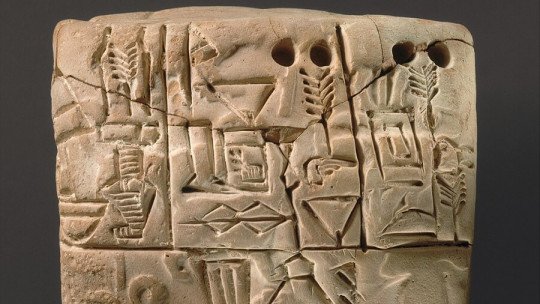
The question is more complex than it seems. Traditional historiography has pointed out Mesopotamia as the cradle of writing, since the earliest finds correspond to the city of Uruk: some clay tablets written in cuneiform alphabet.
However, the debate remains open. Because, although the Uruk tablets date from approximately 3,100 BC (that is, they are more than 5,000 years old), almost at the same time, in Egypt, the inhabitants of the land of the Nile began to express their ideas in the form of an incipient writing. hieroglyphic, as demonstrated by the famous Narmer palette, in which the name of the pharaoh is represented with two hieroglyphs, a fish and a chisel.
The point is that this palette, which has the oldest hieroglyphic inscription, dates back to around 3,050 BC, which makes it practically contemporary with the Uruk tablets. With so few years to spare, It is possible that the first writing occurred in Egypt and not in Mesopotamia (and that no testimonies have been preserved), or it may also be that both writings evolved in parallel.
How many of these have you been "meaning to read" for months?
- 1
 TyndaleThe Life-Changing Art of Self-Brain SurgeryConnecting Neuroscience and Faith to Radically Transform Your LifeListen Free On Audible
 - 2
 Thomas NelsonMaking Peace with What I Can’t ControlFind Relief from the Exhaustion of Overthinking, Trying to Fix Others, and Wanting to Figure It A...Listen Free On Audible
 - 3
 Beacon PressMan's Search for MeaningGreat product!Listen Free On Audible
The issue becomes even more complicated if we take into account the discoveries related to a very ancient culture called Yangshao, which lived in China around the year 4,500 BC. Among the vestiges, some signs have been found that seem to constitute one of the precedents of the current Chinese alphabet… which would mean, then, that China knew writing 1,000 years before Mesopotamia.
An administrative issue
Everything indicates that writing emerged simultaneously in several regions of the world that did not maintain any contact with each other, and that it evolved in parallel. So, we have to ask ourselves: What drove human beings from Mesopotamia, Egypt and China to materialize their thoughts?
The remains point to an eminently practical will.
Let’s return to the tablets of Uruk, one of the most important city-states of Sumerian culture, and which count as the oldest written manifestations (or, at least, for the moment). They are written in cuneiform alphabet, so called because the incision was made with a reed on the wet clay, the result being signs similar to wedges.
It is by no means a poetic or literary text, nor even a letter between family members. The tablets contain administrative and accounting information, evidently necessary in a civilization based on agriculture and commerce.
Therefore, we can affirm that the first written samples in Mesopotamia have the objective of keeping an exact order of the products and their inputs and outputs. Something similar must have happened in Egypt, since the first texts that we preserve are also related to administration (which the scribes were in charge of), as well as to the identification of places and characters. Writing was something sacred for these people. a gift sent by the gods that allowed them to grow as a civilization. For this reason, many of these ancient peoples have a writing god or goddess in their pantheon, such as the famous Egyptian Thoth, who is the one who grants the gift of writing to humanity.
What relationship exists between a sedentary lifestyle and writing?
If these ancient men and women needed to write down their possessions, it was evidently because a solid hierarchy was already established. And if this hierarchy existed it was, of course, thanks to human sedentarization, which arrived with the Neolithic.
By this we do not mean that there was not a certain hierarchy in the nomadic peoples of the Paleolithic, but it is indisputable that, once the communities settled and guaranteed their food through agriculture and livestock, the villages prospered and, with This led to a specialization of work that triggered the emergence of social groups.
Maybe without being sedentary we would never have started writing. Primitive human beings did not need to clearly and indelibly record their possessions, since nomadic societies tended to be communal. It was precisely during the rise of agriculture, livestock and, above all, commerce, when human beings realized the need to keep track of the comings and goings of their products and, especially, the riches that they entailed. In short: writing was born from sedentarization.
So why did it take humanity so long to write?
We can conclude that it took humanity more than 250,000 years to start writing because it also took a long time to settle in a place. Full sedentary lifestyle did not begin until about 10,000 years ago, with notable examples such as the site of Çatal Hüyük in present-day Turkey, whose oldest remains correspond to the 7th millennium BC, and Jericho, in what is now Palestine, whose first constructions date back to no less than the 8th millennium BC
The Neolithic was a true revolution which changed human life forever; Not only was it the time of the great domestication of species (both plants and animals), but it also led to the installation of tribes on a specific terrain and thus allowed the growth of a hierarchy and a society. The surpluses produced by the crops allowed the birth of an incipient trade that, over time, grew and needed writing to capture its evolution.
The answer, however, is not conclusive. There are some questions that cannot be clarified, such as, for example, whether Paleolithic paintings could constitute an ancient communication system. On the other hand, the first clear manifestations of writing in China correspond to those known as oracle bones, religious oracles from the 2nd millennium BC, so we should also include religion as a trigger for the appearance of the text. And religion was present in the Paleolithic communities, there is practically no doubt about that. So could cave paintings be an indecipherable communication code?
The debate remains open, like everything concerning this time so far away in the history of human beings. Older written manifestations may one day appear, but, for the moment, the most sensible thing is to think that writing was born as a result of a sedentary lifestyle, the result of the need to put in writing the assets of each group. And, precisely for this reason, the communal Paleolithic societies had no need to write.
Use this citation format to reference the article clearly and help readers find the original source.
PsychologyFor. (2024). Why Did it Take Humanity so Long to Invent Scripture?. PsychologyFor. https://psychologyfor.com/why-did-it-take-humanity-so-long-to-invent-scripture/