

See more of our articles in your search results.
Philosophy during the Middle Ages gave rise to a series of authors of extraordinary importance in their approaches.
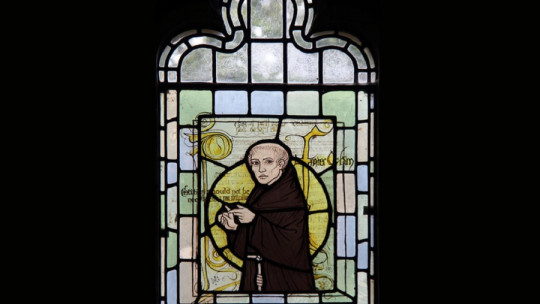
One of the most notable is undoubtedly William of Ockham, whose life and work we will learn about in detail throughout this article, so that we can get a general idea of the influence that this great intellectual had, both for his contemporaries and for others. upcoming authors. Let’s see a biography of William of Ockham in summary format.
Brief biography of William of Ockham
William of Ockham was born around 1985 (there are discrepancies regarding the exact date) in the English town of Ockham, for which he receives his nickname. It is a small town in the southeast of England. He received his education at the London House of Greyfriars, a convent belonging to the Franciscan order.
Subsequently, He attended the University of Oxford to train as a theologian He studied at this institution between the years 1309 and 1321. At that time, upon completing training in a specific area of study, one usually obtained the title of regent teacher, for which one could teach classes in that discipline, considering oneself an expert. in the matter.
However, William of Ockham did not achieve this accreditation. On the contrary, he was granted venerable beginner, a lower rank, which gave him the option of becoming a teacher, but maintaining the status of a student. In any case, he would later become a professor at the University of Paris.
How many of these have you been "meaning to read" for months?


Precisely during his time as a teacher at that institution, he was able to train other students who would become great thinkers, just like him, as was the case of Jean Buridan, a scholastic philosopher who in the future would maintain disagreements with the approaches of The works of William of Ockham.
Controversies with the Church
Throughout the Middle Ages, a series of Christian theological works were created that the Church assumed were fundamental. One of them was the Sentences of Peter Lombard, from the year 1150. It was common for theologians and thinkers to make reflections based on works like this. William of Ockham did the same, but his ideas were not liked by other authors, nor by the authorities of the Church.
So much so, that the comments he wrote on the Lombard Sentences led to the meeting of the bishops in a synod that led to the calling of a meeting with William of Ockham in the French city of Avignon, in 1324. After studying the case in depth, this type of court concluded that his ideas were far from the tenets of the Church Some even described him as a heretic.
The consequence of the ruling of this papal court was a four-year confinement in this city, while the Church deepened its investigation into his writings. This fact has generated discrepancies among some historians, since according to other sources, William of Ockham went to Avignon to teach philosophy classes at a Franciscan center.
Regarding this version, some authors affirm that the intention of said action would be to counteract the influence of the academics who taught the works of Thomas Aquinas. Precisely some of those followers were the ones who had made the accusation of heresy against William.
This second version of the events is based on the fact that, according to other sources, the papal court summoned William of Ockham, not in the year 1324 but in 1327, and that there was no ruling in this regard, much less a house arrest of several years.
Another fact that generated great friction between this author and the leaders of the Church was a work he carried out following a request from Miguel de Cesena, leader of the Franciscans. He asked William of Ockham to study the question of apostolic poverty, a topic that had generated a great debate between the Franciscans themselves and the pope, as well as other orders such as the Dominicans.
The Franciscans claimed that, just as the apostles and Jesus himself preached in poverty, representatives of the Church should do the same. This is what this order called the Rule of Saint Francis, which was not approved by other orders or by the Pope himself, which generated conflict between both parties.
William’s conclusions in this regard were not only supportive of his own order, but he also added that Pope John XXII was falling into heresy, which marked the total break between both figures.
Escape from Avignon and stage in Pisa
The friction that William of Ockham had had with the Church caused him, in 1328, to decide to permanently abandon the French city of Avignon heading towards the region of Pisa, in Italy, in the company of some Franciscans, among whom was Michael of Cesena himself.
Despite the delicate situation in which they found themselves, having as their enemy none other than the Pope of Rome and the highest spheres of the Church, these friars They found protection in Louis IV of Bavaria, king of Italy and emperor of the Holy Roman Empire This allowed William of Ockham to live in peace, without suffering reprisals, during his last period.
During these years, he spent his time creating new works on theology, philosophy, but also politics and law. After the death of his companion and friend, Miguel de Cesena, he assumed the leadership of his group of Franciscans, who had become dissidents after the conflict with Pope John XXII.
William of Ockham would spend his last years in a monastery of his congregation located in the German city of Munich. It is believed that his death occurred due to the Black Death disease. There are divergences regarding the date of her death, since some sources place it in the year 1347 and others in 1349.
Although his escape from Avignon had, among other consequences, his excommunication, the Church reinstated him a decade after his death since Pope John XXII had already died and Innocent VI was in office (there having been several popes between them).

Ockham’s razor
William of Ockham is considered to be one of the most influential thinkers of the entire medieval period, and the greatest exponent of nominalism, a philosophical movement that dates back to this time. The basis of nominalism is that there are no universal elements, but everything is particular. For this reason, it is sometimes also known as particularism.
Regarding the work of William of Ockham, probably the most important concept that he developed and for which he is universally known, is that of Ockham’s razor. This construct is also sometimes called the principle of parsimony or the principle of economy.
Ockham’s razor refers to the fact that, when trying to find out the reason for some issue, whatever its nature, and evaluating different alternatives that are on equal terms, the simplest of them will be more likely to be The correct one. In other words, The simplest explanation is also the most likely
Obviously, this approach is not irrefutable and does not imply a follow-up of the so-called scientific method. However, the simplicity and meaning of this proposed by William of Ockham made it quickly become a general rule when studying different issues and trying to find an explanation for each of them.
One of the problems that arise when studying Ockham’s razor is that it is not always easy to discern between the different levels of simplicity among the alternatives being considered, and therefore it may not be so easy to choose the option that represents the least complexity. , since no differences are found with one or other candidate theories.
Likewise, William of Ockham makes it clear that when using Ockham’s razor system and trying to choose the simplest alternative, the person must know that this is the one most likely to be correct, but that does not mean that it is for sure. Therefore, It will be a probabilistic question, but not exhaustive
The principle of Ockham’s razor has survived to this day and is frequently used in a whole series of areas, knowing that it does not always provide the correct answer, but it does in a high percentage of cases.
Use this citation format to reference the article clearly and help readers find the original source.
PsychologyFor. (2024). William of Ockham: Biography of This English Philosopher and Theologian. PsychologyFor. https://psychologyfor.com/william-of-ockham-biography-of-this-english-philosopher-and-theologian/