

The clock reads 2:47 AM and you’re still staring at the ceiling, mind racing through tomorrow’s responsibilities, replaying today’s conversations, or simply feeling frustratingly, inexplicably awake despite your exhaustion. You’ve tried counting sheep, rearranging pillows, and checking your phone—which you know makes it worse but the boredom and frustration are unbearable. Sleep feels like it should be the most natural thing in the world, yet here you are, night after night, struggling with something that happens effortlessly for others. Or maybe you fall asleep initially only to wake at 3 AM with your mind suddenly switched on, unable to return to the rest your body desperately needs. The next day arrives with its demands, and you face it foggy, irritable, and anxious about whether tonight will bring the same struggle.
If this experience feels painfully familiar, you’re far from alone. Sleep difficulties affect roughly one-third of adults regularly, with insomnia representing one of the most common health complaints worldwide. The causes vary—stress, anxiety, irregular schedules, excessive screen time, chronic pain, hormonal changes, or underlying sleep disorders—but the result is the same: lying awake when you desperately want to sleep, feeling increasingly frustrated and anxious, which paradoxically makes sleep even more elusive. This creates a vicious cycle where worry about not sleeping prevents the relaxation necessary for sleep to occur naturally.
What makes sleep particularly frustrating is that you cannot force it to happen. Unlike most goals where increased effort yields results, trying harder to sleep produces the opposite effect. Sleep requires a specific physiological and psychological state—the nervous system must shift from sympathetic activation (fight-or-flight) to parasympathetic dominance (rest-and-digest), the mind must quiet, the body must release tension, and a sense of safety and letting go must prevail. These conditions cannot be commanded into existence through willpower; they must be cultivated through practices that gently guide your system toward the relaxed state that allows sleep to arise naturally.
This is where relaxation techniques become invaluable. Rather than fighting sleeplessness directly, these practices work with your body’s natural systems to create the physiological and psychological conditions that promote sleep. They activate the parasympathetic nervous system, reduce cortisol and other stress hormones, quiet the mind’s incessant chatter, release physical tension, and create the sense of safety and calm that sleep requires. The techniques I’ll describe aren’t sleep aids in the pharmaceutical sense—they’re skills that, with practice, become increasingly effective tools for transitioning from wakefulness to sleep naturally and reliably.
What I’ve observed in my clinical work is that different techniques work for different people, and what works might vary depending on why you’re struggling to sleep on a particular night. Someone whose sleeplessness stems from physical tension might benefit most from progressive muscle relaxation, while someone with a racing mind might find cognitive techniques more helpful. The key is developing a repertoire of evidence-based techniques you can draw from depending on your needs. With practice, these methods not only help you fall asleep but also improve overall sleep quality, making the sleep you get more restorative and refreshing.
Progressive Muscle Relaxation
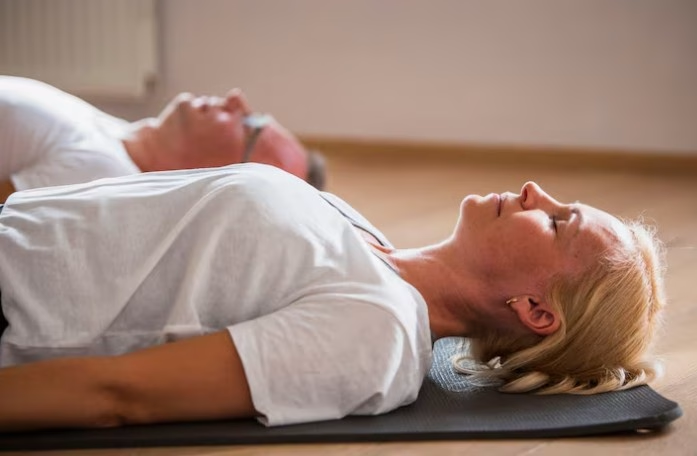
Progressive muscle relaxation, developed by physician Edmund Jacobson in the 1920s, remains one of the most effective and well-researched relaxation techniques for sleep. The method involves systematically tensing and then releasing different muscle groups throughout your body, creating a wave of physical relaxation that spreads from head to toe or vice versa. The practice works on the principle that you cannot be physically tense and mentally relaxed simultaneously—by deliberately releasing physical tension, you facilitate mental relaxation that promotes sleep.
The technique typically begins by lying comfortably in bed. Starting with your feet, you tense the muscles tightly for about five seconds—curling your toes, flexing your feet—then completely release the tension, noticing the sensation of relaxation that follows. You then move systematically through each body area: calves, thighs, buttocks, abdomen, chest, hands, arms, shoulders, neck, face. With each muscle group, you create tension briefly then release it completely, paying particular attention to the contrast between tension and relaxation. The entire sequence takes 10-20 minutes.
What makes progressive muscle relaxation particularly effective for sleep is that it gives your mind something specific to focus on, interrupting worry and rumination that often prevent sleep. The systematic attention to bodily sensations grounds you in the present moment rather than past regrets or future anxieties. Additionally, many people carry chronic muscle tension without realizing it—tension in shoulders, jaw, forehead, or abdomen that they’ve become so accustomed to they no longer notice. The deliberate tensing and releasing helps you recognize and release this habitual tension that might be maintaining arousal and preventing sleep.
Research demonstrates that progressive muscle relaxation significantly improves both sleep onset (how quickly you fall asleep) and sleep quality (how restful your sleep feels). Studies show it reduces the time to fall asleep by an average of 14 minutes and increases total sleep time. It’s particularly effective for people whose insomnia stems from stress, anxiety, or chronic pain conditions where muscle tension plays a role.
For optimal results, practice progressive muscle relaxation regularly, not just when you can’t sleep. Daily practice during the day helps you become familiar with what relaxation feels like, making it easier to achieve at night. As you become more skilled, you can often achieve deep relaxation without the tensing phase, simply scanning through your body and consciously releasing tension wherever you notice it. This abbreviated version works well when you wake during the night and need to return to sleep quickly.
Diaphragmatic Breathing

Breathing techniques for sleep leverage the direct connection between breath patterns and nervous system state. Slow, deep breathing from your diaphragm activates the parasympathetic nervous system, triggers the relaxation response, and counteracts the physiological arousal that prevents sleep. When you’re stressed or anxious, breathing becomes shallow and rapid, centered in the chest. Deliberately shifting to slow, deep diaphragmatic breathing signals your nervous system that it’s safe to relax.
Diaphragmatic breathing, also called belly breathing, involves breathing deeply enough that your abdomen expands rather than just your chest. To practice, lie comfortably with one hand on your chest and one on your abdomen. Breathe in slowly through your nose for a count of four, ensuring that the hand on your abdomen rises while the hand on your chest remains relatively still. Hold briefly, then exhale slowly through your mouth for a count of six to eight, feeling your abdomen fall. The exhalation should be longer than the inhalation—this extended exhale particularly activates the parasympathetic nervous system.
Continue this pattern for 5-10 minutes, keeping your attention focused on the sensations of breathing—the cool air entering your nostrils, your abdomen rising and falling, the feeling of release with each exhale. When your mind wanders to thoughts about tomorrow or why you can’t sleep, gently return attention to your breath without judgment. The breath serves as an anchor keeping you in the present moment rather than caught in the thoughts and worries that fuel insomnia.
The 4-7-8 breathing technique, popularized by Dr. Andrew Weil, represents a specific diaphragmatic breathing pattern particularly effective for sleep. Breathe in through your nose for four counts, hold your breath for seven counts, then exhale completely through your mouth for eight counts. Repeat this cycle four times initially, gradually increasing to eight cycles as you become comfortable with the technique. The extended hold and long exhale create powerful relaxation effects. Many people report falling asleep before completing the sequence.
Research shows that controlled breathing techniques reduce anxiety, lower blood pressure and heart rate, and significantly improve sleep quality. Brain imaging reveals that slow breathing deactivates arousal centers while activating regions associated with relaxation and emotional regulation. For people whose insomnia involves anxiety or an overactive mind, breathing techniques provide immediate, drug-free relief that improves with practice.
Body Scan Meditation

Body scan meditation, a mindfulness practice that involves systematically directing attention through different parts of your body, helps cultivate present-moment awareness while releasing physical and mental tension. Unlike progressive muscle relaxation which involves tensing muscles, body scan meditation uses only attention—simply noticing sensations in each body area without trying to change anything. This gentle, receptive awareness allows tension to naturally release as you observe it without judgment.
Begin by lying comfortably in bed, closing your eyes, and taking a few deep breaths. Starting with your left foot, bring your attention to any sensations present—warmth, coolness, tingling, pressure, or perhaps no particular sensation. You’re not trying to create sensations or change what you feel, just noticing with curiosity and acceptance. After 30-60 seconds, move your attention to your left ankle, then calf, knee, thigh, methodically progressing through every body part. When you notice tension, simply observe it with the same gentle curiosity you bring to neutral sensations.
As you scan through your body, you’ll inevitably notice your mind wandering to thoughts, plans, or worries. This is completely normal and expected. When you notice your attention has drifted, simply acknowledge it without self-criticism and gently return to whichever body part you were focusing on. This pattern of noticing distraction and returning to bodily sensations is actually the practice—it’s training your mind to stay present rather than ruminating on thoughts that prevent sleep.
The body scan typically takes 20-45 minutes to progress through the entire body, though you can adjust the pace. Many people fall asleep before completing the scan, which is perfectly fine when using this technique specifically for sleep. If you remain awake after completing the scan once, simply start over from the beginning. The repetitive, monotonous nature of systematically attending to each body part becomes almost hypnotic, naturally guiding your consciousness toward the threshold of sleep.
Research demonstrates that body scan meditation significantly improves insomnia, reduces sleep medication use, and enhances overall sleep quality. It’s particularly effective for people who struggle with racing thoughts or anxiety at bedtime. The practice teaches you to observe thoughts and sensations without becoming caught up in them—a skill that generalizes beyond sleep to help manage stress and anxiety throughout daily life. Regular practice actually changes brain structure, strengthening regions involved in attention and emotional regulation while reducing activity in the default mode network associated with mind-wandering and self-referential thinking.
Guided Imagery and Visualization

Guided imagery harnesses imagination to create deeply relaxing mental experiences that distract from worries while promoting the psychological and physiological state conducive to sleep. By vividly imagining peaceful, pleasant scenarios using all your senses, you engage your mind in a way that’s incompatible with the anxiety and rumination that often prevent sleep. Your nervous system responds to imagined experiences similarly to real ones—imagining yourself in a relaxing environment triggers actual relaxation responses in your body.
To practice, choose a place where you feel completely peaceful and safe. This might be a beach, mountain meadow, forest, or any real or imaginary location that feels deeply calming to you. Close your eyes and begin constructing this scene in vivid detail. What do you see? Perhaps gentle waves on a beach, sunlight filtering through leaves, or stars in a clear night sky. What sounds are present? Waves lapping, birds singing, wind rustling through trees. What physical sensations do you feel? Warmth of sun on your skin, coolness of grass beneath you, softness of sand. What scents are in the air? Salt water, pine trees, flowers.
The key is engaging all senses to make the imagery as vivid and immersive as possible. The more completely you can immerse yourself in this imagined peaceful place, the more effectively it occupies your attention and triggers genuine relaxation. When intrusive thoughts interrupt—and they will—simply notice them and gently return to your peaceful scene, perhaps adding more sensory details or exploring a different aspect of the environment.
Guided imagery recordings, available through apps or online, provide structured narratives that walk you through relaxing scenarios. These can be particularly helpful when you’re learning the technique because the external voice keeps redirecting your attention back to the imagery when your mind wanders. Over time, you’ll become more skilled at self-generating vivid relaxing imagery without external guidance. Many people develop a few favorite scenes they return to regularly, finding that these become increasingly powerful relaxation triggers with repeated use.
Research shows that guided imagery significantly reduces the time needed to fall asleep and improves subjective sleep quality. It’s particularly effective for people with anxiety or stress-related insomnia. Beyond sleep, regular imagery practice reduces overall stress levels and improves mood. The technique is safe, cost-free, and can be practiced anywhere without special equipment—just your imagination.
The 4-7-8 Breathing Method

While I mentioned the 4-7-8 technique briefly under diaphragmatic breathing, this method deserves special attention as one of the most powerful and popular breathing techniques specifically for sleep. Developed by integrative medicine physician Dr. Andrew Weil and based on ancient yogic breathing practices called pranayama, this technique can help you fall asleep in minutes with practice. The specific rhythm of breathing—4 seconds inhale, 7 seconds hold, 8 seconds exhale—creates profound physiological changes that rapidly shift your nervous system into a state conducive to sleep.
The practice is simple but requires precise execution for maximum benefit. Sit or lie comfortably with your tongue resting against the ridge behind your upper front teeth—it remains there throughout the practice. Exhale completely through your mouth, making a whooshing sound. Close your mouth and inhale quietly through your nose for a mental count of four. Hold your breath for seven counts. Exhale completely through your mouth for eight counts, again making a whooshing sound. This completes one cycle. Repeat for a total of four cycles initially.
What makes this technique particularly effective is the breath retention and extended exhalation. Holding your breath for seven seconds increases oxygen absorption and slows your heart rate, while the long exhale (twice as long as the inhale) maximally activates the parasympathetic nervous system and releases carbon dioxide. This combination creates immediate calming effects that accumulate with each cycle. Many people report feeling noticeably more relaxed after just four cycles.
When first learning 4-7-8 breathing, practice twice daily for four cycles each time, not just at night. Practice during the day helps you become skilled with the rhythm so it’s natural at night. After a month of twice-daily practice, you can increase to eight cycles per session. The technique becomes more powerful the more you practice it—initially it might take several minutes to feel effects, but with consistent practice, you may find yourself falling asleep after just one or two cycles.
The beauty of 4-7-8 breathing is its simplicity and portability. You need no equipment, special setting, or extended time. It works in bed, on a plane, or anywhere you need rapid relaxation. If you wake during the night, practicing a few cycles of 4-7-8 breathing often returns you to sleep quickly. Some people find the count of seven uncomfortable initially—if so, modify to a rhythm that feels manageable while maintaining the extended exhale, then gradually work toward the full 4-7-8 pattern.
Autogenic Training

Autogenic training, developed by German psychiatrist Johannes Schultz in the 1920s, involves using verbal formulae to induce specific physical sensations of heaviness and warmth throughout your body. By repeatedly focusing on statements like “my right arm is heavy” or “my legs are warm,” you create these sensations, which correspond to decreased muscle tension and increased blood flow—both markers of deep relaxation. The technique essentially trains your body to produce relaxation on command through the power of focused attention and suggestion.
A basic autogenic training session for sleep begins by lying comfortably in bed with eyes closed. You mentally repeat phrases focusing first on heaviness: “My right arm is heavy” (repeat 4-6 times), “My left arm is heavy,” “Both arms are heavy,” “My right leg is heavy,” “My left leg is heavy,” “Both legs are heavy,” “My arms and legs are heavy.” You then shift to warmth: “My right arm is warm,” progressing through the same sequence for arms and legs. Next, you might focus on your heartbeat: “My heartbeat is calm and regular,” and breathing: “My breathing is calm and relaxed.” Finally, you might add: “My forehead is pleasantly cool.”
The practice requires passive concentration—a relaxed, receptive attention rather than effortful focus. You’re not trying to make sensations happen but rather allowing them to emerge as you gently hold attention on the verbal formula. With practice, the sensations of heaviness and warmth become increasingly vivid and arise more quickly. What might take 15-20 minutes initially may eventually occur within a few minutes as your body learns the relaxation response associated with these formulae.
Research shows that autogenic training effectively treats insomnia, reduces anxiety, lowers blood pressure, and improves various stress-related conditions. It’s particularly effective for people who respond well to self-hypnosis or who struggle with techniques requiring sustained attention to breath or body sensations. The verbal formulae provide structure that some people find easier to follow than open-ended meditation techniques.
Like other relaxation methods, autogenic training benefits from regular practice. Daily sessions—ideally three times daily for 10-15 minutes when first learning—build skill and strengthen the relaxation response. Once you’ve mastered the basic formulae and can reliably produce sensations of heaviness and warmth, you can use abbreviated versions at night, perhaps focusing only on “Arms and legs heavy and warm, breathing calm, forehead cool” to quickly induce the relaxation that promotes sleep.
Mindfulness Meditation

Mindfulness meditation involves maintaining moment-to-moment awareness of thoughts, sensations, and emotions with an attitude of curiosity and non-judgment. For sleep, mindfulness practices help by interrupting the cognitive arousal—worry, planning, rumination—that often prevents sleep onset and causes middle-of-the-night awakenings. Rather than trying to suppress thoughts (which paradoxically makes them stronger), mindfulness teaches you to observe thoughts as temporary mental events that come and go, loosening their power to keep you awake.
A basic mindfulness practice for sleep involves lying comfortably and bringing attention to your breath—not controlling it, just observing it. Notice the sensation of air entering and leaving your nostrils, your chest or belly rising and falling, the slight pause between breaths. Your mind will inevitably wander to thoughts, memories, plans, or worries. When you notice this (and you will, repeatedly), simply acknowledge “thinking” or “worrying” silently, then gently return attention to breath. The noticing and returning is the practice—not staying perpetually focused but recognizing distraction and coming back.
What makes mindfulness particularly valuable for sleep is the attitude you cultivate toward your experience. Rather than judging yourself for not being able to focus or getting frustrated that you’re still awake, you practice accepting whatever is present with gentle curiosity. This non-striving, accepting stance is precisely what allows sleep to occur—the more desperately you try to sleep, the more you activate arousal systems that prevent it. Mindfulness teaches you to let go of trying, simply being present with whatever is, which paradoxically creates the conditions for sleep to arise naturally.
Mindfulness-Based Stress Reduction (MBSR) and Mindfulness-Based Therapy for Insomnia (MBTI) represent structured programs teaching mindfulness specifically for sleep and stress. Research shows these programs significantly reduce insomnia severity, improve sleep quality, and decrease the time needed to fall asleep. Brain imaging reveals that mindfulness practice deactivates the default mode network involved in self-referential thinking and worry while strengthening prefrontal regions involved in attention and emotional regulation.
Beyond sleep, regular mindfulness practice reduces overall anxiety and depression, improves emotional regulation, and enhances quality of life. The skills you develop for managing insomnia—observing thoughts without getting caught in them, accepting present experience without resistance—transfer to managing stress and difficult emotions throughout your day. Many people find that mindfulness meditation transforms not just their sleep but their entire relationship with their mind and experience.
Counting Techniques and Cognitive Shuffling

Simple counting techniques provide the mind with a monotonous task that occupies attention while being boring enough to allow sleep to occur. The classic “counting sheep” works on this principle, though many people find that more engaging variations work better. The key is choosing a counting task that’s just engaging enough to prevent worry and rumination but not so interesting that it maintains alertness.
Backward counting from a high number (like 1000) by odd intervals (sevens or threes) requires enough attention to prevent mind-wandering but becomes hypnotically dull, naturally guiding you toward sleep. As you count backward by sevens from 1000—1000, 993, 986, 979—your mind has just enough to do that it stops generating the worry and planning that prevent sleep. When you lose track (which you will), simply start over from 1000. The repetition and inevitable losing track and restarting enhance the monotony that promotes sleep.
Cognitive shuffling, a technique based on recent sleep science research, involves randomly generating words or images to occupy your mind. You might choose a random word like “bedtime,” then generate as many words as possible starting with B (blanket, balloon, bicycle), switching to E when you run out of B words (elephant, escalator, envelope), continuing through the word. Or you might visualize random, unconnected images every few seconds—a tree, then a bicycle, then a coffee cup, then a cloud—preventing your mind from constructing the logical narrative chains that maintain alertness.
The theory behind cognitive shuffling is that sleep onset involves a shift from logical, sequential thinking to fragmented, dream-like thought patterns. By deliberately generating random, unconnected content, you mimic the mental state that naturally precedes sleep, potentially triggering your brain to enter sleep mode. Apps like MySleepButton implement this technique, guiding users through random image generation designed to promote sleep onset.
While these techniques might seem simplistic, research suggests they can be surprisingly effective, particularly for people whose insomnia stems from an overactive mind. The key is finding the right level of engagement—interesting enough to prevent worry but boring enough to allow sleep. Different techniques work for different people, so experiment to find what engages your mind appropriately without being too stimulating.
Yoga Nidra

Yoga Nidra, often called “yogic sleep,” is a guided meditation practice that systematically relaxes the body and mind while maintaining a thin thread of awareness. Unlike regular sleep where you lose consciousness, Yoga Nidra keeps you in a state between waking and sleeping where deep rest and restoration occur. When practiced specifically for sleep, Yoga Nidra naturally guides you into actual sleep as awareness finally dissolves.
A typical Yoga Nidra practice begins with setting an intention (sankalpa) for your practice—perhaps simply “I will sleep deeply and wake refreshed.” You then lie in a comfortable position and follow guided instructions that systematically rotate awareness through different body parts, similar to body scan meditation but often with additional elements like breath awareness, visualizations, and awareness of opposite sensations (heaviness/lightness, heat/cold). The practice might last 20-45 minutes, during which you remain as still as possible.
What distinguishes Yoga Nidra from other relaxation techniques is its systematic approach to relaxing different dimensions of your being—physical, energetic, emotional, and mental. The practice might include awareness of breath, sensations, emotions, and thoughts, all held with the same attitude of witnessing without attachment. This comprehensive relaxation addresses multiple dimensions that might be maintaining arousal and preventing sleep.
Research on Yoga Nidra demonstrates significant benefits for sleep, anxiety, stress, and overall wellbeing. Studies show it improves both subjective and objective sleep quality, reduces anxiety and depression, and enhances sense of wellbeing. Brain wave studies reveal that Yoga Nidra creates unique states characterized by alpha and theta waves associated with deep relaxation while maintaining sufficient awareness that learning and psychological integration can occur.
For sleep purposes, Yoga Nidra works best with guided recordings specifically designed for sleep rather than learning the practice from instruction. Many apps and online platforms offer Yoga Nidra recordings of varying lengths. The guided voice keeps redirecting your attention through the practice, preventing the mind-wandering and worry that would otherwise occur. Many people report falling asleep during Yoga Nidra practice, particularly when using it regularly—this is perfectly appropriate when your goal is sleep rather than meditation practice itself.
The Military Method

The Military Method, reportedly developed to help soldiers fall asleep quickly even in challenging conditions, combines several elements of the techniques already discussed into a systematic protocol. The method claims to help you fall asleep within two minutes after six weeks of consistent practice, making it one of the fastest-acting techniques once mastered. While research specifically validating this method is limited, its components are all evidence-based relaxation techniques.
The protocol proceeds as follows: First, relax your entire face, including muscles inside your mouth, tongue, and jaw. Let your shoulders drop as low as they comfortably go, then relax your upper and lower arms one at a time. Breathe out and relax your chest, then your legs starting with thighs and moving down to calves, ankles, and feet. Spend about 10 seconds on each body area, consciously releasing all tension.
Once your body is relaxed, clear your mind for 10 seconds using one of three visualizations: imagine yourself lying in a canoe on a calm lake with clear blue sky above; imagine lying in a black velvet hammock in a pitch-black room; or repeatedly say “don’t think, don’t think, don’t think” for 10 seconds to prevent thought intrusion. The specific visualization matters less than finding one that works for you to maintain mental calm.
The key to the Military Method’s effectiveness is consistent practice. Just as soldiers reportedly require six weeks of nightly practice to achieve the two-minute sleep onset, you need regular practice for your nervous system to learn this rapid relaxation response. The first few nights might not produce dramatic results, but with continued practice, the sequence becomes increasingly automatic and effective.
What makes this method appealing is its comprehensiveness and simplicity. By combining progressive muscle relaxation, controlled breathing, and mental imagery into a streamlined protocol, it addresses multiple dimensions of arousal that prevent sleep. The structured, sequential nature provides clear steps to follow, which some people find easier than more open-ended meditation practices.
Paradoxical Intention

Paradoxical intention represents a counterintuitive approach borrowed from cognitive-behavioral therapy for insomnia. Instead of trying to fall asleep—which creates performance anxiety that prevents sleep—you deliberately try to stay awake. This reversal removes the pressure and anxiety around sleeping, paradoxically allowing sleep to occur naturally since you’re no longer fighting against it. The technique works by eliminating the sleep effort and anxiety that maintain insomnia.
To practice paradoxical intention, lie comfortably in bed with lights off but deliberately try to keep your eyes open and stay awake. Make this intention: “I’m going to stay awake and observe my thoughts and sensations.” Focus passively on staying awake without using stimulating activities—no reading, no screen use, no getting up. Simply lie there trying to remain aware and awake. Don’t actively fight sleep if it comes, but don’t pursue it either.
What typically happens is that without the anxiety and effort around falling asleep, your natural sleep mechanisms can operate unimpeded. Sleep often arrives within minutes once you’ve removed the performance pressure. The technique essentially treats insomnia as a goal-performance conflict—the harder you try to sleep, the more you activate arousal systems incompatible with sleep. By reversing the goal, you eliminate the conflict.
Research on paradoxical intention shows it effectively reduces sleep onset time and anxiety around sleep. It’s particularly helpful for people with psychophysiological insomnia—sleeplessness caused by conditioned arousal and anxiety specifically around sleep. For these individuals, the bed has become associated with frustration and wakefulness rather than with rest, and paradoxical intention helps break this association.
This technique can feel uncomfortable initially because it asks you to do the opposite of what seems logical. However, many insomnia sufferers report profound relief when they discover they can simply let go of trying to sleep. The practice teaches an important lesson about control—that sometimes the way to achieve something is to stop trying so hard to achieve it, allowing it to arise naturally when conditions are right.
Sound Therapy and Binaural Beats

Sound therapy for sleep includes various approaches from white noise to nature sounds to specifically designed binaural beats. These auditory interventions work by masking environmental sounds that might disrupt sleep, providing something constant for your mind to focus on, or entraining brainwaves toward frequencies associated with sleep stages. Different types of sound therapy work through different mechanisms and suit different preferences.
White noise—random sound containing all frequencies at equal intensity—masks other sounds that might wake you or prevent sleep onset. The consistent, monotonous quality of white noise also provides something neutral for your mind to attend to, preventing it from generating the thoughts and worries that prevent sleep. Pink noise, which emphasizes lower frequencies, is similarly effective and some research suggests it might enhance deep sleep and memory consolidation. Brown noise, even lower in frequency, many people find particularly soothing.
Nature sounds—rain, ocean waves, crickets, thunder, forest sounds—combine masking effects with the psychological benefits of imagining yourself in peaceful natural settings. Many people find nature sounds more pleasant than white noise while offering similar sleep benefits. The predictable, repetitive quality of these sounds has a hypnotic effect that naturally guides consciousness toward sleep.
Binaural beats involve playing slightly different frequencies in each ear—for example, 300 Hz in the left ear and 310 Hz in the right ear. Your brain perceives a third beat at the frequency difference (10 Hz in this example), which corresponds to alpha brainwave frequencies associated with relaxation. For sleep, binaural beats in the delta range (1-4 Hz) or theta range (4-8 Hz) theoretically entrain brainwaves toward patterns characteristic of deep sleep. While research on binaural beats is mixed, some studies show improved sleep quality and reduced anxiety.
Apps and devices offering sound therapy for sleep abound, from simple white noise generators to sophisticated programs combining binaural beats with other relaxation techniques. The key is finding sounds that you personally find soothing rather than irritating. What works varies tremendously between individuals—some people find any sound prevents sleep while others cannot sleep without it. Experiment with different options to discover what works for you.
When using sound therapy, set volume levels low enough that sounds are present but not prominent, and consider using a timer so sounds don’t play all night if that’s preferable. If using binaural beats, you must use headphones or earbuds for the effect to work since different frequencies must reach each ear separately.
Creating Your Personal Sleep Routine
While I’ve described twelve specific techniques, the most effective approach involves developing a personalized sleep routine that combines several methods suited to your particular sleep challenges and preferences. Consistency in practicing these techniques matters more than which specific techniques you choose—regular practice trains your nervous system to respond more quickly and effectively. As you develop your routine, you’ll find certain techniques work better for you than others, and what works might vary depending on why you’re having difficulty sleeping on a particular night.
A comprehensive evening routine might begin 60-90 minutes before bed with preparing your environment—dimming lights, reducing screen exposure, lowering temperature. 30-60 minutes before bed, you might practice progressive muscle relaxation or gentle yoga. As you get into bed, you might begin with 4-7-8 breathing for a few cycles, then transition to body scan meditation, guided imagery, or Yoga Nidra. If you’re still awake after 20-30 minutes, you might switch to paradoxical intention or cognitive shuffling rather than lying there frustrated.
The key principles for creating your routine include consistency (practicing at the same time nightly), progression (moving through your routine even if you don’t immediately feel sleepy), and flexibility (adjusting your approach based on what you need on a particular night). Track what works using a simple sleep log, noting which techniques you used and how your sleep was. Over time, patterns will emerge showing which approaches work best for you.
Remember that these techniques become more effective with practice. The first time you try progressive muscle relaxation or 4-7-8 breathing, you might not fall asleep quickly. But with consistent practice over weeks, your nervous system learns the relaxation response more readily, and techniques that initially took 20 minutes might eventually work within 5 minutes. Patience and consistency are crucial—stick with your chosen techniques for at least 2-4 weeks before concluding they don’t work for you.
FAQs About Relaxation Techniques To Sleep Well And Fast
How long does it typically take for relaxation techniques to start working for sleep?
This varies significantly depending on the technique, your consistency of practice, and the nature of your sleep difficulties. Some techniques like 4-7-8 breathing or progressive muscle relaxation might provide noticeable effects within the first few attempts, helping you fall asleep 10-20 minutes faster than usual. However, maximum benefits typically require 2-4 weeks of consistent nightly practice as your nervous system learns to respond more quickly to these relaxation triggers. Techniques like autogenic training or mindfulness meditation that require developing new skills generally take longer—4-8 weeks of regular practice—before becoming highly effective. The key is consistency: practicing techniques nightly, even when you’re not struggling with sleep, trains your body to respond more powerfully when you need these tools. Many people report that techniques that took 20-30 minutes to work initially eventually help them fall asleep within 5 minutes after several weeks of practice.
What should I do if I try a relaxation technique and I’m still awake after 20-30 minutes?
If you’ve been practicing a relaxation technique for 20-30 minutes without falling asleep, it’s generally better to get out of bed rather than lying there increasingly frustrated. Staying in bed while awake and frustrated strengthens the association between your bed and wakefulness, potentially worsening insomnia over time. Get up, go to a different room with dim lighting, and engage in a quiet, non-stimulating activity like reading, gentle stretching, or listening to calming music until you feel sleepy, then return to bed and try your relaxation technique again. This approach, called stimulus control, helps maintain the bed’s association with sleep rather than wakefulness. Additionally, consider whether you might need to try a different relaxation technique—what works varies between individuals and situations. If racing thoughts are the issue, cognitive techniques like cognitive shuffling might work better than body-focused techniques. If physical tension is the problem, progressive muscle relaxation might be more effective than breathing exercises.
Can I combine multiple relaxation techniques or should I stick to just one?
Combining techniques is not only acceptable but often more effective than using single techniques in isolation. Many people develop personal routines that flow through multiple techniques—perhaps starting with 4-7-8 breathing for a few minutes to initiate relaxation, then transitioning to progressive muscle relaxation, then finishing with guided imagery or body scan meditation. The key is creating a logical flow rather than randomly jumping between techniques. You might start with techniques that create physiological relaxation (breathing, muscle relaxation), then move to techniques that calm the mind (meditation, imagery). Alternatively, you might use different techniques for different purposes: breathing and body scan for falling asleep initially, then cognitive shuffling or paradoxical intention if you wake during the night. Experiment to find combinations that work synergistically for you. Just avoid making your routine so complex and time-consuming that it becomes burdensome—simplicity and consistency matter more than comprehensiveness.
Are relaxation techniques effective for people with diagnosed sleep disorders like sleep apnea or restless leg syndrome?
While relaxation techniques benefit anyone by promoting better sleep hygiene and stress management, they should not replace medical treatment for diagnosed sleep disorders. Conditions like obstructive sleep apnea, restless leg syndrome, narcolepsy, or periodic limb movement disorder have physiological causes requiring medical intervention—CPAP machines for sleep apnea, medications for restless leg syndrome, etc. That said, relaxation techniques can complement medical treatment by reducing the anxiety and stress that often accompany these conditions and by improving overall sleep quality. Many people with sleep disorders also develop secondary insomnia—difficulty sleeping that persists due to worry about their condition or conditioned arousal around bedtime—and relaxation techniques effectively address this component. If you suspect you have a sleep disorder beyond simple insomnia (signs include loud snoring, gasping during sleep, severe daytime sleepiness, irresistible urges to move your legs, or performing complex behaviors while asleep), consult a sleep medicine specialist for proper diagnosis and treatment. Use relaxation techniques alongside rather than instead of appropriate medical care.
Will relaxation techniques help if my sleep problems are caused by external factors like noisy neighbors or an uncomfortable mattress?
Relaxation techniques cannot override significant environmental sleep disruptors, and addressing those external factors should be your first priority. A truly uncomfortable mattress, extreme temperatures, loud noise, or excessive light will prevent good sleep regardless of relaxation skills. However, relaxation techniques can help you manage the increased arousal and stress that environmental disruptions create, allowing you to sleep despite less-than-ideal conditions. If you’re bothered by noise, combine sound therapy with relaxation techniques—white noise or nature sounds can mask disruptive sounds while the relaxation practice calms your nervous system. If mattress replacement isn’t immediately possible, relaxation techniques might help you manage the discomfort enough to sleep until you can address the problem. Think of relaxation techniques as one component of comprehensive sleep hygiene rather than a complete solution independent of environment. Optimize your sleep environment as much as possible, then use relaxation techniques to manage remaining challenges and the inevitable occasional situations where conditions aren’t perfect.
Use this citation format to reference the article clearly and help readers find the original source.
PsychologyFor. (2025). 12 Relaxation Techniques to Sleep Well and Fast. PsychologyFor. https://psychologyfor.com/12-relaxation-techniques-to-sleep-well-and-fast/