

You feel a persistent tingling in your feet that won’t go away, or your hands go numb during a long drive, and suddenly you’re googling symptoms late at night, wondering if something is seriously wrong. Maybe you’ve noticed your heart racing before a presentation, your palms sweating, your stomach twisting into knots, even though you know rationally there’s no real danger in the room. Or perhaps someone you love is living with a chronic condition like diabetes and has started losing sensation in their feet, a change that feels frightening precisely because it seems to be happening outside their control. These experiences, as different as they feel, all point back to one vast, body-wide communication network: the peripheral nervous system.
It’s genuinely disorienting when sensations like numbness, tingling, or an uncontrollable racing heart appear seemingly out of nowhere, especially because this network operates almost entirely below conscious awareness until something goes wrong. This can feel isolating for people managing chronic nerve-related symptoms, since friends and family sometimes struggle to understand a pain or numbness they cannot see, and it can be frightening for anyone newly diagnosed with a condition affecting nerve function outside the brain and spinal cord. Because the peripheral nervous system carries every sensory signal into the brain and every motor command back out to the body, disruptions here can affect movement, sensation, and even automatic processes like digestion and heart rate all at once. Understanding how this system is organized can turn confusing, disconnected symptoms into a coherent, manageable picture.
So how does a network of nerves stretching from your scalp to your toes manage to keep the brain constantly informed and the body constantly responsive?
This article explains the structure, parts, and everyday functions of the peripheral nervous system, along with what happens when it is damaged or disrupted.
What Is the Peripheral Nervous System and What Does It Do?
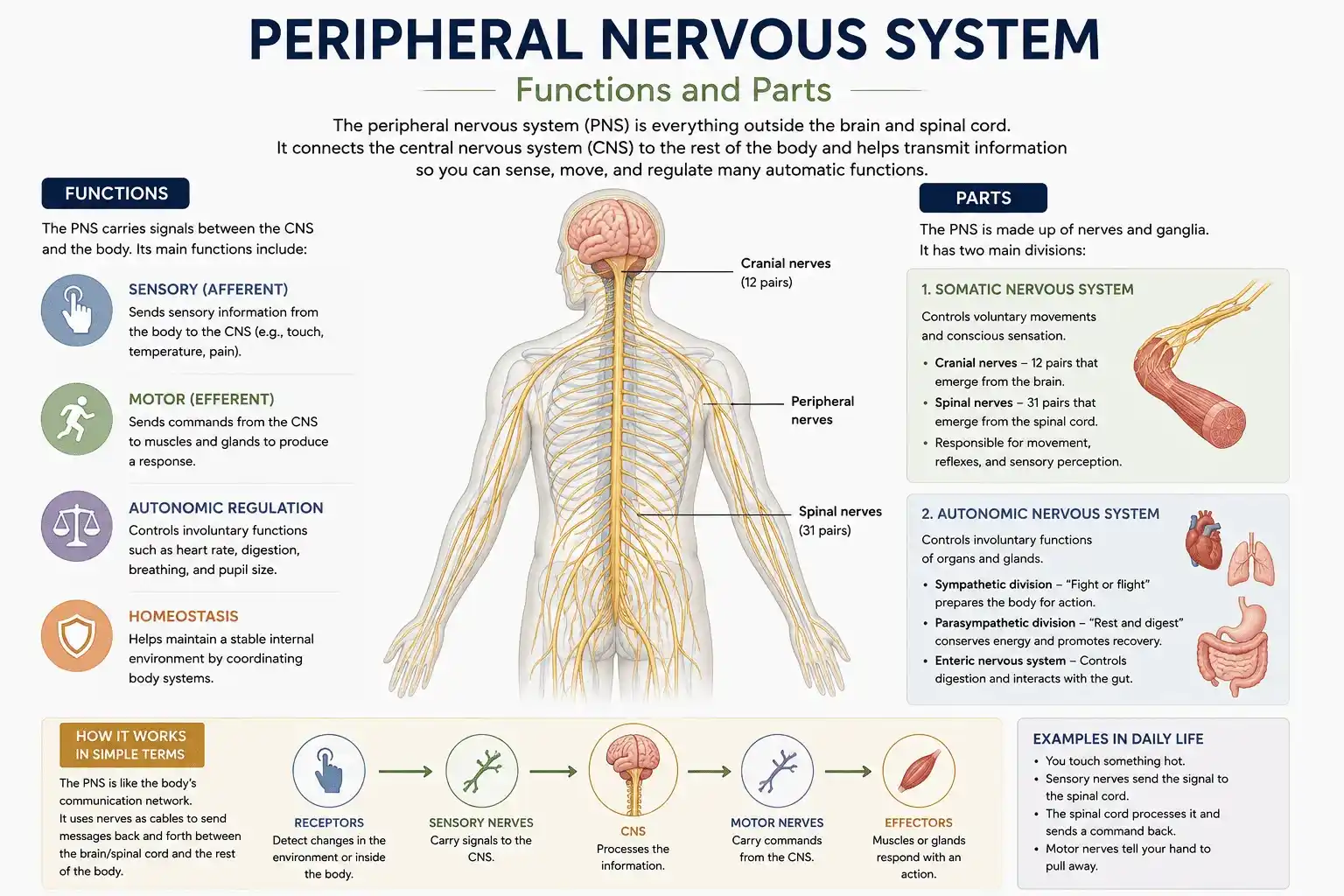
The peripheral nervous system, often abbreviated as the PNS, includes every nerve and ganglion located outside the brain and spinal cord. Its core job is to connect the central nervous system to the rest of the body, carrying sensory information inward and motor commands outward.
Think of the central nervous system as a command center and the peripheral nervous system as the vast network of cables carrying messages to and from that center. The PNS performs three essential jobs continuously: it relays sensory information from receptors throughout the body, including the skin, muscles, and internal organs, back toward the brain; it carries motor commands from the brain out to muscles, enabling voluntary movement; and it manages many involuntary bodily processes, like heart rate and digestion, that happen automatically without conscious effort.
Anatomically, the PNS is made up of billions of individual nerve cells organized into bundles called nerves, along with clusters of neuron cell bodies called ganglia, located just outside the central nervous system. Neuroscientist Santiago Ramón y Cajal’s foundational microscopy work established that these nerve cells function as discrete, individual units rather than one continuous, fused structure, a discovery that shaped the modern understanding of how signals travel through both the central and peripheral nervous systems.
Because the peripheral nervous system extends into nearly every tissue in the body, damage here tends to produce symptoms confined to a specific, traceable area corresponding to the affected nerve, which is genuinely useful for helping clinicians pinpoint exactly where a problem originates.
What Are the Main Structural Parts of the Peripheral Nervous System?
The peripheral nervous system is built from two major categories of nerves: cranial nerves and spinal nerves, along with the ganglia that support their function. Together, these structures form the physical wiring connecting the brain and spinal cord to the entire body.
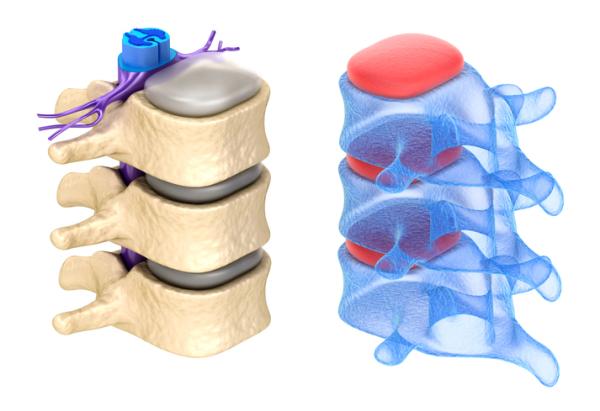
There are twelve pairs of cranial nerves, eleven of which belong to the peripheral nervous system, emerging directly from the brain to control sensation and movement in the head, face, and neck, along with several internal organs reached through the long-branching vagus nerve. There are also thirty-one pairs of spinal nerves, each emerging from the spinal cord at a specific vertebral level, carrying sensory and motor signals to and from a corresponding region of the body. This segmental organization explains why damage to a specific spinal nerve produces symptoms in a very particular, predictable strip of skin or muscle group, a pattern clinicians rely on heavily during physical examination.
- The cranial nerves control sensation and movement in the head, face, and neck, along with several internal organs.
- The spinal nerves carry sensory and motor signals to and from specific regions of the body based on their vertebral level.
- Clusters of neuron cell bodies called ganglia sit outside the central nervous system and support signal relay.
- Each peripheral nerve is protected by layered connective tissue, providing structural support for the delicate nerve fibers inside.
Physiologist Charles Sherrington’s extensive research on how signals pass between individual nerve cells helped establish the concept of the synapse, the communication gap present throughout both the peripheral and central nervous systems, clarifying how these various nerves ultimately transmit coordinated information despite being made up of many separate, non-touching cells.
How Does the Somatic Nervous System Control Voluntary Movement?
The somatic nervous system is the branch of the PNS responsible for voluntary, conscious control of skeletal muscles. Whenever you decide to walk, type, or wave hello, this system is carrying out that decision.
This system operates through two main pathways working in opposite directions. Motor, or efferent, nerve fibers carry commands from the brain and spinal cord out to skeletal muscles, triggering deliberate movement. Sensory, or afferent, nerve fibers carry information back from the skin, muscles, and joints toward the central nervous system, supporting conscious awareness of touch, temperature, and body position, a sense known as proprioception. This constant two-way communication is what allows you to reach for a cup of coffee without needing to look directly at your hand throughout the entire motion.
Because the somatic nervous system is under conscious, voluntary control, damage here often produces noticeable and immediately recognizable symptoms, such as weakness or an inability to move a specific muscle group, which typically prompts people to seek medical attention relatively quickly compared to more subtle autonomic symptoms. This visibility can actually work in a patient’s favor, since obvious motor symptoms tend to lead to faster diagnosis and treatment than the vaguer, harder-to-pin-down symptoms sometimes associated with autonomic nervous system dysfunction.
A practical takeaway: because the somatic nervous system relies on consistent sensory feedback to coordinate smooth, accurate movement, structured physical rehabilitation exercises that combine movement with sensory retraining often produce better outcomes than strength training alone following a somatic nerve injury.
How Does the Autonomic Nervous System Regulate Involuntary Functions?
The autonomic nervous system manages the body’s essential background processes automatically, without requiring conscious thought or effort. It governs functions like heart rate, digestion, breathing rate, and pupil size, adjusting them continuously based on the body’s changing needs.
Physiologist John Newport Langley, who coined the very term autonomic nervous system in the early twentieth century, helped establish that this system divides into two complementary branches working in opposition: the sympathetic and parasympathetic divisions. This structural insight remains the foundation of how modern medicine understands the body’s automatic regulation of internal organs, blood vessels, and glands. Pharmacologist Otto Loewi’s classic experiments further revealed that communication within this system relies on specific chemical messengers, identifying acetylcholine as a key neurotransmitter involved in parasympathetic signaling, a discovery that confirmed nervous system communication is chemical as well as electrical.
Unlike the somatic nervous system, autonomic dysfunction often produces symptoms that are harder to immediately trace back to the nervous system, such as unexplained changes in blood pressure, digestive irregularities, or abnormal sweating, since these processes normally happen so far outside conscious awareness. This subtlety is part of why autonomic dysfunction sometimes goes undiagnosed for longer periods than more obvious motor or sensory symptoms.
Recognizing that these automatic bodily processes have a clear neurological basis, rather than being vague or purely psychological complaints, can validate the experience of people living with conditions like postural orthostatic tachycardia syndrome or other forms of dysautonomia, encouraging more thorough medical evaluation.
Sympathetic vs Parasympathetic: How Do These Two Systems Work Together?
The sympathetic and parasympathetic nervous systems form the two opposing branches of the autonomic nervous system, working together to maintain a dynamic balance suited to the body’s changing demands. One mobilizes the body for action, and the other promotes rest and recovery.
Physiologist Walter Cannon’s influential research described how the sympathetic nervous system produces the well-known fight-or-flight response, rapidly increasing heart rate, redirecting blood flow toward muscles, and heightening alertness in reaction to a perceived threat. The parasympathetic nervous system works in the opposite direction, often summarized as “rest and digest,” slowing heart rate, stimulating digestion, and supporting the body’s recovery once a perceived threat has passed.
| Feature | Sympathetic vs Parasympathetic Nervous System |
| Primary role | Sympathetic: mobilizes energy for action; Parasympathetic: promotes rest and recovery |
| Heart rate effect | Sympathetic: increases heart rate; Parasympathetic: decreases heart rate |
| Digestive effect | Sympathetic: slows digestion; Parasympathetic: stimulates digestion |
These two systems rarely operate in complete isolation; instead, they exist in constant, shifting balance, with one typically dominating depending on the immediate situation. Chronic overactivation of the sympathetic branch, without adequate parasympathetic recovery, has been linked to a wide range of long-term physical health concerns, which is why structured relaxation techniques, like slow, diaphragmatic breathing, offer a genuinely evidence-supported way to actively engage the parasympathetic response during periods of acute stress.
What Is the Enteric Nervous System and How Does It Relate to the PNS?
The enteric nervous system is a specialized division of the peripheral nervous system embedded within the walls of the digestive tract, sometimes informally called the body’s “second brain.” It manages digestion largely independently, even without direct input from the brain.
This system contains hundreds of millions of neurons distributed along the esophagus, stomach, and intestines, coordinating the rhythmic muscle contractions that move food through the digestive system, a process called peristalsis. While the enteric nervous system can operate independently to a remarkable degree, it also maintains close, bidirectional communication with the central nervous system through the vagus nerve, part of the parasympathetic division of the autonomic nervous system, which is part of why emotional states like anxiety or stress can produce very real, physical digestive symptoms.
This connection, often referred to as the gut-brain axis, has become an increasingly active area of research, exploring how digestive health and nervous system function influence one another in both directions. Recognizing this connection can be genuinely validating for people who experience digestive symptoms during periods of emotional stress, since these physical sensations reflect real, measurable nervous system activity rather than an exaggerated or imagined response.
A practical takeaway: because the enteric nervous system responds so directly to autonomic input, stress-reduction practices that calm the broader nervous system, such as regular physical activity and consistent sleep, can meaningfully support healthier digestive function over time.
Today's Top Picks
Updated Daily


How Do Peripheral Nerves Transmit Signals and Support Repair?
Peripheral nerves rely on specialized supporting cells and structural features that allow for both rapid signal transmission and, unlike much of the central nervous system, a genuine capacity for repair after injury. This regenerative potential sets peripheral nerves apart in important, clinically meaningful ways.
Many peripheral axons are wrapped in a fatty insulating substance called myelin, produced by specialized support cells called Schwann cells, first described in detail by physiologist Theodor Schwann in the nineteenth century. This myelin sheath dramatically speeds up signal transmission and, importantly, provides a physical scaffold that can guide axon regrowth if a peripheral nerve is cut or crushed, a capability largely absent in the central nervous system. When a peripheral nerve is damaged, the portion of the axon beyond the injury typically degenerates in a predictable pattern, while Schwann cells help clear debris and form a pathway the regenerating axon can potentially follow back to its original target.
This regenerative capacity, while genuinely encouraging, is neither guaranteed nor typically fast; peripheral nerve regeneration proceeds at only about one to a few millimeters per day, meaning recovery from a significant nerve injury can take many months, and outcomes depend heavily on the severity, location, and type of damage involved.
A practical takeaway for anyone recovering from a peripheral nerve injury: consistent engagement in prescribed physical or occupational therapy exercises supports this natural regenerative process by keeping muscles responsive and encouraging accurate reconnection between regrowing nerves and their target tissues.
What Happens When the Peripheral Nervous System Is Damaged?
Peripheral nervous system damage produces a wide range of symptoms depending on which specific nerves are affected and whether the injury involves a single nerve or many nerves throughout the body. Common causes include diabetes, physical injury, autoimmune conditions, infections, certain medications, and chronic alcohol use.
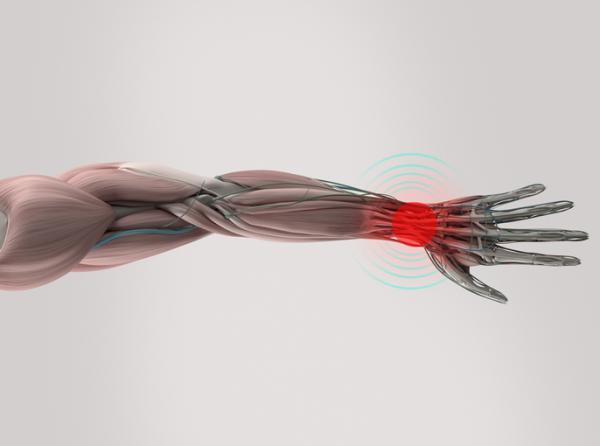
When damage is confined to a single nerve, the resulting condition is called a mononeuropathy, producing symptoms in a specific, traceable area corresponding to that nerve’s distribution, such as carpal tunnel syndrome affecting the median nerve at the wrist. When damage affects many nerves simultaneously throughout the body, the condition is called polyneuropathy, often producing symmetrical numbness, tingling, or weakness that typically begins in the feet and hands before potentially progressing further, a pattern commonly seen in diabetic neuropathy.
- Mononeuropathy affects a single nerve, producing symptoms in a specific, localized area.
- Polyneuropathy affects multiple nerves simultaneously, often causing symmetrical numbness or weakness.
- Autonomic neuropathy can disrupt heart rate, blood pressure, or digestion without obvious external symptoms.
- Diabetic neuropathy represents one of the most common causes of peripheral nerve damage worldwide.
Because peripheral nerve damage can present in such varied ways, ranging from sharp, localized pain to widespread, symmetrical numbness, a thorough medical evaluation, sometimes including nerve conduction studies, is essential for accurately identifying the underlying cause and guiding appropriate treatment.

How Are Peripheral Nervous System Disorders Diagnosed and Treated?
Diagnosing peripheral nervous system disorders typically combines a detailed physical examination with specialized nerve testing to pinpoint the exact location and nature of the problem. Because symptoms can overlap significantly between conditions, this structured evaluation process matters considerably for accurate diagnosis.
Nerve conduction studies and electromyography are the primary diagnostic tools for assessing peripheral nerve function, measuring how well electrical signals travel along specific nerves and how effectively muscles respond to that stimulation. Blood tests can help identify underlying causes like diabetes, vitamin deficiencies, or autoimmune conditions contributing to peripheral neuropathy, while imaging studies may be used when a structural cause, such as nerve compression, is suspected.
Treatment depends heavily on the underlying cause: managing blood sugar levels can slow the progression of diabetic neuropathy, physical therapy supports functional recovery after nerve injury, and specific medications can help manage neuropathic pain that does not respond well to standard pain relievers. For autonomic nervous system dysfunction, treatment often involves a combination of lifestyle adjustments, such as increased fluid and salt intake for certain blood pressure regulation issues, alongside targeted medication when appropriate.
- Seek prompt evaluation for any new numbness, tingling, or weakness, since early diagnosis often improves long-term outcomes.
- Request nerve conduction testing when symptoms suggest a specific, localized nerve problem rather than a more generalized cause.
- Manage underlying conditions like diabetes consistently, since this directly reduces the risk of progressive peripheral nerve damage.
- Engage in structured rehabilitation after a nerve injury, since consistent therapy supports the nervous system’s natural regenerative capacity.
How Does Peripheral Nervous System Function Change Across the Lifespan?
Peripheral nervous system function develops steadily through childhood and can show measurable, predictable changes in older adulthood. Understanding this trajectory helps distinguish typical aging from patterns that deserve closer medical attention.
In infancy and early childhood, ongoing myelination of peripheral nerves continues to improve the speed and coordination of both sensory processing and voluntary movement, which is part of why fine motor skills like handwriting continue developing well beyond the toddler years. In older adulthood, gradual, natural declines in nerve conduction speed can contribute to slightly slower reflexes and a modestly reduced sense of touch, distinct from any specific disease process. Chronic health conditions that become more common with age, particularly diabetes, substantially raise the risk of significant peripheral neuropathy, making consistent management of blood sugar and cardiovascular risk factors an important preventive strategy throughout adulthood.
Certain populations face distinct peripheral nervous system vulnerabilities: people undergoing certain chemotherapy treatments, those with autoimmune conditions, and individuals with long-term, poorly controlled diabetes all face elevated risk of nerve damage, underscoring the importance of regular monitoring and prompt reporting of new sensory or motor symptoms in these groups.
Practical strategies for supporting peripheral nervous system health across the lifespan include managing chronic health conditions proactively, avoiding excessive alcohol use, maintaining a balanced diet rich in essential vitamins, and seeking prompt medical evaluation for any persistent, unexplained numbness, tingling, or weakness rather than assuming it will resolve on its own.
FAQs about the Peripheral Nervous System
What is the main function of the peripheral nervous system?
The peripheral nervous system’s primary role is connecting the central nervous system to the rest of the body, carrying sensory information inward and motor commands outward. It enables voluntary movement through the somatic nervous system and regulates involuntary functions like heart rate and digestion through the autonomic nervous system. Because it extends into nearly every tissue in the body, the PNS is essential for both conscious action and the countless automatic processes that keep the body running smoothly. This dual role makes it one of the most extensive and functionally diverse networks in the entire body.
What are the two main divisions of the peripheral nervous system?
The peripheral nervous system divides into the somatic nervous system, which controls voluntary movement and conscious sensation, and the autonomic nervous system, which manages involuntary functions like heart rate, digestion, and breathing. The autonomic nervous system further divides into the sympathetic branch, which mobilizes the body for action, and the parasympathetic branch, which promotes rest and recovery. Some anatomists also describe the enteric nervous system, embedded in the digestive tract, as a distinct third division. Together, these divisions allow the body to manage both deliberate actions and essential background processes simultaneously.
What causes peripheral nerve damage?
Peripheral nerve damage, commonly called peripheral neuropathy, can result from a wide range of causes, including diabetes, physical injury, autoimmune conditions, certain infections, chronic alcohol use, and some medications, particularly certain chemotherapy drugs. Diabetes remains one of the most common underlying causes worldwide, since prolonged high blood sugar can gradually damage the small blood vessels supplying peripheral nerves. Symptoms typically include numbness, tingling, or weakness, often beginning in the feet and hands before potentially progressing further. Identifying and managing the underlying cause is essential for slowing or preventing further nerve damage.
Can peripheral nerves heal after injury?
Yes, peripheral nerves generally have a greater capacity for repair than nerves within the central nervous system, largely due to the supportive role of Schwann cells, which help clear debris and guide regenerating axons back toward their original targets. However, this regeneration process is typically slow, proceeding at only about one to a few millimeters per day, meaning full recovery from a significant nerve injury can take many months. The extent of recovery depends heavily on the severity, location, and type of nerve damage involved. Consistent engagement in physical or occupational therapy can meaningfully support this natural healing process.
How does the peripheral nervous system relate to stress and anxiety?
The peripheral nervous system’s autonomic division plays a central role in the body’s physical stress response, primarily through the sympathetic nervous system, which triggers the fight-or-flight response, producing a racing heart, rapid breathing, and heightened alertness. The parasympathetic nervous system works in the opposite direction, calming these physical responses once a perceived threat has passed. Chronic or repeated activation of this stress response without adequate recovery time can contribute to real, measurable physical health effects over time. Practices like slow, controlled breathing can help actively engage the parasympathetic system, offering a genuinely evidence-supported tool for managing acute stress and anxiety.
What is the difference between the somatic and autonomic nervous systems?
The somatic nervous system controls voluntary, conscious movement and processes sensory information from the skin, muscles, and joints, allowing deliberate actions like walking or typing. The autonomic nervous system, by contrast, manages involuntary functions that occur automatically, without conscious control, including heart rate, digestion, and pupil size. Damage to the somatic nervous system often produces immediately noticeable symptoms, like weakness in a specific muscle group, while autonomic nervous system dysfunction can cause more subtle symptoms, such as unexplained changes in blood pressure or digestion. Both systems work together continuously as part of the broader peripheral nervous system, even though they operate in fundamentally different ways.
Bibliography
- Cleveland Clinic. (2022). Peripheral Nervous System (PNS): What It Is & Function.
- Kenhub. (2015). Peripheral Nervous System: Anatomy, Divisions, Functions.
- MSD Manuals. (2026). Overview of the Peripheral Nervous System.
- Ramón y Cajal, S. (1899). Textura del Sistema Nervioso del Hombre y de los Vertebrados. Nicolás Moya.
- Sherrington, C. S. (1906). The Integrative Action of the Nervous System. Yale University Press.
- Cannon, W. B. (1932). The Wisdom of the Body. W.W. Norton & Company.
- Loewi, O. (1921). Über humorale Übertragbarkeit der Herznervenwirkung. Pflügers Archiv für die gesamte Physiologie.
- Langley, J. N. (1921). The Autonomic Nervous System, Part 1. W. Heffer & Sons.
- Schwann, T. (1839). Mikroskopische Untersuchungen über die Uebereinstimmung in der Struktur und dem Wachsthum der Thiere und Pflanzen. Sander’sche Buchhandlung.
Use this citation format to reference the article clearly and help readers find the original source.
PsychologyFor. (2026). Peripheral Nervous System: Functions and Parts. PsychologyFor. https://psychologyfor.com/peripheral-nervous-system-functions-and-parts/