

See more of our articles in your search results.
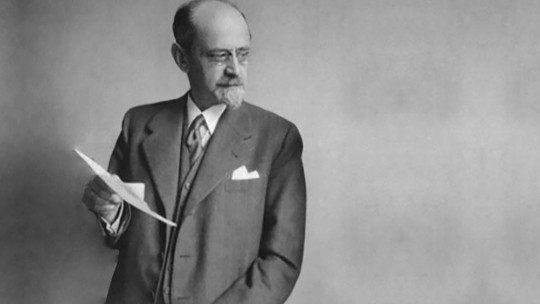
Who was Eugene Minkowski? He is a renowned French psychiatrist and philosopher, of Polish Jewish origin, born in 1885 and died in 1972. He is known above all for having incorporated phenomenology into psychopathology and French psychiatric knowledge.
In this article we will briefly review his biography: origin, personal life, academic and work career, contributions to the field of psychiatry and philosophy, some of his works, death and legacy.
Eugène Minkowski: who was it?
Eugène Minkowski was a French psychiatrist of Polish Jewish origin, who was born in Saint Petersburg (Russia), on April 17, 1885, and who died on November 17, 1972 in Paris (France), at the age of 87.
One of the greatest specialists in psychopathology in France, Eugène Minkowski (1885-1972), He was also one of the most recognized French psychiatrists in world psychiatry Furthermore, he is considered the founder of psychiatric phenomenology, along with Otto Binswanger, an important Swiss psychiatrist and neurologist.
Specifically, on November 25, 1922, his study called “A case of schizophrenic melancholy” was presented at the 63rd Conference of the Swiss Society of Psychiatry (Zurich), as well as a report on phenomenology, by Binswanger. These contributions They were key to calling Eugène Minkowski and Otto Binswanger the fathers of psychiatric phenomenology.
How many of these have you been "meaning to read" for months?


Eugène Minkowski’s ideas began to spread beyond Switzerland and France, and in 1958 they reached the United States, thanks to two other authors: Henri Ellemberger and Rollo May.
Origin
Eugène Minkowski was born into a Polish Jewish family. His father Augusto dedicated himself during his youth to developing the grain market in Saint Petersburg, where Minkowski was born. Minkowski is the second of four brothers.
In his childhood he turns out to be a brilliant student, and stands out for his interest in the political and social sphere.
Career and personal life
Eugène Minkowski’s family returns to Warsaw, with him. In those years (1905), Minkowski hesitated about what studies to pursue (whether mathematics, medicine or philosophy); Finally, however, he ends up studying medicine at the university in Warsaw with his older brother, Mietek. His choice has to do with his sensitivity and vocation to help people.
Minkowski finished his studies in 1908 and moved to Munich A year later he returns to Russia, specifically to Kazan. There he meets Rorschah and Françoise Trockman, his future wife, whom he marries in 1913. Françoise Trockman is a psychiatrist, also Jewish, and the daughter of Poles in Russia.
Françoise’s professional interests and concerns are similar to those of Minkowski. Françoise also makes great contributions; one of them is the introduction of the Hermann Rorschach test in France.
Career and influences
Another interesting fact about Minkowski’s career is that he was a student of Eugen Bleuler, a renowned Swiss psychiatrist. Specifically, Eugène Minkowski and Françoise Trockman, during the First World War, take refuge in Switzerland, where they do an “internship” at Eugen Bleuler’s clinic (specifically in Zurich). To Zurich the couple flees with Minkowski’s brother: Mieczysław.
It is in Bleuler’s clinic that Minkowski, as a clinic assistant, has the opportunity to think about whether he wants to specialize in psychiatry. Bleuler influenced Minkowski, who was very interested in Bleuler’s clinical practice. Another of the authors who influence him is Karl Jaspers; Through his (and other) influences, Minkowski tries to synthesize some knowledge of psychiatry and philosophy.
Later, in 1915, the couple settled in Paris. There Minkowski works at the Ville-Évrard asylum; Furthermore, he begins an investigation into “the essential elements of time and its quality.” Minkowski then enlisted as a military doctor in the French army, where he remained on the front line for two years.
In 1925 Eugène Minkowski, Françoise Trockman and Paul Schiff founded the group “L’Évolution psychiatrique”. It was a society through which a magazine of the same name was created, and which allowed the introduction of phenomenology and psychoanalysis in France.
On the other hand, Minkowski is influenced by phenomenological philosophy, logically (in the hands of Ludwig Binswanger and his existential analysis) and by the vitalist philosophy of the French-Jewish philosopher Henri Bergson. Other authors who influenced his work were Edmund Husserl, a German philosopher, and Max Scheler, also a German philosopher.
Contributions
As we have seen, Minkowski is known in the field of psychiatry for introducing phenomenology into psychopathology Currently, phenomenology is considered a philosophical school that analyzes observable phenomena and tries to explain being and its consciousness.
Another contribution of Minkowski was the notion of “lived time”; With this name he baptizes one of his great works, where he reflects his knowledge of phenomenology and psychopathology.
Minkowski’s schizophrenia
One of the great contributions of Eugène Minkowski was his reflection on schizophrenia The psychiatrist considered schizophrenia as a “problem générateur”, that is, as a generative disorder; He maintained that schizophrenia implied a loss of vital contact with reality, as occurs with autism.
According to Minkowski, schizophrenia was produced (verbatim): “by a deficiency in the sense of time and intuition, and by a progressive hypertrophy of the understanding of spatial factors”
If we go a little further back, we see how Minkowski tries to introduce phenomenology into his field of research on psychopathology and mental disorders. Thus, Minkowski tries to explain the experience of some patients (with schizophrenia, for example); Specifically, he focuses on those who suffered distortions in two areas or elements: time and space.
Thus, in 1927, Minkowski published his first research on the psychopathology of schizophrenia. To carry out this research he allows himself to be influenced by Bergson. He calls his work “La Schizophrénie.” It is the first book on schizophrenia written in French.
Some works
Some of the most notable works of Eugène Minkowski, which deal with topics of psychiatry, psychopathology, philosophy and phenomenology, were: “Schizophrenia: Psychopathology of schizoids and schizophrenics” (1927), “Treatise on psychopathology” (1966) and “Philosophy, semantics, psychopathology” (1969).
Other of his notable works, originally in French, are: Le Temps vécu. Étude phénoménologique et psychopathologiques (Paris: D’Artrey, 1933), La Notion de perte contact vital avec la réalité et ses applications en psychopathologia (Paris: Jouve, 1926), Vers une cosmologie (1936) and Écrits cliniques, (Eres, 2002 ).
In addition to his books, Eugène Minkowski published a large number of articles, also very diverse, which can be found in French, English, German, Spanish and Polish.
Death and legacy
Eugène Minkowski died in Paris on November 17, 1972, and at the age of 87 years. His death occurred accompanied by his daughter and some close friends.
The legacy Minkowski leaves is of great importance, especially for the field of psychopathology and phenomenology, and his contributions continue to be studied in medicine, psychology and other related sciences.
Use this citation format to reference the article clearly and help readers find the original source.
PsychologyFor. (2024). Eugène Minkowski: Brief Biography of This French Psychiatrist. PsychologyFor. https://psychologyfor.com/eugene-minkowski-brief-biography-of-this-french-psychiatrist/