

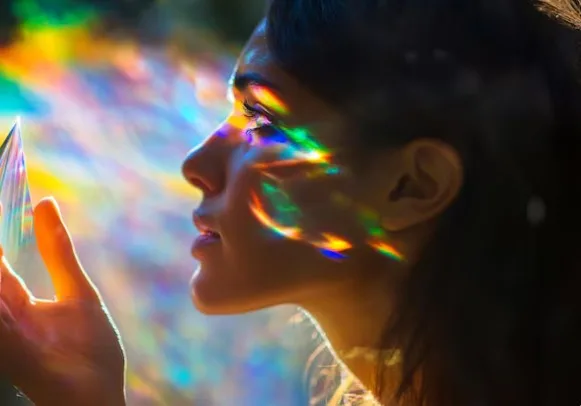
You’ve probably seen the quiz result, the app that promises to scan your selfie, or the friend at a wellness fair who squints at the space around your shoulders and says “oh, definitely violet.” Wanting to know your aura color usually comes from something completely relatable: a desire to understand yourself better, wrapped in a language that feels a little mystical and a lot more fun than a personality test. Curiosity isn’t the problem. The problem is that most explanations skip the actual psychology entirely.
This curiosity matters because it’s rarely just about the color itself. People chasing their aura are often chasing self-understanding, validation, or a sense of belonging to something a bit larger and more meaningful than daily routine. That’s a genuinely human impulse, and it deserves a real answer rather than either blind endorsement or dismissive eye-rolling. Whether or not auras exist as a measurable physical phenomenon, the psychological mechanisms behind why people believe they can perceive one, and why the results feel so personally accurate, are well documented and genuinely fascinating in their own right.
So how exactly are people supposedly identifying their aura color, and what’s really happening psychologically when they do?
This guide walks through the concept of auras, the honest scientific picture, and the practical, psychology-informed methods people use to explore the color of their aura through reflection rather than pseudoscience.

What Is an “Aura” Supposed to Represent?
An aura, in New Age and spiritual traditions, refers to a supposed field of colored energy surrounding a living being, believed to reflect that person’s emotional state, personality, or spiritual condition. It’s a concept with roots stretching across several esoteric and religious traditions, later popularized in Western culture through New Age spirituality during the twentieth century.
How many of these have you been "meaning to read" for months?



Different traditions describe the aura slightly differently, but the common thread is consistent: color supposedly reveals something meaningful about a person’s inner state, shifting as that state changes. Proponents often connect specific colors to specific emotional or spiritual qualities, similar in structure to how astrology assigns traits to zodiac signs. Neither framework has been validated by controlled scientific research, though both remain culturally popular precisely because they offer an appealingly simple system for self-understanding.
It’s worth stating plainly, and without judgment, that no peer-reviewed scientific evidence supports the existence of auras as a literal energy field visible to some people and not others. That doesn’t make the underlying curiosity foolish. It just means the more interesting, evidence-based story lives in psychology rather than energy fields.
| Spiritual Framing | Psychological Framing |
| Energy Field: A colored field believed to surround the body and reflect inner state. | Self-Perception Tool: A symbolic language people use to reflect on mood and identity. |
Is There Scientific Evidence Supporting Auras?
No controlled scientific study has ever demonstrated that auras exist as a physically observable energy field. Multiple formal investigations into aura perception have consistently failed to find evidence beyond what chance alone would predict.
Psychologist Ray Hyman, whose extensive career studying pseudoscience and paranormal claims made him one of the most respected skeptical researchers in psychology, has pointed out that claims of aura perception have never held up under properly controlled, blinded testing conditions. When self-described aura readers are tested without being able to see or interact with the person beforehand, their accuracy drops to chance levels. That’s a meaningful finding. It suggests the “reading” relies on visual, behavioral, and contextual cues rather than any literal energy field.
Skeptic and science communicator Michael Shermer, author of extensive work examining why people believe unsupported claims, has argued that aura belief persists not because of compelling evidence but because of deeply human cognitive tendencies: pattern-seeking, a desire for meaning, and the comfort of feeling truly seen. None of that makes believers foolish. It makes them human, operating with the same cognitive wiring everyone shares.
The Historical and Cultural Roots of Aura Belief
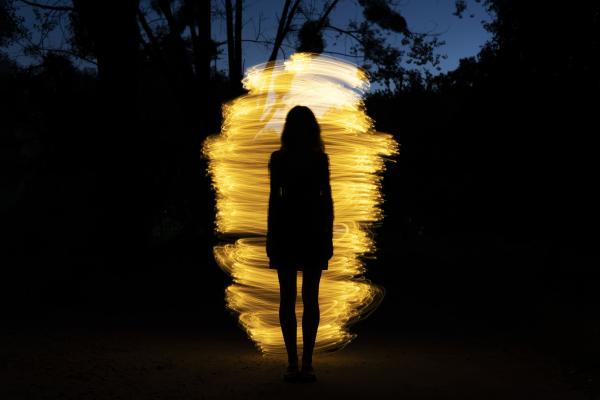
Aura concepts trace back centuries across multiple religious and philosophical traditions, though the specific color-coded system familiar today largely emerged from the Theosophical movement of the late nineteenth and early twentieth centuries. Understanding this history clarifies why the concept feels both ancient and distinctly modern at once.
Theosophist writers, including Charles Leadbeater, published detailed illustrated works describing supposed aura colors and their meanings, blending elements of Hindu and Buddhist energy concepts with Western esoteric traditions and early psychical research popular at the time. These publications were highly influential in shaping the visual and symbolic vocabulary still used in aura reading today, even though the underlying claims were never subjected to the kind of controlled testing modern psychology would require. That historical origin matters because it shows the aura color system as a specific cultural artifact with a traceable history, rather than a universal, ancient truth discovered independently across all cultures.
Similar energy concepts appear in other traditions too, including the Hindu concept of prana and the Chinese concept of qi, though these frameworks differ considerably in their specifics and cultural context. Recognizing these distinct origins helps separate genuine cultural and religious traditions, which deserve respect as belief systems, from the modern commercialized aura reading industry that often borrows loosely from multiple traditions without much regard for their original context or meaning.
The Psychology Behind Why People Believe They See Auras
Belief in aura perception connects to several well-documented psychological phenomena rather than a mysterious sixth sense. Understanding these mechanisms doesn’t diminish the experience; it explains it.
Psychologist Christopher French, who has spent decades researching the psychology of paranormal and anomalous experiences, has shown that visual afterimages, subtle eye fatigue, and even normal variations in peripheral vision can create the genuine visual sensation of a colored glow around a person or object, particularly under specific lighting conditions or after staring at a plain background. This isn’t imagination in a dismissive sense. It’s a real perceptual experience with an ordinary neurological explanation rather than a paranormal one.
Expectation also plays a significant role. Once someone is told to look for an aura, confirmation bias makes it easier to interpret ambiguous visual sensations as confirming evidence, especially in dim lighting or meditative states where visual processing already behaves somewhat differently than normal. Priming effects from prior exposure to aura imagery, colors associated with specific emotions in that person’s culture, and simple suggestion from a facilitator all shape what someone reports seeing, often without any conscious awareness that suggestion played a role at all.
- Visual afterimages and normal eye fatigue can produce genuine colored halo sensations around people or objects.
- Confirmation bias makes ambiguous visual sensations easier to interpret as meaningful once someone expects to see something.
- Cultural priming around color and emotion shapes which aura color a person reports experiencing or perceiving.

Common Aura Colors and Their Popular Meanings
Within aura reading traditions, specific colors carry consistent, if unverified, symbolic meanings that closely mirror broader cultural color associations with those same colors. These meanings function more like a shared symbolic vocabulary than a scientifically established system.
Red is commonly associated with passion, physical vitality, and intense emotion, sometimes interpreted as a sign of anger or urgency depending on context. Blue typically represents calm, communication, and emotional depth, aligning closely with mainstream color psychology research on how blue tends to lower physiological arousal. Yellow often signals optimism, intellect, or creative energy, while green connects to balance, growth, and connection with nature. Purple or violet, frequently described as a “higher” or more spiritually attuned color within these traditions, is often linked to intuition and imagination.
What’s genuinely interesting is how closely these meanings track with documented findings in mainstream color psychology research, even though aura theory itself lacks scientific support. Researcher Eva Heller’s large-scale survey work on color associations found strikingly similar emotional connections between color and psychological states, suggesting the aura color system may simply be repackaging real, broadly shared human associations with color into a spiritual framework.
Popular Methods People Use to “Determine” Their Aura Color
People typically identify their supposed aura color through one of several common approaches, none of which have been scientifically validated but all of which can offer genuine, if indirect, self-reflective value. Here’s a breakdown of the most common methods.
- Take an online quiz that maps personality traits, preferences, or current mood onto a specific color result, similar in structure to a personality test.
- Visit an aura photography booth, which uses a biofeedback sensor to translate skin temperature and moisture into a colored visual overlay on a photograph.
- Practice a guided meditation specifically designed to help you visualize or “sense” a color while in a relaxed, low-arousal mental state.
- Consult an aura reader, a practitioner who claims to visually perceive the color surrounding you during an in-person or photographed session.
Each method produces a color result through a different mechanism, and it’s worth being honest about what’s actually happening behind each one. Quizzes reflect self-reported personality traits mapped onto pre-assigned colors; meditation exercises often surface whatever color someone already associates with calm or their current mood; and aura photography, discussed in more detail further down, measures biometric data rather than any energy field.

The Role of Color Psychology in Aura Interpretation
Color psychology, the legitimate scientific study of how color influences mood, cognition, and physiological arousal, provides a genuinely useful lens for understanding why certain aura color assignments feel accurate to people. This research doesn’t validate auras. It explains the underlying color associations doing real psychological work.
Color researcher Angela Wright, developer of the Colour Affects System used in commercial and design psychology, has shown that specific colors reliably correlate with measurable shifts in mood and arousal across large populations, independent of any spiritual framework. Blue’s association with calm, for instance, holds up under controlled research conditions regardless of whether someone believes in auras at all. That consistency is precisely why aura color meanings often feel intuitively “right” to people: they’re built on genuine, well-documented color associations, just repackaged inside an unverified energy framework.
This overlap explains a lot about the whole phenomenon. When someone gets assigned “blue” as their aura color and feels that it fits, they’re likely responding to blue’s real, broadly shared psychological association with calm and depth, not to any actual energy reading. The color psychology is real. The energy field interpretation layered on top of it isn’t.
Why Aura Reading Feels So Personally Accurate
Aura readings, personality quizzes, and similar systems often feel eerily accurate because of a well-documented psychological phenomenon rather than genuine insight into hidden traits. That feeling of accuracy is real. Its source is not what people typically assume.
Psychologist Bertram Forer demonstrated this effect in a now-classic study, giving participants a generic, vague personality description supposedly generated just for them, and finding that nearly everyone rated it as remarkably accurate, even though every participant received the identical text. This phenomenon, now called the Barnum effect, explains why broad, flattering, or ambiguous statements about personality or spiritual color feel deeply personal even when they’re general enough to apply to almost anyone.
Aura color descriptions tend to be written this way deliberately, or at least conveniently: broad enough to fit most people, flattering enough to feel validating, and vague enough to allow generous interpretation. Recognizing the Barnum effect at work doesn’t make the experience meaningless. It just reframes where the meaning is actually coming from, which is your own interpretation rather than a mystical color reading.
Aura Photography: How the Technology Actually Works
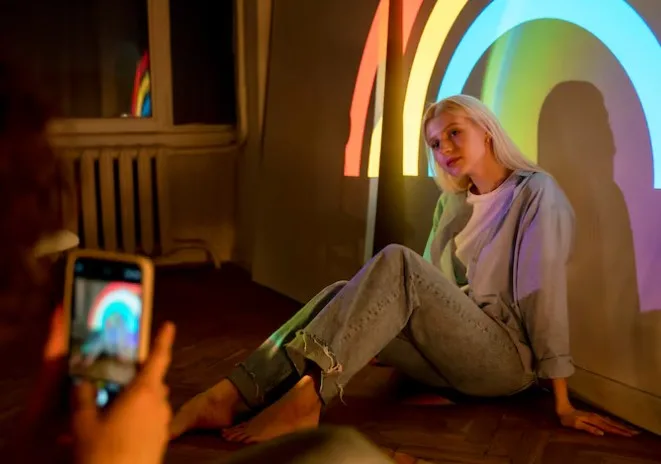
Aura photography, popularized through devices sometimes called Kirlian or biofeedback cameras, produces colorful images by measuring galvanic skin response, temperature, and moisture levels through hand sensors, then translating that biometric data into a colored overlay on a photograph. It’s a real technology. It just isn’t photographing energy.
These devices genuinely capture physiological data, including subtle changes in skin conductivity linked to nervous system arousal, which is a legitimate biofeedback measurement used in other clinical and research contexts entirely unrelated to auras. The color mapping applied to that data, however, is arbitrary, assigned by the software’s programming rather than derived from any established scientific relationship between skin conductivity and a specific hue. Two different aura photo companies can produce entirely different color results from identical physiological readings, which itself reveals the arbitrary nature of the color assignment process.
None of this means the experience is worthless as a novelty activity or a reflective moment. It just means the image reflects your nervous system’s arousal level in that specific moment, translated through someone’s chosen color-mapping system, rather than a photograph of a spiritual energy field.
When Curiosity About Auras Might Reflect Something Deeper
For most people, interest in aura color is simply lighthearted curiosity or a fun form of self-reflection, nothing more complicated than that. Occasionally, though, a strong need for this kind of external validation can point toward something worth examining more closely.
Magical thinking, the tendency to believe one’s thoughts, rituals, or symbolic actions can influence unrelated outcomes, is a normal part of human cognition and shows up in mild forms across nearly everyone, including habits like knocking on wood or having a “lucky” shirt. Psychologist Christopher French’s research on anomalous belief suggests that this tendency intensifies during periods of high stress, uncertainty, or major life transitions, when people naturally search for a greater sense of control or meaning. Wanting to know your aura color during a difficult period isn’t concerning on its own. It’s a completely understandable coping response.
It becomes worth a closer look specifically when reliance on aura readings, psychics, or similar practices starts replacing practical decision-making or professional support for genuine mental health concerns, rather than simply supplementing personal reflection. If you notice yourself making significant life decisions based primarily on aura or energy readings, especially during a period of anxiety or depression, that’s a reasonable moment to also reach out to a licensed therapist, who can offer support grounded in evidence-based practice alongside whatever meaning you find in more symbolic activities.

A Grounded, Reflective Alternative to Aura Reading
If what you’re really seeking through aura color is deeper self-understanding, there are evidence-based approaches that offer genuine insight without requiring belief in an unproven energy field. These alternatives tap into the same underlying desire for self-knowledge, just through more transparent mechanisms.
Psychiatrist Carl Jung’s work on symbolism and the unconscious mind offers a useful reframe here: colors, images, and symbols genuinely can carry personal psychological meaning, shaped by individual history and association, even without any literal energy field attached to them. Using color intentionally in reflective journaling, for instance, asking yourself what color best represents your current emotional state and why, taps into real self-awareness rather than pseudoscientific measurement. The reflection itself is where the actual value lives, regardless of whether you frame it spiritually or psychologically.
- Try a brief color-mood journaling exercise, noting which color feels representative of your emotional state each day and why.
- Use validated personality frameworks, like the Big Five model, for deeper self-understanding grounded in decades of empirical research.
- Approach aura activities as a fun, symbolic practice rather than a diagnostic tool, keeping the enjoyment without the pseudoscientific framing.
FAQs about How to Know the Color of Your Aura
Is there a real, scientific way to find out my aura color?
No, there is currently no scientifically validated method for determining an aura color, since controlled research has not demonstrated that auras exist as a measurable physical phenomenon. Popular methods like online quizzes, aura photography, and guided meditations can produce a color result, but these results reflect self-reported personality traits, biometric data like skin conductivity, or suggestion and expectation rather than an actual energy field. That doesn’t mean these activities are worthless as personal reflection tools, but it’s honest to understand that the “science” behind them isn’t peer-reviewed or empirically supported in the way legitimate psychological assessments are.
Why do aura descriptions often feel so accurate to the person receiving them?
This accuracy is largely explained by a well-documented psychological phenomenon called the Barnum effect, where vague, broadly applicable statements feel deeply personal because people naturally fill in specific details from their own lives and experiences. Aura color descriptions are often written to be flattering and general enough to resonate with almost anyone, which makes them feel remarkably precise even though the same description could apply to countless other people. This isn’t a criticism of anyone who finds these readings meaningful; it’s simply how human psychology processes ambiguous, personalized-sounding information, regardless of the framework being used.
Can aura photography actually detect something real about my body?
Yes, in a limited sense. Aura photography devices typically measure genuine physiological signals, such as skin temperature and galvanic skin response, which reflect nervous system arousal in that specific moment. These are legitimate biometric measurements used in other scientific and clinical contexts. However, the specific colors assigned to different readings are determined by the software’s programming rather than any established scientific link between a particular physiological state and a specific hue, meaning the colorful image itself doesn’t reflect a spiritual energy field, even though the underlying biometric data collection is real.
Does believing in auras mean someone is being irrational or gullible?
No, believing in auras reflects common, well-documented human psychological tendencies rather than a lack of intelligence or critical thinking. Pattern-seeking, a desire for meaning, and the comfort of feeling understood are universal human traits that make belief systems like aura reading appealing across many different types of people, including highly educated individuals. Psychological research into paranormal belief suggests it’s less about intelligence and more about specific cognitive styles, personal experiences, and the emotional needs a belief system fulfills, none of which make someone foolish for finding meaning in the practice.
What’s the difference between aura colors and color psychology?
Color psychology is a legitimate area of scientific research examining how colors influence mood, physiological arousal, and behavior, supported by controlled studies and measurable outcomes. Aura color theory borrows heavily from these same general associations, such as blue representing calm or red representing intensity, but frames them within an unproven spiritual energy field rather than psychological or physiological mechanisms. In other words, the color associations themselves often have a real basis in documented psychology, but the aura framework adds an unsupported metaphysical layer on top of that legitimate foundation.
Can I use color to learn something genuine about myself without believing in auras?
Absolutely, and this is arguably a more grounded way to get the self-reflective benefits people seek from aura reading. Reflective exercises like noting which colors you’re drawn to during different moods, using color intentionally in creative journaling, or exploring how specific colors make you feel in different environments can offer genuine psychological insight rooted in real color psychology research. Pairing this kind of reflection with evidence-based personality frameworks provides a more reliable, scientifically grounded path to self-understanding than relying on an unverified energy field interpretation.
Where did the specific color meanings used in aura reading actually come from?
Most of the specific color meanings used in modern aura reading trace back to Theosophical writers in the late nineteenth and early twentieth centuries, who published illustrated books describing supposed aura colors and their significance. These writers blended elements borrowed from Hindu and Buddhist energy concepts with Western esoteric and early psychical research traditions popular at the time. The resulting color system was influential enough to become the standard reference point still used by aura readers, quiz creators, and photography booths today, even though it was never validated through controlled scientific testing and represents one specific historical tradition rather than a universal discovery.
Is it unhealthy to be interested in aura colors or similar spiritual practices?
Not inherently, no. For most people, curiosity about auras, astrology, or similar symbolic systems functions as a harmless, even enjoyable form of self-reflection and cultural participation, similar to reading a horoscope for entertainment. This becomes worth examining more closely only if reliance on these practices starts replacing practical decision-making, professional medical or mental health care, or if the interest intensifies noticeably during a period of significant anxiety or distress. In those specific cases, the underlying stress or need for certainty is usually the more important thing to address, with a therapist or counselor, rather than the aura interest itself.
Bibliography
- Hyman, R. (1985). The ganzfeld psi experiment: A critical appraisal. Journal of Parapsychology, 49(1), 3-49.
- Shermer, M. (1997). Why People Believe Weird Things: Pseudoscience, Superstition, and Other Confusions of Our Time. W. H. Freeman.
- French, C. C., & Stone, A. (2014). Anomalistic Psychology: Exploring Paranormal Belief and Experience. Palgrave Macmillan.
- Forer, B. R. (1949). The fallacy of personal validation: A classroom demonstration of gullibility. Journal of Abnormal and Social Psychology, 44(1), 118-123.
- Heller, E. (2009). Psychologie de la couleur: Effets et symboliques. Pyramyd.
- Wright, A. Colour Affects: The Psychological Properties of Colours. Colour Affects Ltd.
- Jung, C. G. (1964). Man and His Symbols. Doubleday.
- American Psychological Association. (2022). Understanding Pseudoscience and Critical Thinking. APA Publications.
Use this citation format to reference the article clearly and help readers find the original source.
PsychologyFor. (2026). How to Know the Color of My Aura. PsychologyFor. https://psychologyfor.com/how-to-know-the-color-of-my-aura/