


See more of our articles in your search results.
You woke up with every intention of going out. Maybe there was a simple errand to run, a friend waiting for a message that said “on my way,” or just a vague but genuine plan to step outside and breathe some air. And then—nothing. A wall. A weight. The couch held you a little too firmly, the outside world seemed just a little too loud and unpredictable, and before you made a single move toward the door, you had already quietly negotiated your way out of it. “Tomorrow,” you told yourself. And then tomorrow came, and so did the same wall.
If this feels familiar, the first thing worth knowing is this: you are not broken, and you are not alone. The feeling of not wanting to leave the house is one of the most common experiences that psychologists and therapists hear about—from people of all ages, all backgrounds, and all walks of life. It can be rooted in anxiety, in depression, in burnout, in sensory overload, or simply in the quiet accumulation of a life that has gradually moved indoors. Sometimes it’s a passing phase that lifts on its own. Sometimes it becomes a pattern that quietly narrows your world, week by week, without you fully noticing.
The human brain is wired to seek safety, and home is the most reliable source of it. There is nothing strange about wanting to stay somewhere that feels predictable and controlled. But when that preference hardens into avoidance—when fear, not rest, is what keeps the door closed—it can begin to affect your mood, your relationships, your health, and your sense of who you are. Research consistently links prolonged social isolation to higher rates of anxiety, depression, and diminished physical well-being. The outside world, for all its noise and unpredictability, contains things the interior of a home simply cannot provide: sunlight, movement, unexpected connection, and the steady, grounding reminder that life continues and that you are part of it.
This article explores the psychological roots of not wanting to leave the house, examines the different forms it can take, and offers six practical, evidence-based strategies to help you gently move from avoidance toward re-engagement—at your own pace, without pressure, and with genuine compassion for where you are right now.
Why the Outside World Can Feel Impossible Some Days
Before reaching for solutions, it’s worth sitting with the question of why. Not to over-analyze or spiral—but because the path forward looks very different depending on what’s actually keeping you inside. The experience of not wanting to leave the house is not a single, uniform thing. It has many faces, many roots, and many gradations of severity. Recognizing yours is the first genuinely useful step.
How many of these have you been "meaning to read" for months?


Anxiety and Anticipatory Fear
For some people, the resistance to leaving home is driven by anxiety—specifically, the kind that arrives before anything has even happened. A thought forms: What if something goes wrong? What if I run into someone and don’t know what to say? What if I have a panic attack in public and can’t escape? These thoughts don’t need to be rational to be powerful. The brain processes anticipated threat almost identically to real threat, which means the discomfort of imagining going outside can feel nearly as intense as an actual danger. In more pronounced cases, this pattern can develop into agoraphobia—a condition characterized by intense fear of being in situations where escape might be difficult or help unavailable—which affects far more people than is commonly assumed.
Depression and the Weight of Low Motivation
Depression is a pervasive thief. It doesn’t just lower mood—it saps energy, flattens interest, slows thinking, and makes even the smallest tasks feel as though they require extraordinary effort. Getting dressed and walking out the front door can genuinely feel as demanding as running a marathon when depression is present. The cruelest part is that isolation tends to deepen depression over time, creating a feedback loop that becomes harder and harder to interrupt from the inside. This is not a character flaw or a lack of willpower. It is a recognized clinical reality, and it responds to treatment.
Burnout and the Need to Withdraw
Modern adult life is relentless. Deadlines, responsibilities, digital demands that follow you into every room of your house, the permanent low hum of having too much to do and never quite enough time to do it. For people experiencing burnout, staying home is not laziness—it’s an involuntary withdrawal response, the nervous system’s way of signaling that it has reached its limit. The problem is that withdrawal, while it can provide short-term relief, doesn’t actually address what caused the depletion. And so the relief is temporary, but the habit of avoidance can outlast it.
The Comfortable Trap of Familiarity
Home is safe. Every corner of it is known, controlled, and free from the social demands and sensory unpredictability of the outside world. For some people—particularly those with introverted temperaments or heightened sensitivity to stimulation—the contrast between the comfort of home and the demands of the outside world gradually widens until leaving feels like crossing a very large gap. This isn’t necessarily a clinical condition. But it can quietly shrink a person’s life if left unexamined.
The Digital World’s Quiet Role
Remote work, food delivery, streaming platforms, online shopping, social media—the infrastructure of modern life has made it entirely possible to meet most of your practical needs without stepping outside. Convenience is genuinely wonderful, right up until it becomes a form of avoidance you didn’t notice building. When everything necessary can be done indoors, the motivation to go out has to come from somewhere else—from desire, from curiosity, from the knowledge that something valuable exists beyond your front door. And when motivation is already low for other reasons, that argument doesn’t always win.
6 Practical Tips to Help You Leave the House Again
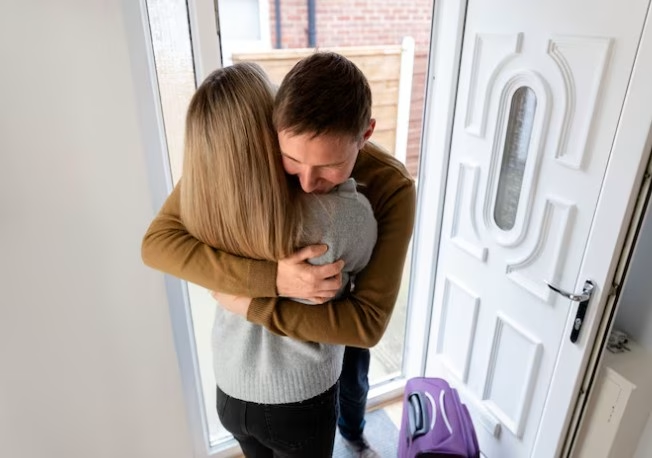
1. Make the First Step Absurdly Small
When the prospect of “going out” feels like a monumental undertaking, the most effective thing you can do is remove the monumental part. The goal is not a productive errand, a meaningful social outing, or a brisk thirty-minute walk. The goal is simply: outside.
Walk to the end of your path and back. Sit on your front step for five minutes. Open the front door and stand in the doorway for a moment, letting the air hit your face. These micro-outings are not consolation prizes for failing to do something bigger—they are the actual work. In clinical psychology, this approach is known as graded exposure: repeated, manageable contact with something that triggers avoidance, just enough to prevent the fear response from escalating, gradually teaching the nervous system that the outside world is survivable.
The genius of starting small is that it sidesteps the anticipatory dread. You’re not committing to anything impressive. You’re just opening a door. And then, with enough repetitions, opening a door becomes ordinary again.
2. Talk to Your Own Mind More Carefully
The internal monologue that plays before you try to leave the house matters enormously. Avoidance is often sustained not by what is happening, but by the story the mind tells about what will happen. It will be too much. I won’t cope. I’ll look strange. Something will go wrong. These thoughts feel factual. They are not.
Cognitive reframing doesn’t mean replacing honest difficulty with false positivity. It means examining the thought and asking: is this accurate, or is this anxiety narrating? Try shifting the language:
- Instead of “I can’t handle being out there,” try “I’ve handled uncomfortable situations before, and I can handle a few minutes of this.”
- Instead of “It’s too hard today,” try “I don’t have to enjoy it. I just have to do it once.”
- Instead of “I have no energy for this,” try “I’ll go as far as I can and turn back whenever I need to.”
The shift is subtle, but it changes the relationship between you and the task. You are no longer predicting failure. You are simply leaving the verdict open—which is, importantly, a more honest position.
3. Attach Leaving to Something That Already Matters to You
Abstract motivation—”I should go out because it’s good for me”—rarely gets people off the couch. Specific, personally meaningful motivation does. Link going outside to something you actually want, rather than something you think you ought to want.
This might look different for everyone:
- A specific coffee you can only get from a particular café a few blocks away
- A podcast episode you’ve been saving, reserved exclusively for outdoor walks
- A bookshop you like wandering through, with no pressure to buy anything
- A park bench in a spot that’s reliably quiet in the morning
The point is that the outing becomes tied to something your brain associates with reward, rather than effort or obligation. Over time, this builds a genuinely positive association with going outside—which is something the avoidance loop steadily erodes and needs to be deliberately rebuilt.
4. Bring Someone With You
Humans are profoundly social animals, and the simple presence of another person can transform the emotional experience of an otherwise daunting situation. There is a reason that accountability partners work in nearly every context where behavior change is difficult: other people make hard things feel more possible, both because their company is genuinely regulating to the nervous system and because the social commitment creates a gentle external structure that is harder to talk yourself out of.
This doesn’t have to be a big arrangement. A text to a friend that says “I’m going for a walk, want to come?” or even “I’m trying to get out more—can we do a short one tomorrow?” is enough. Knowing that someone is expecting you, or simply walking beside you, changes the calculus of avoidance. And if going out with someone feels easier than going alone, lean into that. There is no extra credit for making things harder than they need to be.
5. Build a Bridge Between Indoors and Out
For some people, the difficulty isn’t specifically the outside world—it’s the abruptness of the transition. Going from the quietness and control of home to the full sensory experience of being out in the world can feel like a shock to the system, particularly for those with heightened sensitivity or anxiety.
A transition routine creates a gradual bridge between the two states:
- Begin by opening the curtains and sitting in natural light for a few minutes
- Move to an open window, letting the outside sounds and air reach you without requiring you to step into them
- Sit on a balcony, porch, or doorstep—still technically “home,” but at the threshold
- Take a short, unambitious walk around the immediate area, with no particular destination
This graduated approach respects the nervous system’s need for predictability while gently expanding what feels familiar. The outside world stops being a jarring contrast and gradually becomes a natural extension of your environment. That shift doesn’t happen overnight, but it does happen.
6. Take the Underlying Cause Seriously
All of the above strategies assume that what you’re dealing with is primarily a habit or a motivational challenge. But sometimes, it’s more than that. Sometimes the difficulty leaving the house is a symptom of something that warrants real clinical attention—an anxiety disorder, a depressive episode, a trauma response, or a developing pattern of agoraphobia that will not resolve through gentle self-encouragement alone.
Seeking professional support is not an admission of defeat. It is the most direct and honest response to what’s actually happening. A psychologist or therapist can offer approaches that are specifically designed for this kind of struggle:
- Cognitive-behavioral therapy (CBT), which directly addresses the thought patterns and behavioral cycles that sustain avoidance
- Exposure and response prevention (ERP), a structured, evidence-based method for gradually reducing fear responses
- Mindfulness and somatic approaches that work with the nervous system’s physiological response to perceived threat
- Psychiatric consultation when medication might provide meaningful relief alongside therapeutic work
Mental health challenges are normal human experiences. They do not indicate weakness, and they respond to treatment. Reaching out for support—whether to a therapist, a GP, a crisis line, or a trusted person in your life—is one of the most resilient things a person can do.
The Difference Between Chosen Rest and Fear-Driven Avoidance

It would be a significant distortion to suggest that staying home is always a problem. It isn’t. Rest is not avoidance. Solitude is not isolation. Choosing a quiet evening at home over a social commitment you don’t have the energy for is not something to pathologize—it is something to honor. The body and mind both need periods of recovery, and a life that includes deliberate, chosen rest is a healthier life.
The meaningful distinction is between choice and compulsion. When you stay home because you genuinely want to restore yourself, you’re practicing self-care. When you stay home because the thought of going out produces dread or panic, and you organize your life around avoiding that feeling, that’s avoidance—and it tends to grow over time, not shrink.
Asking yourself honestly which dynamic is operating is not always comfortable. But it is always useful.
What Culture Tells Us About Staying Inside
The experience of not wanting to leave the house is not culturally neutral. In Japan, the phenomenon known as hikikomori—in which individuals withdraw from social life entirely, sometimes for years—has been studied and discussed as a cultural as well as psychological phenomenon. It is associated with social pressure, shame, and the particular demands of a highly performance-oriented society. But versions of it exist everywhere, in different shapes and under different names.
In many Western cultures, staying home is quickly interpreted as laziness or disengagement—a judgment that adds shame to an experience that already carries enough weight. From a psychological standpoint, what looks like withdrawal is almost always a coping response: an attempt, however imperfect, to manage something that feels unmanageable. That reframing doesn’t excuse avoidance from becoming a long-term pattern, but it does replace judgment with understanding—which is a far more useful starting point for change.
Wherever you are in the world, and whatever the cultural script around this experience in your context, what matters most is the specific impact on your life, your relationships, and your sense of self. That is the only measure worth attending to.
Things to Say to Yourself When the Door Feels Heavy
Sometimes what’s needed is not strategy but permission. A small, honest phrase that helps you override the avoidance narrative long enough to take one step. These aren’t affirmations in the glossy, unrealistic sense—they’re just more truthful alternatives to the thoughts that keep you stuck:
- “I don’t have to enjoy this. I just have to do it once.”
- “Five minutes counts. I can always come back.”
- “Feeling nervous doesn’t mean I’m in danger. It means I’m trying something.”
- “I’ve felt like this before and managed. I can manage today.”
- “I’m not going far. I’m just going outside.”
These are not magic. But they do something important: they interrupt the certainty that avoidance relies on. Once you’re no longer certain that going out will be unbearable, the door becomes slightly lighter.
When It’s Time to Ask for Help
There is a difference between struggling and being genuinely stuck—and knowing which is which matters. The following are signs that professional support would be genuinely valuable, not optional:
- You haven’t left your home in days or weeks, not by choice but because going out triggers overwhelming fear or despair
- You experience panic attacks when you try to leave, or in anticipation of leaving
- The avoidance is affecting your work, your relationships, your finances, or your physical health
- You feel trapped, hopeless about changing, or have noticed the pattern worsening over time
- Staying home no longer feels like a choice—it feels like the only option
If any of this resonates, please reach out. To a therapist, a doctor, a mental health helpline, or someone you trust. Asking for help when you’re genuinely struggling is not a failure—it is the beginning of the path back.
FAQs about Not Feeling Like Leaving the House
Is it normal to not want to leave the house sometimes?
Yes—completely. There are days when staying in is exactly what the body and mind need, and that is a form of healthy self-care. The concern arises when the pattern becomes persistent, when going outside consistently produces dread or panic, or when avoidance begins to narrow your life in ways you didn’t choose. Occasional reluctance is human. A sustained, fear-driven pattern that interferes with daily functioning is worth taking seriously and, if needed, addressing with professional support.
How do I motivate myself to go outside when I have no energy at all?
Start by removing the concept of motivation entirely. Waiting until you feel motivated is one of the most reliable ways to stay stuck, because motivation often follows action rather than preceding it. Lower the bar until it feels almost embarrassingly easy—a two-minute walk, standing outside the front door, sitting in a patch of sunlight. Pair the outing with something you genuinely enjoy: a specific playlist, an audiobook you’ve been saving, a treat you’ll allow yourself when you return. Small wins rebuild the connection between going outside and feeling okay, which is precisely what avoidance erodes.
Can staying inside too much actually harm your health?
It can, yes. Insufficient exposure to natural light affects vitamin D synthesis and circadian rhythm regulation, both of which have downstream effects on mood, sleep, and immune function. Prolonged isolation is consistently linked in research to elevated rates of anxiety, depression, and loneliness. Physical inactivity compounds these effects. None of this is meant to alarm—occasional periods indoors are completely fine. But when staying in becomes the default for weeks or months, the cumulative impact on mental and physical health is real.
What if I have a panic attack every time I try to leave the house?
This is a meaningful signal that what you’re dealing with goes beyond ordinary reluctance. Panic attacks in response to leaving the house—or in anticipation of it—can be associated with panic disorder, agoraphobia, or severe anxiety, all of which respond well to professional treatment. Graded exposure therapy delivered by a trained therapist is particularly effective: it involves systematic, supported practice with increasingly challenging situations, at a pace designed to prevent overwhelm. Please don’t try to manage this alone if the panic is severe.
Should I force myself to go outside even when I really don’t want to?
“Forcing” is probably the wrong frame, and it can backfire if the experience confirms the anxiety rather than disconfirming it. A gentler approach—gradual, repeated, manageable exposure to going outside—is more effective and more sustainable. The goal is not to power through fear but to give the nervous system enough repeated experience of surviving the outside world that the fear response gradually diminishes. That process takes time and is best supported by compassion toward yourself, not pressure.
When should I see a psychologist or therapist about this?
If the avoidance has lasted more than a few weeks, is getting worse rather than better, is interfering with work, relationships, or basic self-care, or is accompanied by significant anxiety, depression, or hopelessness—that is the right moment to reach out. You don’t need to have reached a crisis point. Early intervention consistently produces better outcomes than waiting until things are very difficult. Seeking help is a sign of self-awareness and courage, not weakness—and it is one of the most direct things you can do to start feeling better.
Use this citation format to reference the article clearly and help readers find the original source.
PsychologyFor. (2026). I Don’t Feel Like Leaving the House: What to Do, in 6 Useful Tips. PsychologyFor. https://psychologyfor.com/i-dont-feel-like-leaving-the-house-what-to-do-in-6-useful-tips/