

See more of our articles in your search results.
Over the centuries, melancholy has been seen in diverse ways: from the humoral imbalance proposed by Hippocrates and his followers to the key to creative genius consolidated by Marsilio Ficino and the Neoplatonic school, an idea later taken up by the always melancholic Romanticism. In the 19th century it received a new name, “depression”, and, already at the dawn of the 20th century, it was established as a mental illness with multifactorial causes.
The history of melancholy is truly fascinating, since it is about the search for an answer to an apparently disparate state of the true nature of the human being. All the explanations that have been attempted, however, have a common denominator: imbalance.
No matter how you look at it, the melancholic state is the result of a series of unusual factors that make the person remain oblivious to reality and withdraw into themselves, either to give free rein to their creativity or to sink into the deepest abyss. deep. In today’s article we try to address this very complex topic and try to explain how melancholy has been seen throughout the centuries. We hope you enjoy the trip.
Melancholy in history: from the theory of humors to the creative miracle
Melancholy is not something new in our time. It is a feeling that has always existed and that mainly combines two emotions: sadness and fear. The melancholic person tends to apathy and moves away from stimulating activities, especially related to other people. Likewise, it is common for the melancholic to present certain fears of possible futures that are only in his imagination.
The word “melancholy” has become, however, practically obsolete. Currently, other more clinical terms are preferred that better define the essence of this state. However, the fact is that melancholy and depression are not necessarily the same, although throughout history the first term has been used to talk about people who clearly presented depressive symptoms.
How many of these have you been "meaning to read" for months?
- 1
 Workman PublishingNo More Mr Nice GuyA Proven Plan for Getting What You Want in Love, Sex, and LifeListen Free On Audible
 - 2
 Sounds TrueNo Bad PartsHealing Trauma and Restoring Wholeness with the Internal Family Systems ModelListen Free On Audible
 - 3
 New Harbinger PublicationsThe Dialectical Behavior Therapy Skills WorkbookPractical DBT Exercises for Learning Mindfulness, Interpersonal Effectiveness, Emotion Regulation...Listen Free On Audible
Is there a difference between melancholy and depression?
The term depression is relatively modern, as it was coined in 1725 by the English doctor Sir Richard Blackmore (1654-1729). Etymologically, it would mean “to push down,” and it describes the situation experienced by a person who suffers from it. Modern psychology clearly differentiates between depression, which is a mental health disorder, and sadness, which is a functional emotion like any other and that appears at specific times.
Melancholy, however, is more difficult to define. If we take, again, the etymological root, we find that, literally, the word means “black bile.” Strange meaning, right? To understand it in depth, we will have to travel to classical antiquity and briefly explain the theory of humors, which we detail in the next section.
To conclude this point, we will say that, in general, “Melancholy” is the term that has traditionally been used throughout history to refer to what we currently consider “depression.”. The same disparity of opinions about what caused “melancholy” and the various interpretations of it has made the precise meaning extremely vague, as we will see throughout the article.
Hippocrates and the theory of the four humors
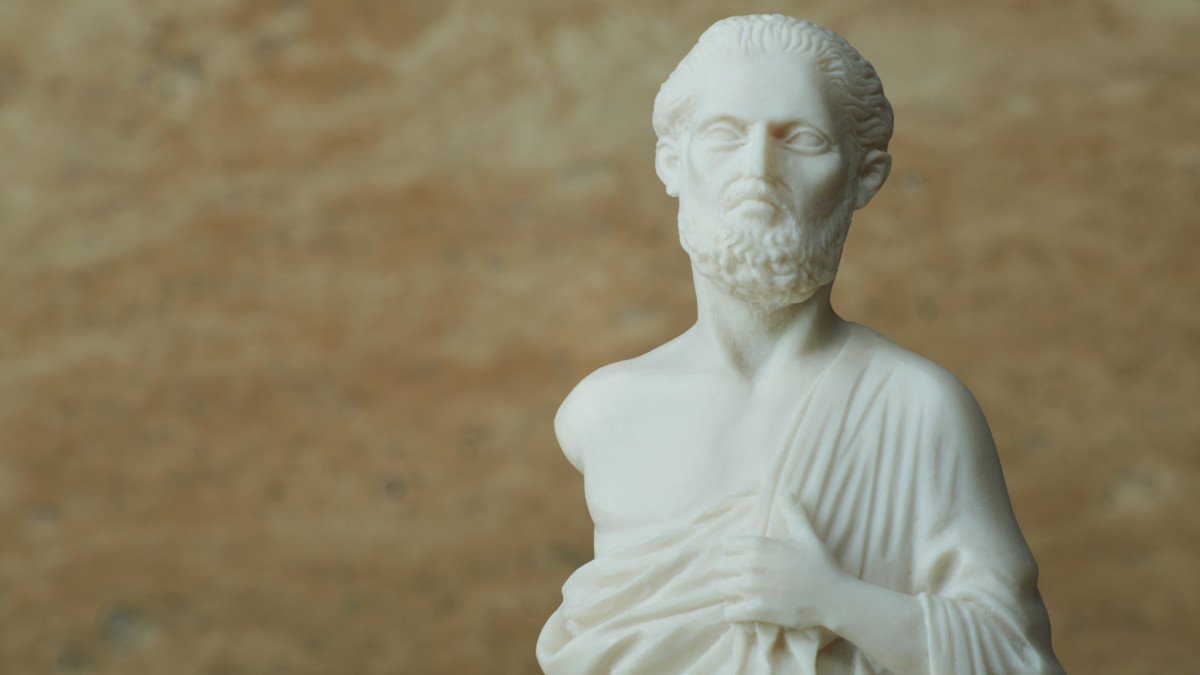
Since ancient times, physicists and philosophers have been interested in this human condition that led to dejection, deep sadness and isolation. It was the Greek physician Hippocrates (c. 460 – c. 370 BC) who codified a theory that remained in force throughout classical antiquity, the Middle Ages and much of the Modern Age: the theory of the four humors.
To understand this curious theory, we must imagine a rhombus in the center of which is the human heart. This rhombus will serve as a conceptual map to understand how the humors work and how they influence the human body.
Blood, yellow bile, black bile and phlegm
At the upper vertex is the air element, which belongs to spring and childhood and which, logically, is hot and humid in nature. Blood is the bodily fluid that governs this part, associated with emotions, so overly sensitive individuals will be called “sanguine” in nature.
At the left vertex of the imaginary rhombus we find the fire element, related to summer, which is by nature hot and dry and is governed by yellow bile. The corresponding human age is youth, and the character is “choleric.”
At the right vertex is the water element, by nature humid and cold, related to winter and the “phlegmatic” character. It is the typical character of old age, the last of human ages, and the corresponding body fluid is phlegm.
Finally, at the lower vertex we find the element of earth and autumn, which are by nature dry and cold and are governed in the human body by black bile. In Greek, “black bile” is formed with the words melon and jole, and this is the origin of our word “melancholy.” Of course, black bile governs the melancholic character, typical of human adulthood.
Humoral imbalance causes disease
According to the Hippocratic theory, all these liquids, substances or humors supposedly flow through the body in an adequate balance, which results in a “balanced” temperament (neither hot nor cold, neither wet nor dry). However, if, for some unknown reason, any of them is altered, a humoral imbalance occurs that not only leads to radical characters, but can also produce diseases.
Therefore, melancholy, that apathetic and sad state, is nothing more for ancient and medieval medicine than an imbalance in the production of black bile, without forgetting the astrological part, since Saturn, the “dark” planet, was also considered and melancholic”, responsible for such an alteration. We will see this astrological aspect later, when we talk about “Saturnian humor.”
The Middle Ages and melancholy as a “sin”
In late antiquity and the early Middle Ages the humoral theory of Hippocrates and Galen was maintained. Thus, melancholy was a disease resulting from the body’s humoral alteration, which, if we consider it carefully, is not very far from the idea of the imbalance of brain neurotransmitters that is known to affect depressive states.
In any case, during the Christian era melancholy began to be related to sin; specifically, with accessia, a deep state of sadness and apathy that, over time, ended up evolving into the sin of laziness. It was considered that this state of “carelessness” (this is the etymological meaning of the word) was produced by a specific demon, the “demon of accessia”, which imbued the person and deprived him of the strength to face life (which, remember, it was a gift from God).
In any case, medieval Christian accessia was the opposite of activity and action, which was an obligation of every good Christian. For this reason, the Benedictine monks had as their main rule the famous Ora et labora (pray and work), since leisure was seen as a dangerous temptation that led to madness and sin. On the other hand, many of the institutions that took in “crazy people” had as their main mission to provide these people with activities that would occupy their time and thus prevent their “madness” from getting worse. It is also necessary to mention the Benedictine Hildegard of Bingen (1098-1179), who prescribed intercourse as a remedy for melancholy, based on the beneficial effects it has on the human body.
The idea of accessia or melancholy as a result of excessive leisure is not only medieval. In fact, it was resumed in the 19th century, with the rise of the bourgeoisie and, therefore, of rich people who had “nothing to do.”. These people, according to the ideas of the time, could afford “the pleasure of being sad,” as the writer Victor Hugo (1802-1885) called it, while people with incessant (and often problematic) activity did not have this possibility.
Today we know that depression can affect anyone, regardless of their lifestyle. However, it is interesting to keep in mind the question of accessia or leisure as a generator of melancholy, since, in reality, one of the things that is recommended for depressed patients is activity.
Melancholy as “Saturnian humor”
In the Renaissance, and, specifically, in the Neoplatonic school of Florence (led by the philosopher Marsilio Ficino), there was a revaluation of melancholy. This becomes the condition par excellence of genius, who, through it (and the creative solitude that it entails) is capable of giving the world authentic wonders.
Thus, the melancholic begins to be associated with a being from other worlds, touched by the hand of God, possessing the privilege of knowing the intellectual depths that other mortals will never even intuit. Astrology, always present but regaining its strength in the 16th century, established Saturn, the “dark” planet, as the ruler of melancholic people and, therefore, of geniuses and artists.
But, while in the Renaissance Saturn is contemplated with a positive vision, during Romanticism, which partly collects these ideas of melancholy as a creative entity, it is preferred to collect the most negative part of the planet and melancholy itself; It is a state that boosts imagination and creativity, but also plunges the individual into eternal darkness. This is why Romanticism is so prone to ruins, gloomy environments and supernatural experiences.
So, The so-called “Saturnian mood” provided by Saturn is a perennial melancholic state, in which the person, usually of great intellectual and artistic capacity, sinks into an atrocious pessimism, through which he clearly sees that he does not have enough life to realize everything your soul wants to pour into the world. The artist, the intellectual, the genius, live, therefore, in a state of perpetual discouragement.
There are numerous examples in the history of art that illustrate this idea. From the famous engraving Melancholia I by Albrecht Dürer (1471-1528), to the well-known Thinker by Rodin (1840-1917), passing through the excellent portrait of Jovellanos by Francisco de Goya (1746-1828); All these works show the dejected genius, with his head resting tiredly on his hand and with a lost look that denotes sadness and sorrow.
Melancholy at the dawn of modernity
We cannot summarize in such a brief article all the treatises that have been written since ancient times on melancholy. Yes, we can cite some of the most important: On melancholy (1569), by Alonso Santa Cruz; Book of Melancholy (1585), by Andrés Velázquez and, above all, Anatomy of Melancholy (1621), by Robert Murton (1577-1640), an excellent three-volume treatise that was one of the most consulted sources of the time and that, among other things, prescribes activity as a remedy.
We have already commented how, in 1721, Sir Richard Blackmore mentions for the first time the term “depression” to refer to the state of despondency, isolation and sadness that melancholy meant. For his part, Philippe Pinel (1745-1826) considered melancholy-depression a “fixation on an object”, which could have a moral, religious, emotional, etc. cause, which inaugurated the idea that melancholy could be based also in a disappointment or resistance.
Sigmund Freud (1856-1939), already in the 20th century and with modern psychiatry underway, published his Mourning and Melancholy, in which, among other things, he associated the melancholic state with the narcissistic personality, since melancholy entails a sublimation of the self, which is situated above the world (to which no attention is paid). And Albert Camus (1913-1960), with The Myth of Sisyphus, contributed his (enormous) grain of sand to the existentialism characteristic of the 20th century, stating that few people are capable of accepting the “absurdity of existing”…
It is impossible to make a complete overview of the concept of melancholy in so few pages. We have been able to see how, throughout history, this state has had a common denominator, that of “imbalance”, whether for good (as a creative genius that stands out above other creatures) or for bad (Christian accessia or the humoral imbalance of Hippocrates). In each era, melancholy has been seen differently and, therefore, its appearance has been attributed to different causes.
It is currently known that depressive states have a lot to do with an imbalance of brain neurotransmitters, which, as we see (and saving the distance) has something in common with that imbalance of the body’s humors. On the other hand, it has also been proven that activity does a lot of good for people who suffer from depression, and this was also known in the Middle Ages, when the institutions in charge of welcoming the “crazy” provided them with activities and jobs to improve your health.
Anyway, like everything related to the human mind, there is still much to investigate and discover. We hope that the studies continue and people who find themselves in these situations can access increasingly effective and decisive treatments.
Use this citation format to reference the article clearly and help readers find the original source.
PsychologyFor. (2024). Melancholy in History: How Has it Been Seen Throughout the Centuries?. PsychologyFor. https://psychologyfor.com/melancholy-in-history-how-has-it-been-seen-throughout-the-centuries/