

See more of our articles in your search results.
Within the person’s nervous system there are hundreds of thousands of neurons that make up its networks and are responsible for transmitting both electrical impulses and certain substances from one place to another.
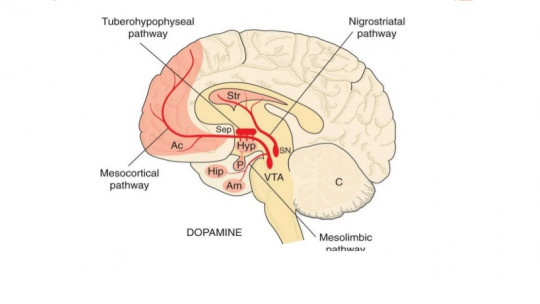
The mesocortical pathway is a network of neurons found throughout the brain and that exercises primordial control over thoughts, emotions and feelings.
What is the mesocortical pathway?
The route or bundle of neurons that connect the ventral tegmental area and the cerebral cortex, especially at the level of the frontal lobe, is known as the mesocortical pathway. The mesocortical pathway is one of the most important pathways of the dopaminergic system, playing a very important role in cognition, as well as emotions and affectivity.
Lesions or alterations in the mesocortical pathway are common in certain psychotic disorders such as schizophrenia, which is hypothesized to be the cause of its cognitive and negative symptoms.
Within the dopaminergic system we also find other pathways whose main task is to transport dopamine from one place in the brain to another The neurons that make up these routes are made up of cells that synthesize dopamine, while the axons are responsible for transmitting it along the entire pathway.
How many of these have you been "meaning to read" for months?
- 1
 MajostaLearning To Love MyselfListen Free On Audible
 - 2
 THOUGHT CATALOGThe Mountain Is YouTransforming Self-Sabotage Into Self-MasteryListen Free On Audible
 - 3
 Spiegel & GrauCodependent No MoreHow to Stop Controlling Others and Start Caring for Yourself (Revised and Updated)Listen Free On Audible
These pathways that accompany the mesocortical pathway and form the dopaminergic system are:
Parts and structures
As mentioned above, the ventral tegmental area (VTA) and the cerebral cortex are mainly involved in the mesocortical pathway. Besides, This connection is made at the level of the frontal lobe
1. Frontal lobe
The frontal lobe is an area of the cerebral cortex located in the anterior area of the brain, its main characteristic being that it is only fully developed in the most complex animals such as vertebrates, mainly hominids.
Among the functions of the frontal lobe are linguistic and oral production, as well as phonoarticulatory movements. In addition, the frontal lobes have the very important mission of coordinating executive functions. These functions are what provide the ability to direct behavior, attention, planning sequencing and reorienting behavior.
2. Ventral tegmental area
This area, also known as the ventral tegmentum, is made up of a set of neurons located in the midline of the floor of the midbrain.
This area is the place of origin of the mesocortical dopaminergic pathway and its function is to regulate the brain’s natural reward system. Therefore, it has a fundamental role in motivation, pleasure and orgasm, addictions, romantic feelings and in some psychiatric disorders.
3. Cerebral cortex
The cerebral cortex, also known as the cerebral cortex, is formed by the network of neurons that form the tissue that covers the extension of both cerebral hemispheres.
Its functions focus on governing perception, imagination, thought and reason
Its involvement in brain functions
Like the rest of the dopaminergic pathways, the mesocortical pathway It has a highly relevant role within a series of essential brain functions for the person’s mental health.
These functions are, on the one hand, cognition as an executive function, and emotions and affectivity on the other.
1. Cognition
By cognition we understand the ability that people have to process the information they receive from the environment through perception, as well as the interpretation and meaning they give it.
Cognition is used in a large number of processes such as learning, reasoning, attention, memory or problem solving
2. Emotions and affectivity
An emotion is a psychophysiological response to a certain stimulus; whether it is a person, a place or situation, an event or the person’s own memories.
On a psychological level, emotions generate changes in attention and activate or inhibit certain behaviors. In addition, It also has the ability to strengthen important associations in memory
As far as affectivity is concerned, while emotions are associated with a series of bodily reactions, affectivity and feelings are related to the mind. Likewise, unlike emotion, affectivity involves a process of interaction between two or more people.
Implication in psychotic disorders
Once the areas of action and functions of the mesocortical pathway are known, it is easier to understand why a decrease in its activity can give rise to numerous characteristic symptoms of psychotic disorders.
Specifically, In schizophrenia, hypofunction of the mesocortical pathway gives rise to cognitive and negative symptoms of this disorder.
Negative symptoms
The negative symptoms typical of schizophrenia are those that manifest themselves through an impoverishment of personality and relationships and a deterioration in mood
Within this symptomatology we can find three different subtypes: language alterations, mood alterations and a third subgroup with other symptoms that do not fit into the previous ones.
Language alterations
These symptoms include laconic speech, poverty of language and short answers lack of language content and empty responses, blocking, and increased response latency.
Mood alterations
It mainly manifests itself with emotional dullness or flattening, facial inexpression or fewer spontaneous movements.
Likewise, patients with negative symptoms show great inconsistencies between the feelings expressed and the situation that surrounds them An example could be laughing at a funeral or crying at a joke.
Finally, other mood symptoms include inappropriate affect or ambivalence, a feeling of emptiness, and the feeling of deep anguish
Other symptoms
Among the rest of the negative symptoms in which the mesocortical pathway is involved, we find abulia and apathy, anhedonia and unsociability, and social maladjustment.
Cognitive symptoms
The cognitive symptoms of schizophrenia refer to problems with concentration and memory, which are reflected in a lack of attention, slow thinking and lack of awareness of the disease or anosognosia.
Use this citation format to reference the article clearly and help readers find the original source.
PsychologyFor. (2024). Mesocortical Pathway: Structures, Functions and Role in Psychoses. PsychologyFor. https://psychologyfor.com/mesocortical-pathway-structures-functions-and-role-in-psychoses/