


See more of our articles in your search results.
The door has been shut since Tuesday. Not slammed, just shut, with a strip of blue light along the carpet and the muffled click of a keyboard that goes quiet whenever your footsteps reach the hallway. You leave a plate outside. It comes back empty, mostly. Eighteen months ago he was the kid who played travel soccer and argued about pizza toppings, and now you can’t remember the last time you heard him laugh at something that wasn’t on a screen. Parents describe this scene in nearly identical words in Ohio, Manchester and Ontario.
Here’s what makes it so maddening. Social isolation in adolescents rarely announces itself with a diagnosis. It looks like laziness, or a phase, or attitude, and the usual levers (grounding him, confiscating the phone, a stern talk over dinner) tend to make the lock turn tighter. Some teens are sinking into depression. Others are frozen by social anxiety, or grieving a friendship that ended when they were quietly removed from a group chat. A few meet the criteria for hikikomori, a term for withdrawal lasting six months or more. Meanwhile school attendance slides, sleep flips to daytime, and you rehearse conversations in the car that you never actually have.
Shouting through a door has never once coaxed a teenager out of it.
This article explains why it happens, how to separate a rough patch from a red flag, and what to do when my son doesn’t leave the room stops being a worry and becomes your daily reality.
Why won’t my teenage son leave his room?
Because the room is the one place where nobody is grading him. That’s the short answer, and it holds up more often than parents expect. For a boy who feels judged at school, ignored online or simply outpaced by his peers, a closed door offers predictable safety: no eye contact, no surprises, no audience.
How many of these have you been "meaning to read" for months?
- 1
 TarcherThe Artist's Way30th Anniversary EditionListen Free On Audible
 - 2
 New Harbinger PublicationsThe Dialectical Behavior Therapy Skills WorkbookPractical DBT Exercises for Learning Mindfulness, Interpersonal Effectiveness, Emotion Regulation...Listen Free On Audible
 - 3
 New Harbinger PublicationsAdult Children of Emotionally Immature ParentsHow to Heal from Distant, Rejecting, or Self-Involved ParentsListen Free On Audible
The longer answer starts with the adolescent brain. Neuroscientist Sarah-Jayne Blakemore, writing with Kathryn Mills, has argued that adolescence is a sensitive period for social processing, a stretch when the circuits that track what other people think of us are unusually reactive. A comment that would’ve bounced off a nine-year-old can lodge in a fifteen-year-old for a week. Rejection registers louder. Embarrassment does too, and it lingers.
Now stack ordinary pressures on top of that wiring. A friend group reshuffles in ninth grade. A growth spurt arrives late, or a voice cracks in class, or a crush screenshots a message and shares it. Grades slip, which brings the lectures, which brings shame, which makes school feel like a place to be avoided. Each retreat feels like relief in the moment. That relief is the trap, because avoidance teaches the brain that the outside world really was dangerous, and the next outing gets harder.
Withdrawal also tends to build quietly. Nobody decides on a Monday to vanish for a year. It’s skipped invitations in October, a canceled birthday party in November, a lunch spent in the library in January, and by spring the friends have stopped texting because he stopped answering. The vicious circle of avoidance runs on its own momentum after that.
One more piece matters, and it surprises parents. Boys are often taught, without anyone saying it aloud, that needing people is a weakness. So a lonely thirteen-year-old rarely says “I’m lonely.” He says “I’m fine,” “leave me alone,” or nothing at all, and you get a locked door where a sentence should be. Is it any wonder the message gets missed?
So the first move isn’t a plan to extract him. It’s a shift in the question you ask yourself, from “why is he being difficult?” to “what is he protecting himself from?” The answer varies, and finding it takes patience more than cleverness.
Is it just a phase, or a warning sign?
Take Daniel, an illustrative composite: fifteen, straight-A student, quiet since the summer. By October he’s eating dinner in his room, and by Thanksgiving he skips the family gathering entirely, telling his aunt through the door that he has a headache. His parents figured it was hormones. It wasn’t a phase, and the giveaway wasn’t any single behavior but the duration and the drop in functioning.
Some retreat is normal. Teens need privacy, they sleep late on weekends and they’d honestly rather text than talk. The line falls where withdrawal starts costing him things he used to value. A useful rule of thumb from the clinical literature: two weeks or more of a marked change deserves attention, and six months of near-total avoidance is the threshold researchers use for hikikomori.
Watch for a cluster rather than one sign. These are the ones that clinicians take seriously:
- Refusing school for several days in a row, or leaving early most weeks
- A reversed sleep schedule, awake at 4 a.m. and asleep through the afternoon
- Dropping every activity he once liked, including the ones with no social demands
- Stopping contact with all friends, not just some, for a month or longer
- Neglecting hygiene or eating in ways that shift sharply (barely at all, or only at night)
- Any talk of being a burden, wanting to disappear or not wanting to be here, which is a red flag for suicide risk
That last item overrides everything else. If you hear it or suspect it, don’t wait for the pattern to prove itself; the crisis resources are in the section on professional help below.
A quieter clue is what happens when he is out of the room. Does he brighten with a cousin or a close friend, or does he look flat everywhere? A boy who’s withdrawn from certain people but lit up with others is usually dealing with a specific social injury. A boy who’s flat in every setting more often has mood disorder features.
And check what the room itself contains. Games and streaming aren’t proof of anything. But a desk buried in unopened schoolwork, curtains taped shut and food wrappers stacking up tell you the room has become a bunker rather than a hangout.

Depression, social anxiety or hikikomori: what’s actually going on?
Myth: a teen who stays in his room is either lazy or “addicted” to games. Fact: withdrawal is a symptom pattern, not a diagnosis, and it usually sits on top of something clinicians can name and treat. Sorting out which something is the first job of any evaluation.
Psychiatrist Takahiro A. Kato and colleagues have spent years mapping hikikomori, a Japanese word for severe social withdrawal in which a young person stays at home, avoids school or work, and has almost no contact outside the household for at least six months. Their international work shows the pattern is no longer a Japanese curiosity; it’s been reported across many countries, including the United States. The disagreement is over what to call it.
That question is where Alan R. Teo comes in. Reviewing the evidence with Albert Gaw, Teo noted that most cases fit existing diagnoses such as depression or social anxiety disorder, yet a notable minority did not; in one prospective study he cited, 19 of 97 people (about 20 percent) had no diagnosable disorder at all. Translation: sometimes the withdrawal is the problem itself.
Here is a rough map of the three most common pictures. Real teens blur the lines, and some have two at once.
| Pattern | What it looks like | Typical clues |
|---|---|---|
| Major depression | Flat mood or irritability, loss of interest, slowed down | Sleep and appetite change, hopeless talk, worse in every setting |
| Social anxiety disorder | Intense fear of being judged, avoids school, calls, cafeterias | Relaxed online or with one trusted person, stomachaches before events |
| Hikikomori-type withdrawal | Months at home, near-zero contact, day-night reversal | Often follows school refusal; may coexist with anxiety or depression |
| Autism or ADHD (undiagnosed) | Exhaustion from masking, sensory overload, social mismatch | Long-standing friendship difficulty, burnout after school |
A study of psychiatric outpatients aged 12 to 15 found that the strongest predictors of withdrawal severity were anxious or depressed symptoms, somatic complaints, poor communication between parents and excessive internet use. Notice the mix. Nobody predicted it from gaming alone.
If you’re wondering whether your son is “just shy,” the difference is impairment. Shyness bends around a person’s life. Social anxiety disorder takes furniture out of it: the team, the class, the trip, the friend who finally stopped asking.
Only a clinician can sort this out, and you don’t need to have it figured out before you call one. You need a description of what you’ve seen, and roughly when it started.
Do phones and video games cause teen isolation?
Screens aren’t the whole story, and they aren’t nothing either. Both camps in this debate are overselling, which is why parents come away from the headlines more confused than when they started.
Psychologist Jean Twenge and her co-authors reported that depressive symptoms and suicide-related outcomes among U.S. adolescents rose sharply after 2010, and that teens who spent more hours on new media were likelier to report them. The timing lines up with smartphone adoption. Social psychologist Jonathan Haidt took that argument further in The Anxious Generation, contending that a “phone-based childhood” has crowded out play, sleep and in-person friendship. His prescriptions are concrete: delay smartphones, delay social media until about 16, keep phones out of schools, and restore unsupervised time with other kids.
The rebuttal deserves equal airtime. Amy Orben, along with Andrew Przybylski, analyzed data on more than 300,000 adolescents and found that technology use explained at most about 0.4 percent of the variation in well-being, an effect they compared to something as trivial as regularly eating potatoes. Correlation studies can’t tell you whether screens make teens miserable or miserable teens reach for screens. Honestly, it’s probably both, and the evidence here is thinner than the confident book jackets suggest.
What seems most defensible is a displacement account. The problem isn’t the glow itself; it’s what the glow replaces. Three hours of multiplayer chat with real friends is a different thing from six hours of solo scrolling at 2 a.m., and only one of those is likely to leave a boy more connected than before.
Consider Jamal, an illustrative composite. At fourteen he plays online with two school friends every evening, jokes on voice chat, and still shows up for band practice. His parents worry about the hours. Now picture his cousin Eli, who quit the team, dropped every friend, and moves between four platforms without speaking to anyone. Same console, different function.
So ask these diagnostic questions instead of counting minutes:
Is the gaming social or solitary? Did the screen time rise before the withdrawal, or after it? Does he still stop when there’s something better on offer, like a friend at the door? A teen who uses games to escape a painful life is telling you about the pain. Taking the console away without touching the pain tends to produce rage, and sometimes a worse crash in mood.
That doesn’t mean unlimited access. Sleep is the non-negotiable, and a house rule that devices charge outside bedrooms overnight is one of the few boundaries with decent support behind it. Just enforce it for everyone, adults included, or he’ll (rightly) call it hypocrisy.
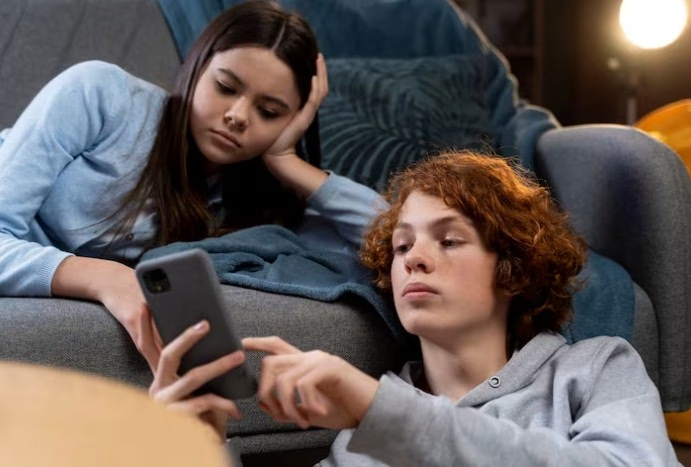
How is school refusal connected to a teen who stays in his room?
School refusal is often the first domino. A boy stops attending, the days at home lengthen into weeks, and the bedroom stops being a retreat and becomes the whole world. Researchers describing withdrawal have repeatedly found a strong link between school refusal and social withdrawal, with many hikikomori-type cases beginning as attendance problems.
Psychologist Christopher Kearney, who developed a functional model with Wendy Silverman, argues that school refusal isn’t one thing. It’s a behavior that persists because of what it does for the child. Working out the “why” changes the treatment, so it’s worth knowing the four functions:
- Avoiding upsetting feelings tied to the school itself, such as a loud cafeteria or a gym locker room
- Escaping social or evaluative situations: presentations, being called on, being watched
- Seeking attention from a parent, often when separation feels frightening
- Gaining rewards outside school, like unlimited gaming or sleeping in
The first two are anxiety-driven and tend to respond well to gradual exposure. The last one is the one that parents assume is the cause of everything, and it rarely explains a teen who looks genuinely miserable. Assume the pleasure of staying home is a consequence, not a motive, until an assessment suggests otherwise.
Here’s a pattern that trips families up. Each day he’s excused, the anxiety about tomorrow shrinks a little, so the excuse feels kind. The next day, the fear has grown to fill the space. Accommodation, the well-meant act of removing the hard thing, keeps anxiety alive, and clinicians who treat young people say so bluntly.
That doesn’t mean marching him through the front doors. Forced returns, especially without a plan, can turn dread into panic and wreck trust. A better route usually involves a meeting with the school counselor, a written re-entry plan (shortened days, a safe room, a named adult), and treatment running at the same time. Many schools in the U.S. can set up a 504 plan; in the UK, ask about an emotionally based school avoidance plan through the school’s SENCo; Canadian provinces vary, so start with the guidance counselor.
Timing matters more than most parents realize. The longer the absence, the harder the return, and the fewer options remain. Can you afford to wait another month?
What does long-term isolation do to a teenager?
It compounds. Each month of withdrawal makes the next month easier to choose and the exit harder to find, and the damage reaches beyond mood into sleep, learning and physical health.
The strongest general evidence comes from adults, so it needs a caveat. Julianne Holt-Lunstad and her colleagues pooled 148 studies covering more than 300,000 people and found that those with stronger social relationships had about a 50 percent greater likelihood of survival over the follow-up periods. The size of that effect was comparable to well-known risks like smoking. Teens weren’t the focus, and no one should quote this as a prediction for your son. But it tells you that connection isn’t a luxury.
For adolescents specifically, the costs are easier to see in ordinary life. Skills that develop through practice, like reading a joke, managing a disagreement or asking someone out, go unrehearsed. Academic records develop gaps. The social anxiety gets worse because every avoided situation confirms the fear. Sleep drifts later and later until daylight itself feels hostile.
Picture a sixteen-year-old, an illustrative composite named Owen, eight months out of school. He hasn’t had a haircut since spring, he’s awake through the night, and the thought of ordering food at a counter now makes his hands sweat. Nothing dramatic happened. Small avoidances simply added up.
There’s a mood cost too. Loneliness and depression feed each other, and it’s hard to say which came first in any given teen. Sustained withdrawal is also associated in clinical samples with higher rates of suicidal thoughts, which is why it should never be filed under “he’ll grow out of it.”
And then there’s the quiet damage to the family. Siblings tiptoe. Parents disagree in low voices about whether to push or wait. One parent starts to resent the other’s approach, and the marriage picks up a hairline crack.
Still, the trajectory isn’t fixed. Young people recover from long periods of withdrawal, sometimes after a single trusted relationship, a change of school or the right treatment finally landing. The point of describing the risks isn’t to frighten you; it’s to explain why “wait and see” has a cost that grows monthly.
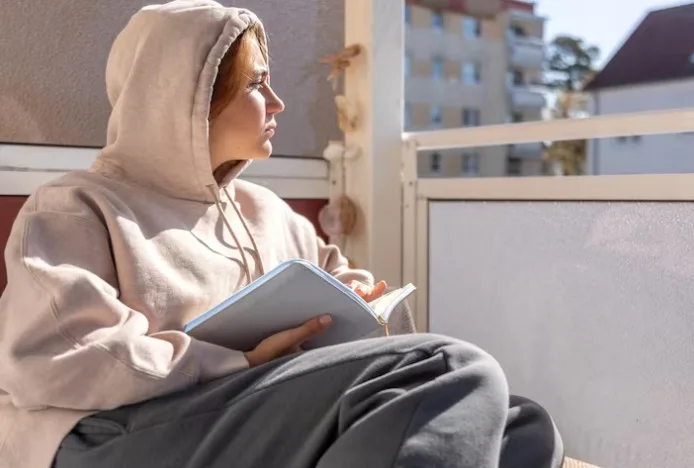
What should you say when he won’t come out?
Say less than you want to, and say it at a lower volume. The goal of the first few conversations isn’t to solve anything; it’s to prove that talking to you is safe.
Picture a Sunday evening in an illustrative household. Marta knocks, hears nothing, and says through the door: “I’m not here to lecture. I made too much pasta, and I miss you.” She leaves. Twenty minutes later there’s a grunt and a plate is gone. That’s not nothing. That’s a thread.
Try these approaches in roughly this order:
- Lead with observation, not accusation. “I’ve noticed you’ve been in your room more since October” lands better than “You never come out.”
- Ask one open question, then stop. “What’s been the hardest part of school lately?” and then silence, even if it stretches.
- Talk side by side, not face to face. Car rides, walking the dog and shooting hoops let a boy speak without being looked at.
- Use his interests as the bridge. Ask him to show you the game, the playlist, the channel he follows, and mean it.
- Name your worry once, clearly, and keep your promise not to punish honesty. If he tells you something hard and gets grounded for it, he won’t tell you again.
What not to say matters as much. Skip “What’s wrong with you?” and “When I was your age…” Avoid comparisons to a cousin. Never threaten to remove the door; it has been tried, and the boy who comes out that way is not the boy you wanted.
Some families find text works when speech doesn’t, and that’s fine. A short message (“No need to answer. Thinking of you.”) keeps the line open without demanding a reply. Text also lets him respond when his heart isn’t pounding.
Expect the first several attempts to go nowhere. That’s normal. You’re not measuring success by whether he talks today; you’re measuring whether the door feels a little less like a wall by the end of the month.
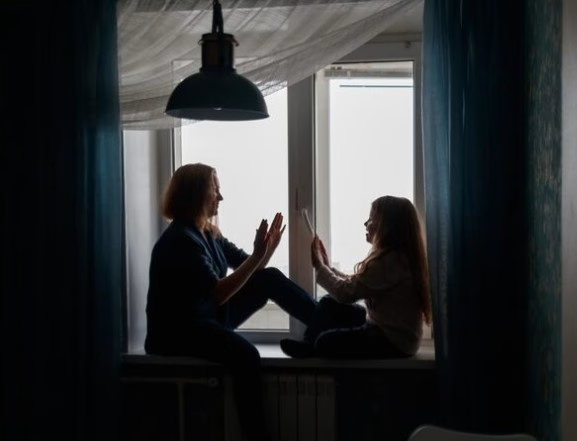
How can you help him leave the room, one step at a time?
Use graded exposure: a series of small, planned steps toward the things he avoids, starting with the least frightening and moving up only when each one feels manageable. It’s the backbone of the best-studied treatment for youth anxiety, cognitive behavioral therapy (CBT).
Psychologist Philip C. Kendall built much of the evidence base here. In a randomized trial of children aged 9 to 13 with anxiety disorders, his team found that a manualized CBT program produced clear gains over a waiting list, with roughly two-thirds of treated children no longer meeting criteria for their diagnosis afterward. The children were younger than your son, the setting was a clinic, and results in the messier real world tend to be more modest. Still, the principle transfers: face fears in small doses, and the fear shrinks.
At home, the steps might look almost embarrassingly small. Day one: he eats breakfast at the kitchen table for five minutes. Week two: he sits on the porch with a drink. Week three: he rides along to drop a sibling at practice and stays in the car. Then a walk to the corner. Then a short visit with the one friend who never gave up on him. Each rung is negotiated, not imposed, and he gets a veto over the order.
Build a fear ladder together on paper. Rank ten situations from 1 to 10 by how scary they feel, and begin around a 3. Praise effort, not outcome; “you tried the porch” counts even if he lasted four minutes. If a step goes badly, don’t retreat to the bottom. Repeat it, or make it slightly smaller.
Two mistakes come up constantly. The first is speed: parents feel the clock ticking and leap from the doorway to a birthday party. The second is inconsistency, where the plan runs for a week and then collapses because everyone’s tired. Boring, repeated practice wins.
Pair the ladder with behavioral activation if depression is part of the picture: scheduling small pleasant or meaningful activities even before he feels like doing them. Mood tends to follow action, not the other way around. And keep sleep anchors steady, since a wake-up time held within an hour of the same target each day does more for morale than most pep talks.
A therapist trained in CBT can run this with him, and often with you. Parents frequently need coaching to stop rescuing.
When should you call a professional?
Sooner than feels comfortable. If your son has withdrawn for more than a few weeks, is missing school, or you’re seeing any of the signs listed earlier, book an appointment with your primary care doctor (a GP in the UK), who can screen for depression and anxiety, check for physical causes and refer onward.
Some situations shouldn’t wait for a referral queue. Get help the same day if any of these apply:
- He talks about suicide, self-harm, or being better off gone
- He’s stopped eating or drinking properly, or you can’t wake him
- He’s hearing or seeing things that aren’t there, or seems frightened by things you can’t explain
In the United States, call or text the 988 Suicide & Crisis Lifeline. In Canada, the equivalent is the 9-8-8 Suicide Crisis Helpline. In the UK, Samaritans answer at 116 123, and for an immediate danger anywhere, use your local emergency number. You can call on behalf of your son; you don’t need his permission to ask for advice.
For ongoing care, look for a psychologist, licensed counselor or child psychiatrist with experience treating adolescents. Ask directly whether they use CBT for anxiety or depression, how they involve parents, and what they do when a teen won’t attend. Many clinicians now offer telehealth, which can be a lifeline for a boy who can’t yet manage a waiting room. Insurance rules and wait times vary widely, so ask each clinic rather than assuming; in the UK, your GP or school can explain what local NHS services exist.
What if he refuses to go? It happens a lot. Start yourself: a session or two with a therapist for parent coaching is a legitimate first step, and research on anxious youth suggests that working through parents can help even when the teen isn’t in the room. Then invite him gradually, perhaps starting with a video call he can leave the camera off for.
Medication is sometimes part of the picture, particularly for moderate to severe depression or anxiety. That decision belongs to a prescribing clinician and your family, and it usually sits alongside therapy rather than replacing it.

How do you keep going when nothing seems to work?
It’s 11 p.m., the hallway light is still on, and you’re standing outside his door with your hand up, unsure whether knocking helps or harms. Every parent who’s been there knows that moment. It is exhausting, and it’s also survivable.
Start with the unglamorous basics: protect your own sleep, eat at regular times, and find one person who isn’t your co-parent to talk to. A friend, a support group, a therapist of your own. Parents of withdrawn teens often report shame and isolation of their own, which mirrors what their child is living through. That’s worth noticing.
Agree with your partner on a single script. Split parenting, where one pushes and the other rescues, gives a withdrawn teen a fault line to hide inside. You don’t have to agree on everything; you do need to agree on the next three moves and on what happens if he threatens to hurt himself.
Expect setbacks. He’ll manage a coffee with a friend on Saturday and then not leave the room for four days after a bad text. That isn’t failure; it’s how exposure-based recovery usually looks, jagged rather than smooth. Keep a simple log of small wins (a shower, a meal at the table, a laugh) so you can see the trend when the week feels grim.
Lower the temperature at home. Not every battle is worth the fight, and a messy room is one you can concede. Save your energy for sleep, safety, treatment and school plans.
Don’t take his silence as a verdict on your parenting. Withdrawn teens come from warm, attentive, well-run households constantly, and blaming yourself only steals energy you need for the next small step.
Look for allies. A favorite teacher, an older cousin, a coach he once liked, a neighbor with a dog that needs walking. Adolescents often accept from other adults what they’d never accept from a parent, and one steady relationship can be the first rung of the ladder.
And keep the door, and the plate, and the low-pressure “we’re here.”
FAQs about a Son Who Won’t Leave His Room
Is it normal for a teenage boy to stay in his room all day?
Sometimes. Weekends spent mostly in bed with a phone are ordinary for teens, and wanting privacy is healthy. What isn’t ordinary is a steady shrinking of life: fewer friends, missed school, dropped hobbies, and a room he only leaves for the bathroom. Look at the trend over weeks rather than any one Saturday. Ask whether he still has at least one person he talks to and something he looks forward to. If both answers are no, and it has lasted more than two weeks, the pattern deserves a conversation with a doctor, not a lecture at the dinner table.
Can video games cause a teen to become a recluse?
Rarely on their own. Studies of large teen samples, including the Orben and Przybylski analysis, find that technology use explains only a tiny slice of well-being differences, and that direction of cause is hard to prove. More often, a boy who is anxious, depressed or bullied leans on games because they are the one place he feels competent and unjudged. The gaming then makes withdrawal easier, which feeds the loop. Look at whether play is social or solitary, whether it began before or after the retreat, and whether it’s crowding out sleep. Treat the underlying distress first, and the hours often shrink without a fight.
Should I take the door off or confiscate his phone?
Almost never. Removing the door or the phone reads as an attack, and a withdrawn teen who feels attacked usually retreats further or explodes. It can also cut off his last link to friends, which matters more than parents think. Boundaries are still fair: devices charge outside the bedroom at night, meals happen at a set time, and school or treatment isn’t optional. The difference is that these rules are announced calmly, applied to the whole family, and paired with warmth. If you fear for his safety, that’s a different situation, and a crisis line or emergency services can advise on what to do immediately.
How long is too long for a teen to isolate himself?
There’s no magic number, but clinicians use rough markers. Two weeks of clear change in mood, sleep or social contact is enough to raise the question. Missing school for several days running warrants a school meeting. Researchers studying hikikomori define severe withdrawal as lasting six months or longer, and by then the pattern is often entrenched and harder to reverse. Waiting for the six-month mark before acting is a mistake. Earlier action usually means simpler treatment, fewer missed classes and less family strain. Trust your gut here; parents usually notice the shift long before anyone else does.
Why does my son refuse to go to school but seem fine at home?
Because home removes the trigger. Anxiety about school tends to be situational: the noise, the cafeteria, being called on in class, a particular kid. Away from those, he looks relaxed, and parents naturally suspect manipulation. The relief is real, but it doesn’t mean the fear isn’t. A stomachache on Sunday night that vanishes by Monday at ten is a classic sign of school-related anxiety rather than faking. Kearney’s model suggests asking what the absence does for him: avoiding distress, escaping evaluation, gaining attention, or earning rewards elsewhere. A counselor or therapist can help sort out which one is driving it, and a gradual return plan works better than a forced one.
What happens if I just wait it out?
Sometimes it passes, particularly when a specific event triggered the withdrawal and life improves, like a move to a new school or a repaired friendship. But waiting is a gamble with poor odds when the retreat is already several weeks old. Avoidance strengthens itself; each week at home makes returning feel riskier. You also lose time to catch depression or anxiety while they’re most treatable. A middle path is to wait no more than a couple of weeks while actively trying: talking, adjusting routines, and booking a checkup in parallel.
Can a teen recover fully from severe social isolation?
Yes, many do. Recovery rarely looks like a dramatic breakthrough. It looks like a slow widening: a walk, a shop, a class, a job shift, a friend. Teens who receive treatment for underlying anxiety or depression, keep at least one trusted relationship, and have a flexible route back into school or work tend to do better than those who get none of that. Some carry a lifelong sensitivity to social stress, and relapses under pressure are common. That doesn’t mean failure. Think of it as managing a tendency, the way someone manages asthma, with early recognition and a plan.
Why does my son sleep all day and stay up all night?
A flipped schedule is common in withdrawal, and it’s partly a hiding strategy: at night the house is quiet, nobody expects anything and friends are online. Biology contributes too. Teens’ body clocks naturally shift later, and late-night light from screens delays sleep further. Once the pattern sets, daylight starts to feel exposed. It can also signal depression, which disturbs sleep in either direction. Move the wake-up time earlier in 30-minute steps rather than all at once, get bright light in the morning, keep devices out of the bedroom overnight, and tell his doctor about the reversal because it changes treatment decisions.
Bibliography
- Blakemore, S.-J., & Mills, K. L. (2014). Is adolescence a sensitive period for sociocultural processing? Annual Review of Psychology, 65, 187-207.
- Haidt, J. (2024). The anxious generation: How the great rewiring of childhood is causing an epidemic of mental illness. Penguin Press.
- Holt-Lunstad, J., Smith, T. B., & Layton, J. B. (2010). Social relationships and mortality risk: A meta-analytic review. PLoS Medicine, 7(7), e1000316.
- Kato, T. A., Kanba, S., & Teo, A. R. (2019). Hikikomori: Multidimensional understanding, assessment, and future international perspectives. Psychiatry and Clinical Neurosciences, 73(8), 427-440.
- Kearney, C. A., & Silverman, W. K. (1990). A preliminary analysis of a functional model of assessment and treatment for school refusal behavior. Behavior Modification, 14(3), 340-366.
- Kendall, P. C. (1994). Treating anxiety disorders in children: Results of a randomized clinical trial. Journal of Consulting and Clinical Psychology, 62(1), 100-110.
- Orben, A., & Przybylski, A. K. (2019). The association between adolescent well-being and digital technology use. Nature Human Behaviour, 3(2), 173-182.
- Teo, A. R., & Gaw, A. C. (2010). Hikikomori, a Japanese culture-bound syndrome of social withdrawal? A proposal for DSM-5. Journal of Nervous and Mental Disease, 198(6), 444-449.
- Twenge, J. M., Joiner, T. E., Rogers, M. L., & Martin, G. N. (2018). Increases in depressive symptoms, suicide-related outcomes, and suicide rates among U.S. adolescents after 2010 and links to increased new media screen time. Clinical Psychological Science, 6(1), 3-17.
Use this citation format to reference the article clearly and help readers find the original source.
PsychologyFor. (2026). ‘My Son Doesn’t Leave the Room’: Social Isolation in Adolescents. PsychologyFor. https://psychologyfor.com/my-son-doesnt-leave-the-room-social-isolation-in-adolescents/