

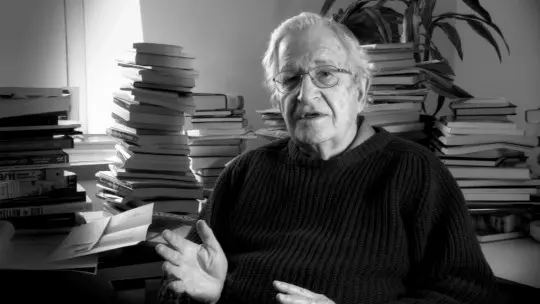
A three-year-old child walks up to you and says, “I goed to the park yesterday.” The error is obvious—”goed” should be “went.” But stop and think about what just happened. That child has never heard anyone say “goed” before. They weren’t imitating adults or repeating what they’d been taught. They independently created a word by applying a grammatical rule they’d somehow internalized: add “-ed” to make past tense. This seemingly simple mistake reveals something profound about language acquisition that Noam Chomsky recognized in the 1950s—children aren’t just parroting what they hear but are actively generating language using complex grammatical rules they’ve never been explicitly taught.
Before Chomsky, the dominant theory of language learning was behaviorism. B.F. Skinner and other behaviorists argued that children acquire language through imitation, reinforcement, and conditioning—the same mechanisms that teach rats to press levers or pigeons to peck keys. Parents say “ball,” the child repeats “ball,” parents praise the child, and through thousands of such interactions, language gets learned. It seemed logical. Straightforward. Observable. Then Chomsky published a devastating review of Skinner’s “Verbal Behavior” in 1959, systematically dismantling the behaviorist account and proposing something radically different: humans are born with an innate capacity for language, a biological endowment as fundamental to being human as having two hands or a beating heart.
Chomsky’s nativist theory of language development revolutionized linguistics, cognitive science, and developmental psychology. He argued that the speed, consistency, and creativity with which children master language—despite receiving limited and often flawed input—can only be explained by innate linguistic structures hardwired into the human brain. Every normal child, regardless of intelligence, culture, or socioeconomic status, acquires their native language by age four or five with remarkable consistency, mastering thousands of words and incredibly complex grammatical rules that linguists need years of study to explicitly describe.

What makes this even more remarkable is what Chomsky called the “poverty of the stimulus”—the language children hear is insufficient to explain what they learn. Parents don’t systematically teach grammar. Children hear incomplete sentences, false starts, errors, and yet they still extract the underlying rules. They produce sentences they’ve never heard before, applying grammatical principles no one taught them explicitly. A behaviorist account can’t explain this. Imitation can’t explain creativity. Reinforcement can’t explain rule application to novel situations.
Chomsky proposed that humans possess a Language Acquisition Device (LAD)—a specialized mental module containing Universal Grammar, the set of principles and parameters common to all human languages. Exposure to any specific language (English, Mandarin, Swahili) sets the parameters of this universal grammar, like flipping switches that determine specific features while the overall architecture remains constant. This explains why children can learn any language they’re exposed to with equal ease but also why certain grammatical structures appear universally across all human languages despite their apparent diversity.
This article explores Chomsky’s theory comprehensively: who Chomsky is and the context of his revolutionary ideas, the core concepts of Universal Grammar and the Language Acquisition Device, the poverty of stimulus argument, how the theory evolved over decades, criticisms and challenges it has faced, and why understanding Chomsky’s contributions matters for linguistics, psychology, education, and our fundamental understanding of what makes humans uniquely capable of the most complex communication system in the natural world.
Who Is Noam Chomsky
Noam Chomsky was born December 7, 1928, in Philadelphia, Pennsylvania, to Jewish immigrant parents. His father, William Chomsky, was a Hebrew scholar, and growing up in an intellectually stimulating household shaped Chomsky’s early interest in language. He attended the University of Pennsylvania, where he studied linguistics, mathematics, and philosophy, earning his BA in 1949, MA in 1951, and PhD in 1955.
Chomsky joined the faculty at Massachusetts Institute of Technology (MIT) in 1955 and remained there for his entire academic career, becoming Institute Professor in 1976, MIT’s highest faculty position. While he’s known publicly for his political activism and critiques of American foreign policy, his academic contributions to linguistics are what earned him recognition as one of the most influential intellectuals of the 20th century. His work fundamentally transformed how we understand language, mind, and human nature.
His 1957 book “Syntactic Structures” introduced generative grammar, a revolutionary approach analyzing language as a system of rules that can generate an infinite number of sentences from a finite set of elements. This was followed by “Aspects of the Theory of Syntax” (1965), which developed the Standard Theory including transformational grammar. His 1959 review of B.F. Skinner’s “Verbal Behavior” is considered one of the most devastating critiques in intellectual history, effectively ending behaviorism’s dominance in psychology and linguistics.
What distinguished Chomsky from previous linguists was his focus on competence (the underlying knowledge of language) rather than performance (actual language use). He wanted to understand the mental grammar—the unconscious knowledge that allows speakers to produce and understand an infinite number of sentences. This shift from describing languages to explaining the cognitive capacities underlying language faculty helped launch the cognitive revolution in psychology and established linguistics as a branch of cognitive science.
Chomsky’s influence extends far beyond linguistics into philosophy of mind, cognitive science, computer science, and psychology. His concept of innate mental structures challenged empiricist philosophy’s blank slate view of the mind. His work influenced artificial intelligence and computational approaches to language. His theory raised profound questions about human nature, the origins of knowledge, and what makes humans unique among species. He’s been called “the father of modern linguistics” and is one of the most cited scholars in any field.
The Language Acquisition Device: Biology of Language
The Language Acquisition Device (LAD) is Chomsky’s proposed innate mental capacity for language acquisition. It’s not a physical structure you can point to in the brain but rather a theoretical construct describing the biological endowment that makes language learning possible. Chomsky argued that children are born with the LAD pre-programmed with Universal Grammar—the fundamental principles underlying all human languages.
The LAD functions as a specialized language processor that allows children to analyze the language input they hear, extract the underlying grammatical rules, and generate an infinite number of sentences following those rules. Unlike general learning mechanisms that behaviorists proposed, the LAD is domain-specific—it’s dedicated exclusively to language, which explains why language acquisition follows different patterns than learning other skills like mathematics or playing musical instruments.
Think of the LAD as providing the blueprint for language while the environment provides the building materials. Every human child is born with the same basic blueprint (Universal Grammar), but the specific language they learn (English, Japanese, Arabic) depends on which language they’re exposed to. The LAD contains parameters—linguistic switches that get set based on input. For example, whether the language is head-initial (verb comes before object, like English “ate apples”) or head-final (object before verb, like Japanese “apples ate”) is a parameter that environmental input sets.
What evidence supports the LAD’s existence? First, the universality of language acquisition—all normal children acquire language, regardless of intelligence or culture. Second, the critical period—language acquisition is easiest in childhood and becomes progressively harder after puberty, suggesting biological maturation affects the LAD’s functioning. Third, specific language impairment disorders where children have normal intelligence but struggle specifically with language, suggesting a specialized language faculty can be selectively impaired.
Fourth, the consistency of developmental milestones—children across cultures go through similar stages (babbling around 6 months, first words around 12 months, word combinations around 18-24 months, complex sentences by age 4-5). This consistency suggests biological programming rather than cultural learning. Fifth, creolization—when children are exposed to pidgins (simplified communication systems without full grammar), they spontaneously create creoles with complete grammatical systems, suggesting they impose structure from their innate LAD when environmental input is insufficient.
The LAD also explains language creativity—children produce sentences they’ve never heard, make systematic errors like “goed” showing rule application rather than imitation, and understand subtle grammatical distinctions that were never explicitly taught. This generative capacity—creating infinite outputs from finite inputs—is exactly what you’d expect if language acquisition involves activating an innate computational system rather than just memorizing utterances.

Universal Grammar: The Common Foundation
Universal Grammar (UG) is the theory that all human languages share underlying structural similarities despite their surface differences. Chomsky proposed that beneath the apparent diversity of the world’s 7,000+ languages lies a common grammatical core—a set of principles and parameters that constrain how languages can be structured. This universal grammar is what the LAD contains, making it possible for children to acquire any human language with equal facility.
The principles of UG are structural constraints that all languages must obey. For example, all languages have nouns and verbs. All languages distinguish between subjects and objects. All languages have rules governing how words combine into phrases and sentences. All languages can express negation, questions, and commands. These aren’t coincidences or cultural universals but reflect the biological constraints of the human language faculty.
Parameters are the points of variation between languages within the universal framework. The pro-drop parameter determines whether languages require explicit subjects (English: “She is tall,” can’t say “Is tall”) or allow dropping them (Spanish: “Ella es alta” or just “Es alta”). The head-directionality parameter determines whether verbs precede or follow objects. There are dozens of proposed parameters accounting for systematic variations across languages.
What’s remarkable is how efficiently parameters work. A child learning English hears a few sentences and sets the pro-drop parameter to “subjects required.” A child learning Spanish hears different sentences and sets it to “subjects optional.” This parameter-setting happens automatically and unconsciously—no one teaches children these rules explicitly, yet by age three or four, they reliably follow them.
Universal Grammar explains several puzzling phenomena. Why are all languages equally complex—there are no “primitive” languages, and children acquire any language with equal ease? Because all languages instantiate the same universal grammar. Why do children never make certain types of grammatical errors despite never being told those constructions are wrong? Because those constructions violate universal principles that the LAD won’t generate. Why can children understand sentences with ambiguity (like “Visiting relatives can be boring”—is “visiting” a verb or adjective?) that would require complex inference if they were learning from scratch? Because UG provides interpretive constraints that limit possible meanings.
Critics have challenged whether UG actually exists or whether apparent universals reflect other factors—cognitive constraints, communicative efficiency, or historical language evolution. Cross-linguistic research has found more variation than early UG theory predicted. But the core insight—that languages share deep structural similarities that children somehow know about before learning any specific language—remains influential even among linguists who’ve moved beyond Chomsky’s specific formulation.

Poverty of the Stimulus: The Learning Problem
The “poverty of the stimulus” argument is Chomsky’s most famous justification for innate language knowledge. The argument has two parts: First, the language input children receive is insufficient to learn grammar from scratch. Second, children nevertheless master their language completely and consistently. Therefore, they must be filling in the gaps with innate knowledge.
Consider what children actually hear. Adult speech is full of false starts, errors, incomplete sentences, and ungrammatical utterances. “I want—did you see—where’s the—never mind, I’ll get it myself.” Children aren’t typically corrected for grammatical errors, only for factual ones. If a child says “I goed to the park,” most parents respond to the content (“Oh, what did you do at the park?”) rather than the grammar. Yet somehow, children extract perfect grammatical rules from this imperfect input.
More fundamentally, many grammatical rules involve subtle distinctions that children master despite never encountering relevant evidence in their linguistic input. For example, English-speaking children know you can say “The boy who is tall is crying” but not “The boy who is crying is tall?” without being taught this distinction explicitly. They know you can form questions by moving auxiliary verbs (“He is tall” becomes “Is he tall?”) but know certain movements aren’t allowed even though they’d never hear the incorrect forms to be told they’re wrong.
Chomsky calls these “negative evidence problems”—children know what they can’t say even though they’ve never heard those constructions marked as incorrect. If learning was purely from input, how do children learn about linguistic impossibilities? Behaviorism can’t explain this because reinforcement requires feedback, but children don’t receive feedback about impossible constructions because those constructions never occur in the input.
Another aspect of poverty of stimulus is the “logical problem of language acquisition”—the input underdetermines the output. The sentences children hear are consistent with multiple possible grammars. How do children converge on the correct grammar for their language rather than one of the many logically possible but incorrect alternatives? Chomsky’s answer: because Universal Grammar constrains the hypothesis space, children only consider grammars consistent with UG principles, making the learning problem tractable.
Critics have challenged whether the stimulus is actually impoverished, arguing that children hear more grammatical input than Chomsky acknowledged and that sophisticated statistical learning mechanisms can extract grammatical patterns from input without innate grammatical knowledge. Computational models have shown that powerful learning algorithms can acquire some grammatical knowledge from input alone. But defenders argue these models still require substantial built-in structure and that the basic problem—children learn more than they hear—remains unexplained without some form of innate linguistic knowledge.

Competence Versus Performance
Chomsky drew a crucial distinction between linguistic competence and linguistic performance. Competence is the underlying knowledge of language—the mental grammar that speakers possess unconsciously. Performance is the actual use of language in concrete situations, which is affected by memory limitations, distractions, speaking errors, and other factors extraneous to grammatical knowledge itself.
This distinction was methodologically important because it justified studying idealized language rather than messy actual usage. Linguists could construct grammaticality judgments (“Is this sentence acceptable?”) rather than recording natural speech. They could investigate what sentences are theoretically possible in a language rather than just which ones people actually produce. Critics from sociolinguistics and usage-based approaches argued this distinction dismissed important aspects of how language actually works, privileging idealized competence over real performance.
Competence includes knowledge that native speakers have but can’t articulate. You know “The child seems sleeping” is ungrammatical even though you probably can’t explain why. You know “Colorless green ideas sleep furiously” is grammatical but meaningless. This implicit knowledge—knowing without knowing that you know—characterizes competence. It’s what makes native speakers reliable judges of grammaticality and what distinguishes learning your first language (acquiring competence unconsciously) from learning second languages as adults (consciously studying explicit rules).
The competence/performance distinction also explained how children could have complete grammatical knowledge even when their performance was limited. A two-year-old saying only “Doggie bark” doesn’t lack grammatical competence for complex sentences but lacks the performance abilities (memory, articulation, processing speed) to produce them. Their comprehension typically exceeds production, showing competence that performance doesn’t fully reveal.

Evolution of Chomsky’s Theories
Chomsky’s linguistic theories evolved substantially over seven decades, going through several distinct phases with different emphases and technical apparatus. Understanding this evolution shows how his core insights about innate language capacity were refined and reformulated in response to empirical challenges and theoretical developments.
The early phase (1950s-1960s) introduced generative grammar in “Syntactic Structures” and developed transformational grammar in “Aspects of the Theory of Syntax.” This Standard Theory proposed deep structures (underlying abstract representations) and surface structures (actual sentences) connected by transformational rules that moved, deleted, or inserted elements. The famous example was how passive sentences (“The ball was hit by John”) derive from active structures through transformations.
The Government and Binding Theory (1980s) replaced transformational rules with more abstract principles and parameters. Rather than language-specific transformation rules, GB theory proposed universal principles (constraints on all languages) and parameters (points of variation) that together explained linguistic diversity and acquisition. This made the theory more constrained and explanatory—fewer mechanisms doing more work—and better suited to explaining how children set parameters based on limited input.
The Minimalist Program (1990s-present) attempted to show that language faculty is optimally designed for interfacing with other cognitive systems. Minimalism asks what’s the minimal machinery needed for language and whether language structure reflects general computational principles rather than language-specific mechanisms. This represented a move toward even more abstract, economical descriptions of linguistic knowledge.
Throughout these phases, core commitments remained: language faculty is innate, all languages share deep structural similarities (Universal Grammar), language acquisition cannot be explained by general learning mechanisms alone, and the proper object of linguistic study is the internalized mental grammar (I-language) rather than external language behavior (E-language). But the specific technical proposals for how UG is structured and how it guides acquisition changed substantially.
Later Chomsky emphasized the biological basis of language more strongly, arguing that language emerged in human evolution relatively recently (perhaps 100,000 years ago) through a single genetic mutation that allowed recursive thought and communication. This evolutionary scenario remains controversial, with many evolutionary biologists arguing language capacity evolved gradually through natural selection rather than appearing suddenly through mutation. But it shows Chomsky’s continued focus on language as a biological endowment rather than cultural invention.
Criticisms and Challenges
Despite its enormous influence, Chomsky’s theory has faced substantial criticisms from multiple directions. Understanding these challenges provides a more balanced view of nativist theories of language acquisition and highlights alternative approaches that have developed partly in response to perceived limitations of Chomskyan linguistics.
The most fundamental criticism comes from usage-based and emergentist approaches arguing that language can be learned from input without innate grammatical knowledge. These approaches, associated with researchers like Michael Tomasello and Joan Bybee, emphasize domain-general cognitive mechanisms (pattern recognition, statistical learning, social cognition) that can extract linguistic structure from experience. Computational models using neural networks have shown impressive success learning aspects of grammar from input without built-in grammatical rules.
Cross-linguistic research has revealed more variation than Universal Grammar initially predicted. Languages differ in fundamental ways—some lack nouns/verbs distinctions that were thought universal, some have radically different word orders and grammatical systems than Indo-European languages that dominated early linguistic theorizing. While defenders argue these variations are surface realizations of deeper universal principles, critics contend the universal principles are either false or so abstract as to be vacuous.
The poverty of stimulus argument has been challenged by corpus linguistics showing that children’s linguistic input is richer and more structured than Chomsky acknowledged. Parents do modify their speech to children (child-directed speech or “motherese”), providing clearer examples of grammatical structure. Statistical patterns in input are more informative than previously thought. Learning algorithms applying to this input can acquire substantial grammatical knowledge without innate grammatical principles.
Evolutionary biologists criticize Chomsky’s account of language evolution, arguing that complex biological systems like language capacity evolve gradually through natural selection rather than appearing suddenly through single mutations. The claim that language faculty has no evolutionary precursors in other species and serves no communicative function (Chomsky argues language is primarily for thought, not communication) conflicts with standard evolutionary theory requiring intermediate forms with adaptive advantages.
Neuroscience hasn’t identified a distinct “language organ” in the brain as the LAD construct suggests. Language processing involves multiple brain regions that also support non-linguistic functions, suggesting language may emerge from interactions between general cognitive systems rather than being a separate module. While certain brain areas show specialization for language, the degree of modularity is less than what strong nativist theories predict.
Social-interactionist approaches, influenced by Vygotsky, emphasize that language development occurs through social interaction rather than unfolding from innate knowledge triggered by input. Children learn language to communicate with others, and social contexts shape what and how they learn. The form language takes reflects its communicative function, not just abstract grammatical principles. This perspective sees language acquisition as fundamentally social rather than primarily biological/cognitive.

Impact on Education and Child Development
Chomsky’s theory has influenced educational practice and child development understanding, though sometimes in ways Chomsky himself might not endorse. His emphasis on innate language capacity suggested that formal grammar instruction is largely unnecessary for first language acquisition—children acquire grammar naturally without explicit teaching, so drilling grammar rules may be ineffective for young children learning their native language.
For second language acquisition, however, implications are less clear. The Critical Period Hypothesis, related to Chomsky’s work though not originated by him, suggests language learning is easiest during a developmental window (roughly birth to puberty) when the LAD is maximally receptive. This has influenced policies about when to introduce foreign language instruction, though evidence on critical periods remains contested—adults can learn languages successfully, just perhaps not as easily or completely as children.
Understanding language acquisition as biologically constrained rather than entirely environmentally determined has shifted parenting advice away from intensive language training programs. Parents don’t need to explicitly teach grammar or vocabulary through flashcards and drills—exposing children to rich language environments through conversation, reading, and play provides sufficient input for the LAD to do its work. This reduced pressure on parents and validated naturalistic language exposure over formal instruction.
Speech and language therapy approaches have been influenced by recognizing that language difficulties can stem from problems with the innate language faculty (specific language impairment) rather than just environmental deprivation or general cognitive deficits. This has led to specialized interventions targeting grammatical deficits specifically rather than treating language as part of general developmental delay.
In linguistics education, Chomsky’s revolution meant studying language became studying cognitive structures underlying language capacity rather than just describing linguistic forms across languages. This made linguistics more scientific and explanatory, though some linguists argue it moved too far from studying actual language use in favor of idealized competence. Understanding that children’s errors reflect rule application rather than failures helps parents and educators respond appropriately rather than viewing errors as problems requiring correction.
FAQs About Noam Chomsky’s Theory of Language Development
What is the main idea of Chomsky’s language theory?
Chomsky’s central claim is that humans are born with an innate capacity for language—a biological endowment called the Language Acquisition Device (LAD) containing Universal Grammar, the fundamental principles shared by all human languages. Children don’t learn language from scratch by imitating and receiving reinforcement (as behaviorists claimed) but rather activate innate linguistic knowledge when exposed to a specific language. This explains why language acquisition happens so quickly, consistently, and creatively despite limited input. Children master complex grammatical rules by age four or five without explicit instruction because their brains are pre-programmed with the basic architecture of language, needing only environmental input to set parameters determining which specific language they’re learning. The theory revolutionized linguistics by treating language as a biological faculty rather than learned behavior, shifting focus from describing languages to explaining the cognitive structures that make language possible.
How does Chomsky’s theory differ from behaviorism?
Behaviorist theories like Skinner’s argued that language is learned through imitation, reinforcement, and conditioning—children hear utterances, repeat them, get praised for correct forms, and gradually build linguistic repertoires through accumulated associations. Chomsky demolished this account by demonstrating that children produce sentences they’ve never heard, apply grammatical rules that were never explicitly taught, and learn language despite receiving limited and often incorrect input with minimal correction. He argued that behaviorism couldn’t explain the creativity of language (generating infinite sentences from finite rules), the poverty of stimulus (learning more than the input contains), or developmental consistency across diverse environments. Instead, he proposed nativism—language capacity is innate, and children are biologically prepared to acquire grammar. While behaviorists emphasized environment and learning, Chomsky emphasized biology and innate knowledge. This debate between empiricism (learning from experience) and nativism (innate knowledge) became central to cognitive science more broadly, with Chomsky’s victory over behaviorism helping launch the cognitive revolution in psychology.
What is the Language Acquisition Device?
The Language Acquisition Device (LAD) is Chomsky’s theoretical construct describing the innate mental capacity for language acquisition. It’s not a physical brain structure but rather a hypothesized cognitive module specialized for processing linguistic input and extracting grammatical rules. The LAD contains Universal Grammar—principles and parameters common to all languages—which allows children to analyze the language they hear and set parameters determining their specific language’s properties (word order, whether subjects are required, etc.). The LAD explains several puzzling facts: why all normal children acquire language without explicit teaching, why language development follows similar stages across cultures, why children converge on correct grammars despite limited input, and why certain grammatical errors are never made despite no one telling children those constructions are wrong. Critics challenge whether a specialized language module exists or whether general learning mechanisms can explain language acquisition, but the LAD concept captured the key insight that language learning seems qualitatively different from other types of learning, suggesting specialized biological preparation.
What is Universal Grammar?
Universal Grammar (UG) is the set of linguistic principles and parameters that Chomsky proposed are innate to all humans and shared across all languages. Principles are absolute constraints that all languages must obey—for example, all languages have recursive structures allowing sentences to be embedded within sentences. Parameters are points of variation between languages, like switches that get set differently based on input—whether verbs precede or follow objects, whether subjects must be explicitly stated, and dozens of other structural choices. UG explains why languages, despite surface diversity, share deep structural similarities. It explains why children can learn any language with equal ease—they’re not learning from scratch but setting parameters within a pre-existing framework. It explains why certain conceivable languages don’t exist—they would violate universal principles. Critics argue that cross-linguistic variation is greater than UG theory predicts, that proposed universals are either false or trivially true, or that apparent universals reflect cognitive constraints or communicative efficiency rather than innate grammar. But the concept profoundly influenced linguistics by shifting focus from describing individual languages to explaining universal features of human language capacity.
What is the poverty of stimulus argument?
The poverty of stimulus argument claims that the linguistic input children receive is insufficient to learn grammar from scratch, yet children reliably master their native language, therefore they must possess innate linguistic knowledge filling the gaps. Children hear speech full of errors, incomplete sentences, and false starts yet extract perfect grammatical rules. They know what’s ungrammatical despite never hearing those constructions marked as wrong (negative evidence problem). They master subtle grammatical distinctions never explicitly taught. The input underdetermines the output—many different grammars are consistent with what children hear, yet all children converge on the same correct grammar for their language. Chomsky concluded that children approach language learning with innate constraints (Universal Grammar) that limit possible grammars, making the learning problem tractable. Critics challenge this argument by showing that children’s input is richer than Chomsky acknowledged, that statistical learning algorithms can extract more from input than previously thought, and that children do receive implicit feedback through communicative success/failure. The debate continues about whether language acquisition requires innate grammatical knowledge or whether powerful general learning mechanisms operating on rich input can explain children’s achievements.
Is Chomsky’s theory still accepted today?
Chomsky’s influence on linguistics remains enormous, though specific aspects of his theory are debated and alternative approaches have emerged. The core insight that language acquisition involves innate biological capacities rather than just general learning is widely (though not universally) accepted. However, what exactly is innate remains controversial. Strong nativist positions arguing for detailed Universal Grammar containing specific grammatical principles are less dominant than in Chomsky’s heyday. Usage-based approaches, construction grammar, and emergentist theories offer alternatives emphasizing domain-general learning mechanisms and richer information in linguistic input. Cross-linguistic research has revealed more variation than early UG theory predicted. Neuroscience hasn’t confirmed the modular language faculty that strong nativism implies. Most contemporary researchers take intermediate positions—some innate linguistic preparation exists, but it may be less language-specific than Chomsky proposed, and interaction with environment plays larger roles than early nativist theories acknowledged. Chomsky’s work remains foundational—his questions and frameworks structure debates even among those who reject his specific answers. His impact on making linguistics scientific, cognitive, and biological rather than merely descriptive is permanent even as particular theoretical proposals evolve.
How has neuroscience tested Chomsky’s theories?
Neuroscience has sought to identify neural bases for language faculty that Chomsky’s theory predicts should exist as specialized brain systems. Research has identified language-sensitive brain regions—Broca’s area (speech production), Wernicke’s area (comprehension), and networks connecting them—showing that language has neural correlates distinct from other cognitive functions. Brain imaging studies show differential activation for syntactic versus semantic processing, suggesting grammatical computation may be neurologically distinct. Studies of specific language impairment (SLI) and genetic disorders affecting grammar support the existence of specialized language mechanisms. However, the degree of modularity is less than strong nativism predicts—language regions also respond to music, math, and other structured sequences. Language processing involves distributed networks overlapping with general cognition rather than a single “language organ.” Neuroplasticity research shows brains are more flexible than strict modularity suggests—if language areas are damaged early in development, other regions can support language, though this becomes harder with age (supporting critical period concept). Overall, neuroscience confirms that language has biological bases and some neural specialization but hasn’t found the kind of distinct, modular LAD that early interpretations of Chomsky might predict. The relationship between Chomsky’s theoretical constructs and actual neural implementation remains debated.
Can Chomsky’s theory explain second language learning?
Chomsky’s theory focused primarily on first language acquisition in childhood, and its application to second language learning is less straightforward. The Critical Period Hypothesis (related to though not originated by Chomsky) suggests that language acquisition is easiest during a developmental window when the LAD functions optimally. After puberty, accessing innate Universal Grammar becomes progressively harder, which might explain why adult second language learners rarely achieve native-like proficiency despite explicit instruction and motivation. Adults learning second languages show different patterns than children acquiring first languages—more conscious rule-learning, persistent foreign accents, fossilized errors, and incomplete grammatical mastery. However, adults do successfully learn second languages, challenging strong versions of the critical period. Some researchers propose that adults can still access UG but that other factors (first language interference, reduced neural plasticity, different learning environments) make second language acquisition harder. Others argue that second language learning relies more on explicit memory and general learning mechanisms than innate language capacity. Practically, the theory might suggest that earlier second language instruction is beneficial and that providing rich input allowing implicit acquisition works better than purely grammar-focused approaches, though debates continue about optimal second language teaching methods and whether nativist theories illuminate or obscure second language processes.
What role does environment play in Chomsky’s theory?
While Chomsky emphasized innate knowledge, environment plays crucial roles in his theory—it’s not a strict nature-only account. Environment provides the input that triggers the LAD and sets parameters determining which specific language is learned. A child with German parents in Germany learns German; the same child adopted by Japanese parents would learn Japanese—genes provide language capacity but environment determines which language. Environmental input must be adequate—children need to hear language to acquire it. Cases of severe linguistic deprivation show that innate capacity alone isn’t sufficient without environmental input during critical developmental periods. However, Chomsky argued that environment’s role is primarily triggering innate mechanisms rather than teaching language through associations and reinforcement. The poverty of stimulus argument specifically claims that environmental input is insufficient to fully explain what children learn, so innate knowledge must fill gaps. Critics argue Chomsky underestimated environmental richness and overestimated innate specificity—that richer input combined with powerful general learning mechanisms can explain more than Chomsky acknowledged. The nature-nurture debate in language acquisition isn’t whether both matter (clearly both do) but rather their relative contributions and whether language acquisition requires language-specific innate knowledge or whether general cognition operating on environmental input suffices. Chomsky’s position emphasized nature more than competing theories but didn’t eliminate environment’s importance.
Why do children make grammatical errors like “goed” if they have innate grammar?
Errors like “goed” actually support Chomsky’s theory rather than contradicting it. This error shows the child has internalized the regular past tense rule (add -ed) and is applying it creatively to an irregular verb. The child has never heard anyone say “goed”—it’s not imitation but rule application. This demonstrates that children extract grammatical rules from input and generate novel forms, exactly what Chomsky’s theory predicts. The error occurs because children initially overgeneralize regular rules before learning that some verbs are exceptions. Eventually they learn “go-went” as a special case, but the path through overgeneralization shows active rule learning rather than passive imitation. If children were just imitating what they heard, they’d never make this error because adults say “went.” The fact that children create forms they’ve never heard by applying grammatical principles proves they’re doing more than parroting input. Chomsky distinguished competence (underlying grammatical knowledge) from performance (actual language production affected by processing limitations, memory constraints, and incomplete learning). Children’s errors reflect developing competence and performance limitations, not absence of innate language capacity. As children mature and gain more linguistic experience, they master irregularities and exceptions, but the creative errors along the way reveal the rule-governed nature of language acquisition that Chomsky’s theory explains.
Noam Chomsky revolutionized our understanding of language by demonstrating that linguistic capacity is an innate biological endowment rather than learned behavior. His theory that humans possess a Language Acquisition Device containing Universal Grammar—principles and parameters common to all human languages—explained puzzling facts about language acquisition that behaviorism couldn’t address. Children master complex grammatical rules quickly, consistently, and creatively despite receiving limited and imperfect input, suggesting they bring substantial innate knowledge to the language learning task.
The theory’s impact extended far beyond linguistics. It helped launch the cognitive revolution in psychology by proving that complex mental structures could be studied scientifically and that understanding behavior required examining internal cognitive processes, not just external stimulus-response associations. It influenced philosophy of mind by challenging empiricist accounts of knowledge acquisition and supporting rationalist positions about innate ideas. It shaped computer science approaches to natural language processing and artificial intelligence. It affected educational practices by suggesting that formal grammar instruction is unnecessary for first language development and that rich linguistic environments support natural acquisition better than drills and explicit teaching.
Yet the theory faces substantial challenges. Usage-based linguists argue that powerful statistical learning mechanisms operating on rich input can explain language acquisition without innate grammatical knowledge. Cross-linguistic research reveals more variation than Universal Grammar initially predicted. Neuroscience hasn’t identified the kind of modular language faculty that strong nativist theories imply. Evolutionary biologists question whether language capacity could emerge suddenly through genetic mutation as Chomsky suggests rather than evolving gradually through natural selection.
Contemporary language acquisition research integrates insights from multiple theoretical traditions rather than accepting any single approach as complete. Most researchers acknowledge both innate constraints on language learning and significant environmental influences. The question isn’t whether nature or nurture matters but rather what specific capacities are innate (general learning mechanisms versus language-specific grammar), how much variation Universal Grammar allows, and how genes and environment interact during development. Chomsky’s specific theoretical proposals continue evolving and being debated, but his fundamental contribution—showing that language acquisition requires explaining not just what children learn but how they could possibly learn it given the input they receive—permanently transformed how we study language and mind.
What remains undeniable is that humans uniquely possess sophisticated language capacity that emerges reliably across enormous environmental variation. Every normal child, regardless of intelligence, culture, or circumstances, acquires their native language by early childhood with remarkable consistency. Languages, despite superficial diversity, share deep structural similarities. Children produce creative utterances following grammatical rules they’ve never been explicitly taught. These facts require explanation, and Chomsky’s insight that biological preparation plays central roles in language acquisition—whatever specific form that preparation takes—represents one of the most important advances in understanding human nature. Whether the Language Acquisition Device contains detailed Universal Grammar or more abstract computational capacities, whether innate linguistic knowledge is language-specific or emerges from general cognition, whether poverty of stimulus arguments withstand scrutiny given richer understanding of input and learning mechanisms—these debates continue advancing our understanding of how humans acquire their most distinctively human capacity: language itself.
Use this citation format to reference the article clearly and help readers find the original source.
PsychologyFor. (2025). Noam Chomsky’s Theory of Language Development. PsychologyFor. https://psychologyfor.com/noam-chomskys-theory-of-language-development/