


I have a confession. For the first three years of my clinical practice, I avoided Jung. Not consciously, exactly. But I’d been trained in evidence-based cognitive-behavioral approaches, and Jung felt too mystical, too abstract, too difficult to pin down. Then a patient came in describing recurring dreams that kept pulling her toward something she couldn’t name. We’d done solid CBT work on her anxiety, and she was better—but something was still missing. She felt like she was living someone else’s life, going through motions that looked right but felt hollow.
I finally picked up Man and His Symbols that weekend. And something clicked. Jung was addressing exactly what my patient was experiencing—the call toward wholeness, the struggle between who we pretend to be and who we actually are, the symbols and images that carry meaning our conscious minds can’t quite grasp. CBT had given her tools to manage symptoms. Jung was offering a map for why those symptoms existed in the first place.
Carl Gustav Jung remains one of the most influential figures in psychology, psychiatry, and philosophy, whose work continues to inspire millions of readers and professionals worldwide. As the founder of analytical psychology, Jung offered groundbreaking insights into the human mind, exploring concepts like the collective unconscious, archetypes, individuation, and psychological types. But here’s what textbooks don’t tell you—Jung’s work isn’t just intellectual theory. It’s deeply practical for anyone trying to live an authentic life rather than the life they think they’re supposed to live.
I’m going to walk you through the 21 best books by Carl Gustav Jung. Not just listing them with brief descriptions, but actually explaining what makes each one valuable, who should read it, and how it connects to the broader landscape of his thought. Some of these books are accessible to general readers. Others are dense academic texts that require serious commitment. All of them contain insights that have shaped how I think about psychology, about my patients, and about the human struggle toward meaning and wholeness.
Books That Introduce Jung’s Core Ideas
If you’re new to Jung, you need to start with books that explain his central concepts without assuming prior knowledge. These are the ones I recommend to patients who are curious about depth psychology or to students who are dipping their toes into analytical psychology.
1. Man and His Symbols
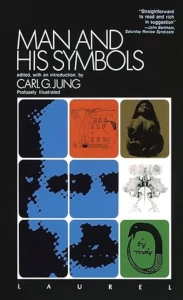
Man and His Symbols was Jung’s final work, published in 1964, and it’s deliberately written for general audiences. Jung knew most of his other writing was inaccessible to non-specialists, so he created this book specifically to introduce his ideas about how symbols shape human consciousness and influence our dreams, culture, and personal growth.
The book is beautifully illustrated and organized around the premise that understanding symbols—particularly the symbols that appear in dreams—can unlock hidden aspects of personality and promote self-awareness. Jung explains archetypes, the collective unconscious, and the process of individuation through accessible language and compelling examples.
What makes this book special is that Jung worked on it knowing he was dying. There’s an urgency to make his life’s work comprehensible, to bridge the gap between complex psychological concepts and everyday life. The other authors who contributed chapters (Marie-Louise von Franz, Joseph Henderson, Jolande Jacobi, and Aniela Jaffé) were close colleagues who understood his work deeply.
I recommend starting here if you’re completely new to Jung. You’ll get the essential ideas without needing a psychology background, and the visual elements make abstract concepts more concrete.
2. Modern Man in Search of a Soul

Modern Man in Search of a Soul is one of Jung’s most widely read works, and for good reason. It’s a collection of essays providing practical insights into psychotherapy, religion, and the human psyche that remain remarkably relevant nearly a century after publication.
Jung wrote these essays during the period when he was developing his mature thought. They cover the stages of life, the differences between his approach and Freud’s, the relationship between psychology and spirituality, and the meaning of dreams. What makes the book powerful is how Jung emphasizes self-knowledge, spirituality, and psychological balance as essential for navigating modern life.
I return to this book when I need to remember that psychology isn’t just about symptom reduction. Jung is asking bigger questions—what does it mean to live a meaningful life? How do we find purpose in a world that’s lost traditional sources of meaning? What role does spirituality play in psychological health even for people who aren’t religious?
These aren’t abstract philosophical questions. They show up constantly in my office. The successful executive who’s achieved everything he thought he wanted but feels empty. The mother who’s done everything “right” but doesn’t recognize herself anymore. Jung speaks directly to that kind of crisis.
3. The Undiscovered Self
The Undiscovered Self addresses the challenges of modern society, including alienation, conformity, and the loss of individuality. Written in 1957, it responds to the Cold War era’s anxieties about mass movements, totalitarianism, and the individual’s place in increasingly bureaucratic societies.
But Jung’s concerns feel more relevant now than ever. He’s writing about what happens when people lose touch with their inner lives because external pressures—social expectations, political ideologies, mass media—overwhelm individual consciousness. Jung emphasizes the need for self-awareness and inner growth to navigate the pressures of social and political systems without losing yourself in the process.
The book is short and accessible, making it perfect for readers who want Jung’s perspective on contemporary social issues without diving into his more technical psychological writings. I recommend this to patients who feel like they’re living according to others’ scripts rather than their own authentic desires and values.
Books About Psychological Structure and Personality
These books explore Jung’s theories about how the psyche is structured and how different personality types function. They’re more technical than the introductory books but still accessible to motivated readers.
4. Psychological Types

Published in 1921, Psychological Types introduces the concepts of introversion and extraversion, as well as the four fundamental psychological functions: thinking, feeling, sensation, and intuition. This classification system has had lasting impact on personality psychology and is the foundation for assessments like the Myers-Briggs Type Indicator.
But here’s what gets lost when people only know Jung’s typology through the MBTI—Jung wasn’t trying to put people in boxes or create a personality test. He was trying to understand why people with different psychological orientations literally experience reality differently. An introverted thinking type and an extraverted feeling type aren’t just different—they’re perceiving and processing the world through fundamentally different psychological structures.
The book is dense. Jung spends significant time analyzing historical and literary figures to illustrate his types. But if you’re interested in personality theory or if you work clinically with individuals and want to grasp why people approach life so differently, this book provides theoretical foundations you won’t get anywhere else.
I don’t use typology rigidly in clinical work, but I do find it helpful for recognizing that when a patient and I are talking past each other, we might be operating from different psychological functions. The introverted thinking type trying to make sense of emotions intellectually. The extraverted feeling type confused why their logical arguments aren’t changing how they feel. Jung’s typology helps me meet people where they actually are.
5. Two Essays on Analytical Psychology

This collection introduces foundational concepts in analytical psychology, including the personal and collective unconscious and the process of individuation. Jung examines the psychological conflicts between conscious and unconscious mind, offering profound insights into human behavior and mental health.
The first essay, “The Relations Between the Ego and the Unconscious,” explores how the ego develops and how it relates to both personal unconscious material (repressed or forgotten experiences) and collective unconscious material (archetypal patterns shared across humanity). The second essay, “On the Psychology of the Unconscious,” traces Jung’s break with Freud and the development of his own approach.
These essays are essential for anyone who wants to grasp the theoretical foundations of Jungian psychology. They’re more academic than the introductory books but they explain concepts that show up throughout his other writing. If you’re serious about Jung rather than just casually interested, read these essays.
6. Psychological Aspects of the Persona

Jung analyzes the persona—the social mask individuals present to the world—and its effects on personal development. He explains how overidentification with the persona can lead to inner conflict and disconnection from the authentic self.
This concept shows up constantly in therapy. The patient who’s so identified with being “the responsible one” that they can’t access their own needs or desires. The person whose professional identity has consumed their entire sense of self. The people-pleaser who’s lost track of what they actually want versus what makes others comfortable.
Jung isn’t saying we shouldn’t have personas—we need them to function socially. But when the persona becomes the whole identity rather than just one aspect of personality, problems develop. You’re performing a role rather than living authentically, and eventually that catches up with you in the form of depression, anxiety, or a sense that your life doesn’t belong to you.
This book helps readers recognize when they’ve over-identified with roles and how to differentiate between persona and authentic self. It’s particularly valuable for anyone experiencing a life transition—retirement, empty nest, career change—where an old persona no longer fits.
Books About the Unconscious and Symbols
These are Jung’s books exploring the unconscious mind, dream interpretation, and symbolic processes. They’re central to his thought and to analytical psychology’s practical application.
7. The Archetypes and The Collective Unconscious

In this book, Jung explores the collective unconscious—a concept describing universal, inherited elements of the human psyche shared across cultures. The text delves into archetypes, the recurring symbols, themes, and motifs that appear in myths, dreams, and art.
Jung’s claim is bold: beneath our personal unconscious (our own repressed material, forgotten memories, etc.) lies a deeper layer of unconscious that we share with all humans. This collective unconscious contains archetypal patterns—the Hero, the Mother, the Shadow, the Wise Old Man, the Anima/Animus—that structure human experience across cultures and throughout history.
This sounds mystical, and frankly, it is. Jung is making claims that are difficult to test empirically. But clinically, archetypal thinking is incredibly useful. When a patient describes a dream about being chased by a dark figure, recognizing that as potentially a shadow dream (encountering rejected aspects of self) provides interpretive framework. When someone’s going through a major life change, recognizing heroic journey patterns helps normalize the struggle and locate meaning in difficulty.
The book is academic and requires concentration. But if you want to grasp what Jung means by collective unconscious and archetypes—concepts central to everything else he wrote—this is the definitive text.
8. Symbols of Transformation

Originally published as Psychology of the Unconscious in 1912, Symbols of Transformation explores the role of mythology, dreams, and symbols in personal development. This was the book that cemented Jung’s break with Freud because it rejected Freud’s exclusively sexual interpretation of unconscious material.
Jung analyzes the fantasies of a young woman named Miss Miller, using her symbolic material to explore how unconscious processes use mythological and archetypal imagery. He argues that transformation—genuine psychological growth—happens through engaging with symbolic material from the unconscious rather than just understanding personal history intellectually.
The book is challenging and sprawling. Jung pulls in material from mythology, religion, anthropology, and literature to illustrate how symbols carry psychological meaning. It’s not a book you read casually. But it’s crucial for grasping Jung’s mature thought about the transformative power of the unconscious and how individuation actually happens.
9. Dream Analysis

In Dream Analysis, Jung offers practical guidance for interpreting dreams, arguing that dreams are messages from the unconscious that can illuminate hidden conflicts, desires, and potential. He explores symbolic language, recurring motifs, and archetypal imagery.
Jung’s approach to dreams differs fundamentally from Freud’s. For Freud, dreams disguise forbidden wishes. For Jung, dreams reveal—they’re the unconscious trying to communicate with consciousness, offering compensation for one-sided conscious attitudes or showing aspects of self we’re ignoring.
I work with dreams regularly in therapy, and Jung’s approach is more clinically useful than Freud’s in my experience. When you treat dreams as communications rather than disguises, patients can engage with them more openly and find genuine insight. The dream about falling might not be about castration anxiety—it might be the psyche saying “you’re moving too fast, you’ve lost your ground, slow down and find your footing.”
This book is based on a seminar series Jung conducted, so it has a conversational quality that makes it more accessible than some of his formal writings. If you’re interested in practical dream interpretation from a Jungian perspective, this is where to start.
10. On the Psychology of the Unconscious

This early work explores foundational ideas of analytical psychology, including dream interpretation, complexes, and archetypes. It provides readers with historical perspective on Jung’s intellectual development and the evolution of his psychological theories.
The book shows Jung working out his ideas in real time, moving away from Freudian theory toward his own distinctive approach. You can see him struggling with how to conceptualize unconscious material, how to make sense of symbolic imagery, how to explain psychological development in ways that don’t reduce everything to sexuality and childhood trauma.
For students of Jung or anyone interested in the history of psychology, this book illuminates how analytical psychology emerged. It’s not as polished as his later work, but that rawness makes it valuable for seeing the development of ideas that became central to depth psychology.
Books Connecting Psychology to Spirituality and Culture
Jung was unusual among psychologists for taking spirituality seriously as a psychological phenomenon rather than dismissing it as neurosis or delusion. These books explore that intersection.
11. Psychology and Religion

Jung explores the psychological significance of religious experience, analyzing how faith and spirituality influence the human psyche. He suggests that religious symbols serve as mirrors of the unconscious, offering guidance and insight for personal development.
Jung isn’t arguing for or against any particular religion. He’s examining religious experience as a psychological phenomenon—what function does it serve? Why do humans across all cultures develop religious beliefs and practices? His answer is that religion addresses psychological needs that purely rational approaches can’t meet.
This matters clinically because many patients struggle with spirituality. They’ve rejected traditional religion but feel like something’s missing. Or they maintain religious practice that feels hollow and performative. Or they’ve had profound spiritual experiences they can’t integrate with their rational worldview. Jung provides framework for taking spiritual experience seriously without requiring literal belief.
The book is based on lectures Jung gave at Yale, so it’s relatively accessible compared to some of his more technical writing. For anyone interested in the psychology of religion or for therapists working with patients navigating spiritual questions, this book is essential.
12. The Spirit in Man, Art, and Literature

In this collection of essays, Jung examines the interplay between psychology, creativity, and spirituality. He argues that artistic expression reflects unconscious processes and serves as a vehicle for psychological insight and personal growth.
Jung analyzes works by Joyce, Picasso, and others, exploring how art reveals psychological truths that conscious thought can’t directly access. He’s particularly interested in how creative individuals channel material from the collective unconscious, producing work that resonates across cultures because it taps into archetypal patterns.
This work is particularly relevant for therapists interested in expressive arts therapy, for artists trying to understand their own creative process, or for anyone interested in the psychological dimensions of literature and art. Jung shows how engaging with art—creating it or experiencing it deeply—can be psychologically transformative.
13. Psychology and Alchemy

In Psychology and Alchemy, Jung draws parallels between alchemy and psychological transformation, suggesting that alchemical symbols reflect inner processes of personal growth. He explores how mythological and symbolic motifs guide individuals in integrating the unconscious into conscious awareness.
This is one of Jung’s most challenging books. He’s arguing that medieval alchemists weren’t just trying to turn lead into gold literally—they were unconsciously engaged in psychological work, using chemical processes as symbols for spiritual and psychological transformation. The alchemical goal of creating the philosopher’s stone parallels the psychological goal of achieving wholeness through individuation.
Unless you’re deeply invested in Jung or specifically interested in esoteric symbolism, this probably isn’t where you start. But for advanced students of analytical psychology, it reveals dimensions of Jung’s thought about transformation that aren’t as explicit in more accessible works.
Books About Clinical Practice and Therapy
These books address Jung’s approach to psychotherapy and its practical application.
14. The Practice of Psychotherapy

This book presents Jung’s approach to psychotherapy, including techniques, case studies, and theoretical foundations. It emphasizes the therapist’s role in guiding clients through individuation, balancing analytical insight with empathy and intuition.
Jung’s therapeutic approach is less directive than many modern therapies. He’s not giving homework or teaching specific skills (though he doesn’t oppose those approaches). He’s creating space for unconscious material to emerge and be integrated. The therapeutic relationship itself becomes a container for transformation rather than just a context for applying techniques.
This matters because Jung reminds us that therapy isn’t just technical skill. It’s a human encounter between two people, and the therapist’s own psychological development directly affects their capacity to help others. If you haven’t done your own shadow work, you’ll miss your patients’ shadow material. If you haven’t wrestled with your own meaning crisis, you can’t help patients through theirs.
The book is valuable for practicing therapists, particularly those doing longer-term depth work. It won’t give you session-by-session protocols, but it will deepen your understanding of what actually facilitates psychological change.
15. Psychology of the Transference

This work focuses on the therapeutic relationship and the process of transference—the phenomenon where patients project unconscious material onto their therapist. Jung explains how transference can serve as a catalyst for self-awareness and psychological healing.
Jung uses alchemical images to illustrate stages of the therapeutic relationship, which sounds weird but actually works. He’s showing how the intense feelings that develop in therapy—idealization, erotic feelings, anger, dependency—aren’t obstacles to treatment. They’re the material of transformation when handled skillfully.
The book emphasizes that therapists must be conscious of their own countertransference—their emotional responses to patients—because those responses carry important information about what’s happening psychologically. This is advanced clinical material that assumes familiarity with psychodynamic concepts, but it’s invaluable for therapists doing relational work.
16. The Development of Personality

In The Development of Personality, Jung presents a concise overview of psychological growth and development across the lifespan. The book addresses how individuals move from dependency to autonomy and self-realization.
Jung’s developmental theory differs from stage theories like Erikson’s or Piaget’s. He’s less interested in universal stages everyone moves through and more interested in how individuation—becoming who you actually are rather than who you’re supposed to be—unfolds across the lifespan. This process often intensifies in midlife, when outer achievements stop providing meaning and people are forced to confront questions of authentic identity and purpose.
The book is relatively short and accessible, making it useful for general readers interested in lifespan development from a depth psychology perspective. It’s also helpful for therapists working with patients navigating life transitions.
Jung’s Most Personal and Complex Works
These final books represent Jung’s most intimate self-exploration and his most ambitious theoretical work.
17. Memories, Dreams, Reflections

Memories, Dreams, Reflections is Jung’s autobiography, providing deep personal insight into his life, thoughts, and experiences. Readers explore Jung’s formative years, his dreams, his encounters with patients, and the development of his ideas.
What makes this book essential is how Jung reveals the personal experiences underlying his theoretical work. His childhood visions and dreams. His intense relationship with Freud and their eventual split. His own psychological crisis—what we’d now call a breakdown—when he explored his unconscious through active imagination and created the material that became The Red Book.
The book offers a unique blend of personal narrative and professional reflection. You’re not just learning about Jung’s theories—you’re seeing how they emerged from his lived experience and his own psychological struggles. For anyone serious about Jung, this autobiography provides crucial context for everything else he wrote.
18. The Red Book

The Red Book, or Liber Novus, is Jung’s most personal and unusual work. It documents his encounters with the unconscious during a period of personal crisis between 1913 and 1930. Filled with vivid illustrations, calligraphy, and visionary experiences, it reveals the mystical and visionary dimensions of his psyche.
This book wasn’t published until 2009, decades after Jung’s death, because he considered it too personal and unconventional. Reading it is like witnessing someone’s descent into and return from the depths of the psyche. Jung records dialogues with archetypal figures—Philemon, Salome, the serpent—treating them as autonomous presences with wisdom to impart.
The Red Book is challenging and weird. It won’t make sense if you’re looking for straightforward psychology. But it reveals the experiential foundation of Jung’s later theoretical work. The concepts that show up in his academic writing emerged from this intense confrontation with his own unconscious. For anyone interested in the visionary or mystical dimensions of depth psychology, this book is incomparable.
19. Aion: Researches into the Phenomenology of the Self

In Aion, Jung investigates the concept of the self as an archetypal structure representing wholeness and integration. The book explores shadow aspects, ego development, and individuation, offering deep examination of how individuals achieve psychological balance.
Jung also explores Christian symbolism and its psychological meaning, examining how the figure of Christ represents the self archetype. He traces the evolution of religious imagery across historical periods, arguing that these shifts reflect changes in collective consciousness.
This is dense, academic work for advanced students of analytical psychology. Unless you’re deeply invested in Jung’s theoretical system, particularly his concept of the self as central organizing principle of the psyche, you probably won’t get through this book. But for serious scholars, it represents Jung’s most sophisticated thinking about psychological wholeness.
20. Collected Works of C.G. Jung

The Collected Works of C.G. Jung is a comprehensive compilation of Jung’s writings spanning essays, lectures, and books. This monumental series—20 volumes plus supplementary material—is indispensable for serious students and scholars, providing access to the full breadth and depth of Jung’s thought across multiple domains including psychology, philosophy, art, and spirituality.
This isn’t where you start unless you’re pursuing graduate work in Jungian psychology or becoming a Jungian analyst. It’s a reference library, not a reading project. But I mention it because people sometimes ask where to find Jung’s complete writings on a particular topic—individuation, the anima/animus, synchronicity, etc. The Collected Works is where that material lives, organized thematically across volumes.
Libraries often have the Collected Works, so you can access specific volumes without buying the entire set. If you’re writing academically about Jung or practicing as a Jungian analyst, you’ll eventually need these volumes. For general readers, the individual books I’ve already discussed provide everything you need.
21. Modern Man in Search of a Soul (Second Edition)

This expanded edition of Jung’s classic work includes additional essays and reflections on therapy, spirituality, and societal challenges. It provides comprehensive introduction to Jungian thought, emphasizing the relevance of psychological insight in daily life.
The second edition adds material that deepens the themes of the original. If you’re choosing between the original and this edition, get this one—you’re getting everything from the first plus bonus content that extends Jung’s thinking on topics like the stages of life and the relationship between psychology and religion.
This expanded version works as both introduction for newcomers and valuable reference for people already familiar with Jung’s thought who want more material on specific topics covered in the original essays.
FAQs About The 21 Best Books By Carl Gustav Jung
What is the best book by Carl Jung for beginners?
Man and His Symbols is the best starting point. Jung wrote it specifically for general audiences, and it explains core concepts like archetypes and the collective unconscious with clear language and helpful illustrations. If you want something more narrative, Memories, Dreams, Reflections provides personal context that makes his theoretical work more accessible. Modern Man in Search of a Soul also works well for beginners interested in practical applications rather than pure theory.
Which Jung book explores the unconscious most deeply?
The Red Book provides the most intimate and profound exploration of unconscious experiences, documenting Jung’s personal confrontation with his own psyche through visionary narratives and symbolic illustrations. It’s challenging and unconventional, but nothing else reveals the experiential depths underlying his theoretical work. For more academic exploration of the unconscious, The Archetypes and The Collective Unconscious is definitive.
Are Jung’s books suitable for self-help purposes?
Yes, many of Jung’s writings provide practical insights for personal growth. Modern Man in Search of a Soul and The Undiscovered Self offer accessible guidance for self-awareness and psychological resilience. Man and His Symbols helps readers work with their own dreams and symbolic material. Jung isn’t self-help in the conventional sense—he’s not offering quick fixes or simple techniques. But his work provides frameworks for understanding yourself and navigating life’s psychological challenges.
What is the significance of archetypes in Jung’s work?
Archetypes are universal patterns and symbols present in the collective unconscious that structure human experience. They appear across cultures in myths, dreams, and art because they represent fundamental human situations and relationships—the mother, the hero, the shadow, the wise guide. Understanding archetypes helps you interpret dreams, recognize patterns in your own development, and grasp the shared psychological heritage connecting all humans. The Archetypes and The Collective Unconscious explores this concept thoroughly.
Which book should psychologists read to understand Jungian therapy?
The Practice of Psychotherapy is essential for practical guidance on applying Jungian concepts clinically. It covers techniques, case studies, and theoretical foundations. Psychology of the Transference addresses the therapeutic relationship specifically and is valuable for depth-oriented work. Two Essays on Analytical Psychology provides theoretical foundations that inform clinical practice. Most Jungian analysts have read all three plus significant additional training.
Can Jung’s work be applied to art and creativity?
Absolutely. The Spirit in Man, Art, and Literature explicitly explores how artistic expression reflects unconscious processes and fosters insight. Jung argues that creativity involves channeling material from the collective unconscious, which is why great art resonates across cultures—it taps into archetypal patterns we all share. Many artists, writers, and creative therapists find Jung’s work deeply relevant to understanding and facilitating creative process.
How does Psychological Types influence modern personality theory?
Psychological Types introduced introversion and extraversion as fundamental personality dimensions and identified four psychological functions (thinking, feeling, sensation, intuition). This framework became the foundation for the Myers-Briggs Type Indicator and influenced countless other personality assessments. Jung’s typology remains relevant because it captures genuine differences in how people perceive and engage with reality, not just superficial behavioral differences.
Are all Jung books difficult to read?
No. Books like Man and His Symbols, Modern Man in Search of a Soul, and Memories, Dreams, Reflections are accessible to general readers. Others like Aion, Psychology and Alchemy, and parts of the Collected Works are academically dense and require significant background knowledge. Start with the accessible books, build your understanding, then tackle more technical works if you’re interested. Don’t let fear of difficulty stop you from engaging with the introductory texts—they’re genuinely readable.
Which books address spirituality most directly?
Psychology and Religion focuses specifically on religious experience from a psychological perspective. The Spirit in Man, Art, and Literature explores spirituality through creativity and cultural expression. Modern Man in Search of a Soul discusses spirituality’s role in psychological health. Jung took spiritual experience seriously as meaningful psychological phenomenon rather than dismissing it as delusion, making his work valuable for people navigating spiritual questions.
Where should I start if I want comprehensive study of Jung’s work?
Start with Memories, Dreams, Reflections for personal context, then read Man and His Symbols for accessible theory. Move to Two Essays on Analytical Psychology for theoretical foundations. From there, explore specific interests—dreams, personality types, therapy, spirituality—through relevant books. The Collected Works becomes useful once you’ve built foundational knowledge and want to dive deep into specific topics. Don’t try to read everything at once—Jung’s corpus is massive and requires time to digest.
By citing this article, you acknowledge the original source and allow readers to access the full content.
PsychologyFor. (2025). The 21 Best Books by Carl Gustav Jung. https://psychologyfor.com/the-21-best-books-by-carl-gustav-jung/