

Imagine being able to travel to a world where you can explore different scenarios without leaving your room. This is essentially the concept of thought experiments—powerful cognitive tools used to explore ideas, test hypotheses, and push the boundaries of our understanding without needing physical experiments or real-world implementation. Thought experiments are especially common in fields like philosophy, psychology, and science, where they allow us to envision and test the consequences of theories, concepts, or ethical dilemmas.
Thought experiments encourage creative thinking, help clarify complex ideas, and often provoke new questions or insights. Whether it’s imagining a world where time travel is possible, or questioning how a society might behave under different moral principles, thought experiments allow us to explore scenarios that are difficult or impossible to test in the real world.
This article will explore what thought experiments are, their uses in different fields, and provide several examples that demonstrate their power in shaping human knowledge and understanding.
What Is a Thought Experiment?
A thought experiment is an imaginative exercise where a hypothetical scenario is created and explored mentally, rather than through physical experimentation. This method is widely used to test concepts, propose new theories, or critically evaluate existing ideas by imagining situations in which certain variables change or new rules are applied.
Unlike traditional scientific experiments that rely on physical observation and data collection, thought experiments focus on mental exploration of possible outcomes, often guided by logic, reasoning, or hypothetical reasoning. They are particularly useful when it is not feasible to conduct real-world experiments, due to practical, ethical, or logistical limitations.
Uses of Thought Experiments
Thought experiments have mainly arisen from a specific intention or purpose: to understand how a phenomenon works, without the need to actually experiment with it.
However, others have emerged from this same intention, for example, that of justify or refute the legitimacy of a philosophical, mathematical, historical, economic or scientific model (especially they have been used in physical sciences).
That is to say, thought experiments have three main uses: explaining, legitimizing or refuting explanatory models about the nature of a phenomenon. However, these two uses may be more specific according to the author who proposes them, or according to the theoretical and philosophical position that supports them.
For example, they have been widely used not only in the physical sciences but in philosophy of mind and morals, in cognitive and computational sciences, and in formal education. That is why they have also been considered a model for teaching, that is, a didactic tool.
In contrast to these uses and functions, thought experiments have also faced some criticism. For example, there are those who consider that they are simply intuitions and as such, they cannot sustain sufficient rigor to be considered in terms of scientific knowledge or methodology.
Testing Theories and Hypotheses
Thought experiments allow us to test the validity of theories and hypotheses without needing to physically execute them. They help to evaluate ideas by projecting their potential implications in various imagined situations. For example, thought experiments can be used to determine whether a particular scientific theory holds true when applied in extreme or unusual circumstances.
In physics, thought experiments help scientists consider scenarios that are difficult to observe directly, such as imagining what would happen if a person fell into a black hole or how light behaves in extreme gravitational fields. These thought experiments provide insights into scientific principles and theories, allowing scientists to refine their understanding of complex phenomena.
Ethical Exploration
Thought experiments are a staple in ethics and moral philosophy, where they help examine the ethical consequences of actions, policies, or societal structures. By exploring hypothetical moral dilemmas, these experiments challenge our ethical frameworks and encourage deeper analysis of right and wrong.
A classic example of an ethical thought experiment is the trolley problem, where you must decide whether to divert a runaway trolley to kill one person and save five others. The dilemma probes questions about utilitarianism, the value of individual lives, and the ethics of making difficult decisions.
Clarifying Complex Concepts
In both science and philosophy, thought experiments are used to clarify and explore complex or abstract concepts. By constructing hypothetical situations, thinkers can better understand how these concepts might manifest in different scenarios. Thought experiments simplify intricate ideas by breaking them down into more accessible or relatable situations, allowing individuals to engage with complex problems at a conceptual level.
For example, in philosophy, the brain-in-a-vat scenario is often used to question the nature of reality and perception. It suggests a situation where the brain is kept alive in a vat of nutrients while being stimulated to experience a virtual reality. This experiment questions how we can know if what we perceive as reality is true, prompting deeper reflection on knowledge and existence.
Encouraging Creative Problem-Solving
Thought experiments also serve as a tool for creative problem-solving. They encourage thinking outside of traditional boundaries and generate new ideas or solutions to existing problems. By imagining alternative realities, individuals can step beyond the constraints of current knowledge and propose novel solutions or approaches.
In engineering or technology, thought experiments can help identify potential innovations by imagining future scenarios that incorporate cutting-edge technologies. This process stimulates forward-thinking and exploration of new possibilities for technological advancements.
Famous Thought Experiments and Examples
1. Schrödinger’s Cat
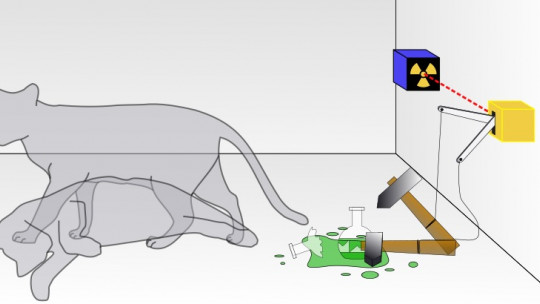
One of the most well-known thought experiments in modern science is Schrödinger’s Cat, proposed by physicist Erwin Schrödinger in 1935. The experiment was designed to illustrate the strange nature of quantum mechanics, particularly the concept of superposition. In this experiment, a cat is placed inside a sealed box with a radioactive atom, a Geiger counter, and a vial of poison. If the atom decays, the poison is released, killing the cat. If it doesn’t decay, the cat remains alive.
In quantum mechanics, until the box is opened and the cat is observed, it is said to be both alive and dead simultaneously. This paradox highlights the bizarre and counterintuitive principles of quantum physics, challenging our understanding of reality and observation. Although Schrödinger’s Cat is not meant to be a literal scenario, it has been influential in discussions of quantum theory and the observer effect.
2. The Trolley Problem
The trolley problem is a well-known ethical thought experiment that explores moral dilemmas. In the classic scenario, a trolley is heading toward five people tied to the tracks, and you have the option to pull a lever to divert the trolley onto another track where only one person is tied. The question is whether it is morally acceptable to sacrifice one life to save five others.
This thought experiment challenges ethical frameworks like utilitarianism (maximizing overall happiness) versus deontological ethics (following rules regardless of the consequences). The moral quandary posed by the trolley problem has made it a popular subject in discussions about ethical decision-making, particularly in the fields of philosophy and bioethics.
3. The Ship of Theseus
The Ship of Theseus is a thought experiment used to explore questions about identity and change. The scenario presents a ship that is gradually having its parts replaced over time. Eventually, every single part of the ship is replaced with new material. The question posed is: Is the ship still the same ship, or is it a completely new ship after all the changes?
This thought experiment raises questions about the nature of identity and continuity—whether an object remains the same when all of its components have been altered. The Ship of Theseus is often used in philosophy to explore personal identity, especially in relation to the mind-body problem.
4. The Brain in a Vat
The brain-in-a-vat scenario is a thought experiment that challenges our understanding of reality and perception. In this scenario, a brain is kept alive in a vat of nutrients and is connected to a computer that provides it with simulated experiences, much like a virtual reality. The brain believes it is experiencing the real world, but it is actually living in a simulation.
This thought experiment is often used to illustrate skepticism about knowledge and perception. It poses the question: How can we know if what we experience is real, or if we are simply being deceived by an external force?
5. The Chinese Room
The Chinese Room thought experiment, proposed by philosopher John Searle, challenges the idea of artificial intelligence. In this scenario, a person who does not speak Chinese is locked in a room with a set of instructions for manipulating Chinese symbols. The person can produce Chinese responses to questions by following the instructions, but they do not understand the language.
Searle used this thought experiment to argue that computers or artificial intelligence may be able to simulate understanding but do not truly understand the information they process. The experiment raises important questions about the nature of consciousness and artificial intelligence.
FAQs about Thought Experiments
What is the purpose of a thought experiment?
The purpose of a thought experiment is to explore hypothetical scenarios to test ideas, examine ethical dilemmas, or evaluate the consequences of various theories. Thought experiments help clarify complex concepts and encourage creative problem-solving.
Are thought experiments used in science?
Yes, thought experiments are commonly used in science, particularly in areas where real-world experiments are difficult or impossible to perform. They help scientists imagine hypothetical scenarios, explore theories, and understand complex scientific principles.
Can thought experiments be used in everyday life?
Yes, thought experiments can be used in everyday life to help make decisions, clarify personal values, or explore potential outcomes of various actions. They encourage critical thinking and promote a deeper understanding of complex issues.
Why are thought experiments important in philosophy?
In philosophy, thought experiments are used to test moral, metaphysical, and epistemological theories. They help philosophers probe complex questions about the nature of existence, reality, ethics, and human behavior, often leading to important insights and debates.
Can thought experiments lead to real-world applications?
Yes, thought experiments can inspire real-world applications by encouraging innovative thinking and prompting new ideas that can be tested in the real world. They are often used to guide scientific discovery, influence policy decisions, or reframe societal norms.
Use this citation format to reference the article clearly and help readers find the original source.
PsychologyFor. (2025). What Are Thought Experiments? Uses and Examples. PsychologyFor. https://psychologyfor.com/what-are-thought-experiments-uses-and-examples/