

See more of our articles in your search results.
Perception is a characteristic of the human being. Don’t we bond with other people based on the perception we have in social encounters? Let’s think for a moment about certain random animals and cars: it is evident that the shapes vary. This is not only applicable to forms in general, we could also address the level of sentences since the human being can give meaning to what he says and hears from the interpretation that is made of the language.
Furthermore, it is also possible to understand a totality referring to any topic in question even if it is incomplete. And people can realize some meaning if they complete the pieces of the puzzle. If what you are reading is interesting to you, these lines may help you. In this PsychologyFor article, we will provide you with information about What is the Gestalt law of closure and examples<
What is the Gestalt law of closure?
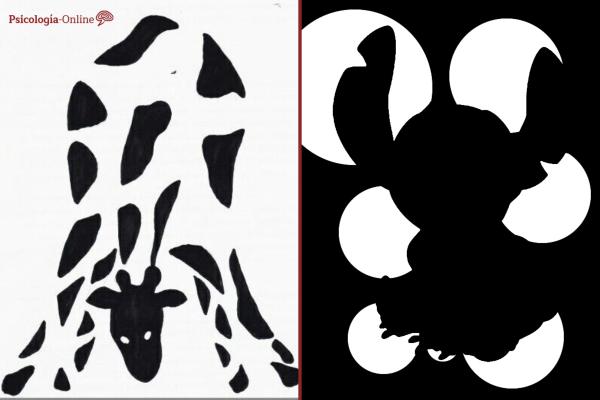
When we refer to the Gestalt law of closure, we are referring to one of the particular laws adopted by Gestalt theory. In a more simplified way, this law has the principle of the tendency of the mind to make sense and/or close sentences and images from the perception of the stimulus that arises. For this reason, it is possible that people can understand what is presented to them even if the stimulus appears incomplete.
How many of these have you been "meaning to read" for months?
- 1
 TarcherThe Artist's Way30th Anniversary EditionListen Free On Audible
 - 2
 New Harbinger PublicationsThe Dialectical Behavior Therapy Skills WorkbookPractical DBT Exercises for Learning Mindfulness, Interpersonal Effectiveness, Emotion Regulation...Listen Free On Audible
 - 3
 New Harbinger PublicationsAdult Children of Emotionally Immature ParentsHow to Heal from Distant, Rejecting, or Self-Involved ParentsListen Free On Audible
How to use the Gestalt law of closure
Now that you know what the law of Gestalt Closure is, I will explain how it is used: in principle, in order to perceive the incomplete forms that people can understand in everyday life, it is necessary to start from prior knowledge. In other words, the ability to recognize and close shapes It can be carried out if you have some previous experience in relation to the object, image and/or word that you want to close.
Following these aspects, we will place three steps that the mind carries out to exercise the Gestalt law of closure:
- Stimulus recognition: consists of the association of the image, word, phrase and/or object with some memory that allows us to know what is presented to the person. Here previous experiences come into play that raise a relationship with the stimulus in question.
- Shape Perception: one of the principles of Gestalt theory lies in giving greater value to the totality of the stimulus than to the sum of its parts. When it comes to incomplete forms, the mind has the ability to perceive the stimulus even if something is missing.
- Closing: when the incomplete stimulus has been perceived, the mind tends to close the form based on the knowledge acquired during the course of life.
Examples of the Gestalt law of closure
In order to provide greater clarity to the topic being addressed, it is essential to provide some examples in which the Gestalt law of closure can be glimpsed because this principle has great theoretical implications. For this reason, we will develop some examples linked to the field of advertising and daily life:
Gestalt Law of Closure in Advertising
One of the main uses of the Gestalt law of closure is the realization of brand logos of various products. The purpose of the incomplete shapes that appear in advertising logos lies in the fact that the person remembers the image observed because the mind closes what he has seen.
As an example, one could think of the logos of some computer brands as well as globally recognized supermarket chains. Beyond this, factors such as color, symmetry, among others, come into play here.
Gestalt Law of Closure in Everyday Life
Another example of Gestalt’s law of closure in everyday life is the casual conversations that take place in various social settings. In general terms, it usually happens that a person is recounting some event and leaves an incomplete sentence or a certain word.
When this occurs, the mind of the person listening tends to fill in what is missing as this becomes a more stabilizing aspect for itself.
We hope you found this post about the Gestalt law of closure interesting. If you want to continue investigating the topic, we recommend reading our article What is the Gestalt law of proximity.
This article is merely informative, at PsychologyFor we do not have the power to make a diagnosis or recommend a treatment. We invite you to go to a psychologist to treat your particular case.
If you want to read more articles similar to What is the Gestalt law of closure and examples we recommend that you enter our Cognitive Psychology category.
Bibliography
- López Ortiz, RH (2016). Analysis of the Gestalt laws and their application in teaching materials for early education children II. Pontifical Catholic University of Ecuador Esmeraldas headquarters. Faculty of Administrative and Accounting Sciences, School of Graphic Design.
- Oviedo, GL (2004). The definition of the concept of perception in psychology based on Gestalt theory. Journal of Social Studies, 18 (3), 89-96.
Use this citation format to reference the article clearly and help readers find the original source.
PsychologyFor. (2023). What is the Gestalt Law of Closure and Examples. PsychologyFor. https://psychologyfor.com/what-is-the-gestalt-law-of-closure-and-examples/