

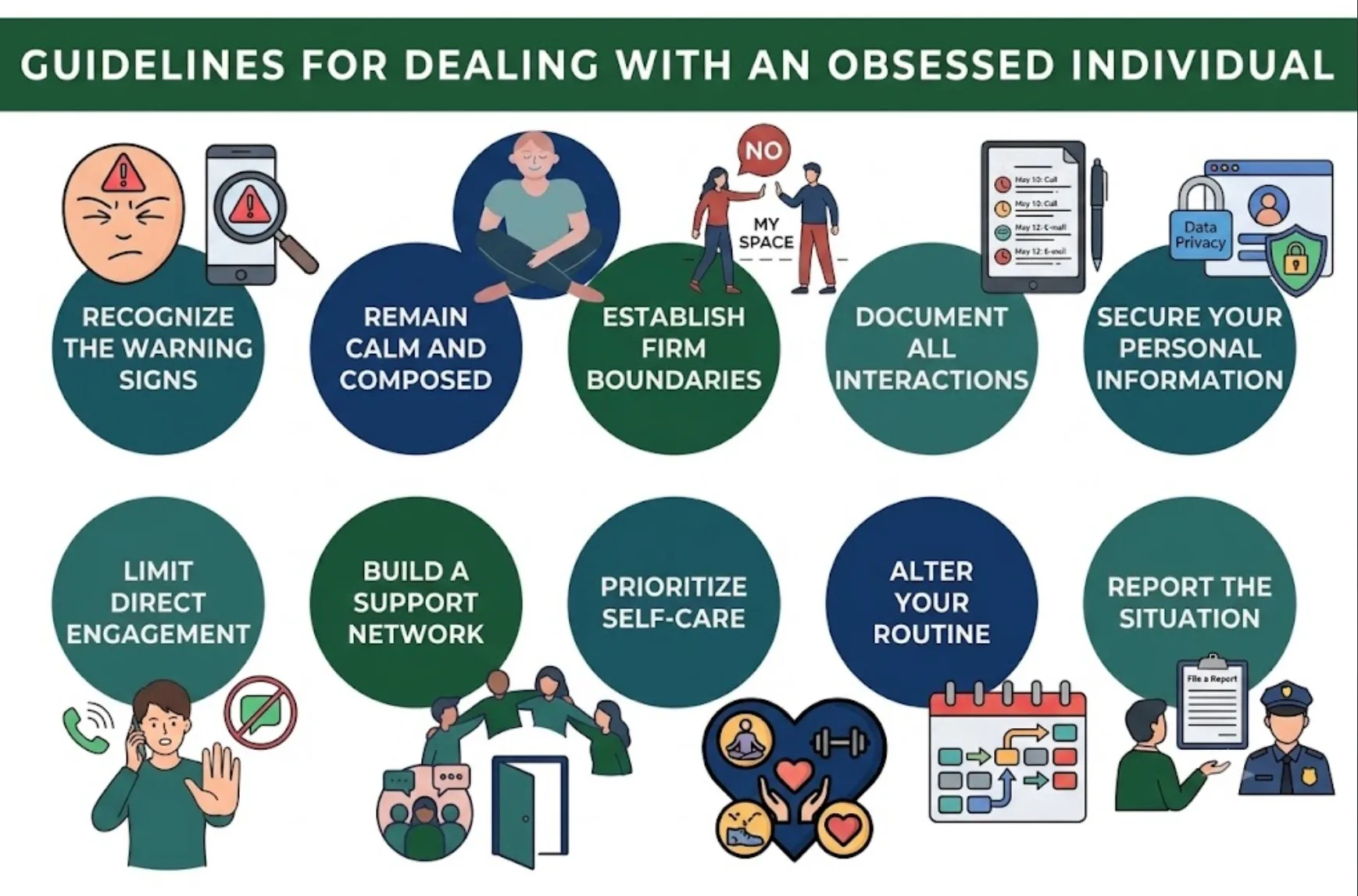
There is a significant difference between someone who deeply admires you and someone who has developed an obsessive fixation on you. The first feels flattering, warm, even reciprocal. The second feels like something has shifted — there is an intensity that goes beyond normal affection, a persistence that ignores your signals, a possessiveness that did not come with permission. You may have noticed the excessive messages, the unexpected appearances, the way they seem to monitor your life, or the emotional escalation that follows any attempt on your part to create distance. And now you are wondering: what do I do?
This question is more common than many people realize. Obsessive behavior toward another person exists on a wide spectrum — from the person who simply cannot move on after a rejection, to patterns that involve stalking, intimidation, or genuine threat. Understanding where on that spectrum the situation falls, and calibrating your response accordingly, is one of the most important things you can do for your own safety and wellbeing — and, where it is safe to do so, for the other person’s.
The psychology of obsession in relationships is well-documented. Obsessive love — characterized by intrusive thoughts, intense jealousy, possessiveness, and an inability to respect the other person’s autonomy — is associated with a range of underlying psychological conditions including attachment disorders, obsessive-compulsive spectrum conditions, erotomania, and certain personality disorders. Understanding these roots does not mean excusing harmful behavior. It means understanding what you are dealing with — because the most effective way to respond depends enormously on what is actually driving the behavior.
This article provides a comprehensive, psychologically grounded guide to navigating a situation in which someone has become obsessed with you — covering how to recognize the signs, the psychological mechanisms involved, how to communicate boundaries effectively, how to protect your own wellbeing, and when the situation requires professional or legal intervention.
If you are in immediate danger, contact emergency services immediately.
How to Recognize When Admiration Has Become Obsession
Recognizing obsession early gives you the maximum range of responses. The transition from intense admiration to obsessive fixation is not always dramatic — it often develops gradually, and the person experiencing it rarely announces it clearly. Learning to identify the signs protects you from minimizing a serious situation and from mistaking ordinary affection for something more problematic.
The following patterns consistently distinguish obsessive behavior from healthy, if intense, interest:
- Disproportionate contact volume: Sending messages repeatedly without waiting for a response, calling multiple times in quick succession, showing up at locations without invitation or prior arrangement. The volume of contact is far beyond what the relationship level would warrant.
- Monitoring and surveillance behavior: Tracking your movements, appearing at locations you did not share with them, checking your social media activity intensively, asking others about your whereabouts and activities, or displaying knowledge of your routine that you did not provide.
- Intense emotional reactions to ordinary distance: Reacting with extreme distress, anger, or desperation to normal, healthy behaviors on your part — such as not responding immediately to a message, spending time with other people, or declining an invitation.
- Possessive language and thinking about someone they have no established relationship with: Referring to you as “mine,” expressing jealousy about your relationships with others, or framing your autonomy as a betrayal.
- Ignoring stated boundaries: Continuing contact after you have clearly asked them to stop, returning after you have ended communication, finding new routes to contact after previous ones are blocked.
- Idealization combined with controlling behavior: Expressing intense admiration, love, or devotion alongside behavior that seeks to limit your freedom, access to others, or independence.
- Escalation patterns: The behavior intensifies over time rather than moderating — what begins as excessive contact progresses to monitoring, which progresses to confrontation, which may progress to intimidation.
Not all of these signs are present in every case, and their presence does not automatically indicate danger. But the pattern — particularly the escalation pattern and the consistent disregard for your stated preferences — is the most important diagnostic feature. A person who genuinely cares about you will ultimately respond to clear, consistent boundary-setting. A person in the grip of obsessive fixation typically cannot.

The Psychology Behind Obsessive Behavior: Why It Happens
Understanding the psychological mechanisms driving obsessive behavior toward another person does not require you to sympathize with it or accept it. But it does help you respond more strategically and avoid the common mistakes that can inadvertently reinforce or escalate the pattern.
Several psychological frameworks illuminate what is typically happening:
Attachment theory — developed by John Bowlby and extended by researchers including Mary Ainsworth and Kim Bartholomew — provides one of the most useful frameworks. People who develop obsessive patterns in their orientation toward others frequently show features of anxious or fearful-avoidant attachment: a deep, chronic fear of abandonment; an intense need for validation and closeness combined with profound difficulty trusting that closeness is secure; and hypervigilance to any signal of rejection or withdrawal. When their attachment system is activated by someone they are attracted to, the threat of losing access to that person — even before any genuine relationship has been established — can trigger desperate, controlling behavior that is driven more by terror of loss than by genuine love.
Limerence — a concept introduced by psychologist Dorothy Tennov to describe an involuntary obsessive state of intense romantic preoccupation — helps explain the cognitive and emotional experience from the inside. The person in a state of limerence is not simply choosing to fixate; they are experiencing intrusive, compulsive thoughts about the object of their fixation that they may find distressing and difficult to control. This does not make their behavior acceptable, but it does help explain the qualitative difference between obsessive preoccupation and ordinary romantic interest.
Erotomania — also known as de Clérambault’s syndrome — is a specific delusional condition in which the person believes that someone (often of higher social status) is in love with them, despite clear evidence to the contrary. Erotomania represents the more severe end of the obsessive spectrum and is associated with serious mental illness. People with erotomania may interpret your attempts to disengage as coded messages of hidden affection, making ordinary responses ineffective and potentially reinforcing. This is a situation that requires clinical and potentially legal intervention rather than personal management.
Obsessive-compulsive spectrum considerations are also relevant. Obsessive thoughts about another person can occur within the broader context of OCD-spectrum conditions, where the intrusive thoughts about the person are ego-dystonic — experienced as unwanted and distressing — rather than as expressions of genuine desire. This distinction has implications for treatment, as OCD-spectrum obsession responds to different clinical approaches than attachment-based obsession.
Finally, narcissistic and controlling personality patterns may drive obsessive behavior that is less about genuine love or fear of loss and more about the need for control, the intolerance of rejection, and the experience of the other person as an object of possession rather than a separate individual with independent will. This profile — sometimes associated with narcissistic personality disorder or aspects of dark triad psychology — requires particularly careful management, as attempts to reason or empathize may be experienced as concession rather than communication.

How to Set Boundaries with Someone Obsessed with You
Boundary-setting with an obsessive person is one of the most psychologically demanding interpersonal challenges there is — because many of the normal principles of boundary communication do not apply in the same way, and because the stakes of getting it wrong can be significant.
The most important principle — and the one most frequently violated by well-meaning people in this situation — is the principle of clear, single communication followed by consistent silence. The instinct, when someone is persistent and distressed, is to explain, justify, soften, negotiate, and repeatedly clarify. This instinct is completely understandable. It is also, in most cases, counterproductive.
Every response you give — however firm, however clear — provides the obsessive person with something: contact, engagement, evidence that you are still thinking about them, and often implicit evidence that continued contact produces some form of response. Variable reinforcement schedules — where a behavior is sometimes rewarded and sometimes not — are the most powerful reinforcement schedules known in behavioral psychology. An intermittent response to persistent contact may be more reinforcing than consistent engagement would be.
The evidence-based approach involves:
- State the boundary once, clearly and calmly. You do not need to justify it, explain it extensively, or apologize for it. “I need you to stop contacting me. I will not be responding to further messages.” Said once, clearly, without anger or emotional elaboration, this is the most effective single communication you can make.
- Follow through with complete consistency. After stating the boundary, do not respond to further contact — not to explain again, not to express frustration, not to check in on their wellbeing. Every response resets the reinforcement clock. Consistency is not cruelty; it is the clearest possible signal that the boundary is real.
- Do not soften the message with ambiguous signals. Expressions of caring, concern for their feelings, offers of friendship, or explanatory messages that acknowledge the depth of their feelings may feel kind. In the context of obsessive fixation, they are often interpreted as invitations to continue or escalate. Clarity, delivered calmly and without elaboration, is the most genuinely compassionate response available.
- Limit digital access. Block on all platforms where contact is possible — not as punishment but as a practical reduction of access and stimulation. This includes secondary accounts, messaging platforms, and any other routes through which contact has been attempted.
- Inform trusted people in your life. Tell close friends, colleagues, and family members what is happening so that they are not inadvertently recruited as information sources, and so that you have support and witnesses for anything that escalates.
One important caveat: in situations involving significant threat assessment risk, consulting with a threat assessment professional or law enforcement before communicating the boundary may be appropriate. In some high-risk cases, a sudden, clear boundary communication can trigger escalation. Understanding the risk level of your specific situation should inform how you proceed.

Common Mistakes to Avoid When Dealing with Obsessive Behavior
People navigating obsessive attention from another person often make well-intentioned errors that inadvertently prolong or intensify the situation. Knowing what not to do is as important as knowing what to do.
- Do not try to let them down gently through gradual distancing. Vague, gradually increasing distance is experienced by the obsessive person as ambiguity — as a puzzle to be solved, a signal to be decoded, or a challenge to overcome. Clear, direct communication — even when it feels unkind — is more effective and ultimately less harmful than a prolonged period of mixed signals.
- Do not engage with the content of their fixation. Explaining why you are not right for them, discussing the nature of your feelings, analyzing their behavior, or trying to reason them out of their feelings engages with the fixation itself — keeping it alive and giving it material to work with. This is not a conversation that can be resolved through logic.
- Do not display anger or emotional reactivity. Strong emotional responses — even negative ones — provide intensity of connection that can be reinforcing. A calm, neutral tone in any necessary communication is more effective than expressing the frustration you genuinely feel.
- Do not accept unwanted contact to avoid conflict. The path of least resistance — tolerating messages, accepting calls, spending time with the person to manage their distress — signals that persistence is rewarded. Even when setting the boundary feels harder in the short term, it is consistently better for both parties in the long term.
- Do not dismiss escalating warning signs. People in this situation sometimes minimize their concerns — “they’re harmless,” “they’re just struggling,” “it’s not that bad.” Take your own discomfort seriously. Escalating behavior warrants escalating response.
- Do not engage through third parties. Sending messages through mutual friends, asking others to explain your position, or using intermediaries to manage the situation creates ambiguity and additional contact routes. When the boundary is set, it should be maintained through all channels.
Protecting Your Own Mental Health and Emotional Wellbeing
Being the object of someone’s obsession is a genuinely stressful experience — and its psychological impact on you deserves explicit acknowledgment and care. The fear, hypervigilance, guilt, and emotional exhaustion that often accompany this situation are real and significant, and they require active attention rather than dismissal.
Several dynamics are particularly common in people navigating obsessive attention from another:
Misplaced guilt and responsibility is one of the most consistent psychological burdens. Many people feel, consciously or not, that they are somehow responsible for the other person’s obsession — that they encouraged it, failed to discourage it early enough, or should be able to fix it. This is almost invariably inaccurate. Obsessive fixation is driven by the internal psychological dynamics of the person experiencing it; you did not cause it and cannot resolve it through personal adjustment. Releasing misplaced responsibility is important both for your emotional health and for making clear-headed decisions about how to respond.
Chronic hypervigilance — the state of ongoing threat monitoring that develops when you cannot predict when or how the obsessive contact will arrive — is psychologically exhausting and shares features with trauma responses. The nervous system cannot distinguish between actual and anticipated threat, and sustained hypervigilance produces the same physiological and psychological effects as sustained stress exposure: impaired sleep, concentration difficulties, emotional dysregulation, and physical health impacts. Recognizing this as a genuine psychological consequence — not an overreaction — is important for seeking appropriate support.
Social withdrawal and secondary isolation sometimes develop as people limit their own activities, relationships, and movements to reduce the risk of unwanted encounters. This secondary restriction of your own life deserves attention: the person’s behavior should not progressively narrow your world. Maintaining your own social connections, activities, and routines — with appropriate safety awareness — is both a practical and psychological priority.
Seeking support from a therapist who has experience with interpersonal trauma, stalking, or boundary violations can be genuinely valuable — not because experiencing obsessive attention means something is wrong with you, but because having a professional space to process the emotional complexity of the situation, think through your responses, and maintain your own psychological orientation is a legitimate and important resource.

When Obsession Becomes Stalking: Recognizing the Legal Threshold
Obsessive behavior exists on a spectrum, and part of acting effectively in this situation involves understanding where behavior crosses the line from unwanted attention into legally actionable stalking or harassment. This distinction is important both for your own safety planning and for knowing when and how to involve authorities.
Stalking is generally defined in law as a pattern of behavior directed at a specific person that would cause a reasonable person to feel fear. While legal definitions vary by jurisdiction, stalking typically involves:
- Repeated unwanted contact (in person, by phone, online, or through third parties) after the person has been asked to stop
- Following or monitoring the person’s movements
- Appearing at the person’s home, workplace, or other locations
- Sending unwanted gifts or objects
- Threatening behavior, whether explicit or implied
- Damaging property
- Gathering information about the person through surveillance or third parties
If the behavior you are experiencing meets these criteria, several concrete steps are important:
- Document everything. Keep records of all unwanted contact — screenshots of messages, notes of in-person incidents with dates, times, and locations, records of any witnesses. This documentation is essential for any legal action and for building a pattern that demonstrates the sustained nature of the behavior.
- Report to law enforcement. Even if a single incident seems minor, reporting creates an official record that is important if the behavior escalates. Many police jurisdictions now have dedicated units or officers with training in stalking and harassment cases.
- Consult a lawyer about protective orders. Restraining orders and protective injunctions are legal tools that create formal, legally enforceable boundaries — and violating them constitutes a criminal offense. A lawyer can advise on the threshold and process in your specific jurisdiction.
- Contact a victim advocacy organization. Organizations specializing in stalking and domestic abuse can provide practical guidance, safety planning support, and advocacy in legal processes. In the US, the Stalking Prevention, Awareness, and Resource Center (SPARC) and the National Center for Victims of Crime are established resources.
An important safety principle: if you are concerned about your physical safety, prioritize it above all other considerations. No social norm about politeness, no concern about the other person’s distress, and no reluctance to “make things worse” should override your right to safety.

How to Talk to a Person Who Is Obsessed with You: If Communication Is Necessary
There are some situations — a colleague you must continue to work with, a family member, someone in a shared community — where complete non-engagement is not immediately possible, and some form of communication is unavoidable. In these cases, how you communicate matters enormously.
The core principles for necessary communication with an obsessive person are:
- Be direct without being harsh. State what you need clearly and simply: “I need our interactions to remain professional and work-focused.” “I am not in a position to pursue a closer relationship.” Direct language removes the ambiguity that the obsessive mind feeds on.
- Avoid emotional engagement with the obsession itself. Do not discuss their feelings for you, do not analyze the dynamics, do not express sympathy in ways that could be misread as reciprocal interest. Keep the conversation focused on behavior and boundaries rather than emotional states.
- Keep communications brief and documented. In professional or legally relevant contexts, written communication creates a record and reduces the opportunity for misinterpretation.
- Have a witness where possible. In-person conversations in contexts where you anticipate difficulty should ideally take place in the presence of a trusted third party or in a setting where others are present.
- Do not meet privately. Agreeing to a private meeting to “talk things through” is rarely productive and potentially unsafe. Any necessary conversation should take place in a public, witnessed, or professionally mediated context.
Supporting Someone Else Who Is Being Obsessed Over: How to Help
If you are reading this because someone you care about is navigating unwanted obsessive attention from another person, your role as a support person is important and requires its own consideration. The most helpful forms of support include:
- Believe them. One of the most common and damaging responses to someone experiencing stalking or obsessive attention is minimization — “Are you sure you’re not overreacting?” or “They probably just really like you.” Take the person’s experience seriously from the first conversation.
- Help them document. Offer to help keep records of incidents — screenshots, notes, dates — that may be important if the situation escalates to legal action.
- Do not become an information channel. If the obsessive person contacts you for information about their target, do not share it — regardless of how it is framed. Inform the person you are supporting that contact was attempted.
- Support their decision-making without directing it. Decisions about whether and how to engage, whether to involve law enforcement, and how to manage the situation belong to the person being targeted. Your role is to support their agency, not to make decisions for them.
- Help them access professional resources. Encouraging them to connect with a therapist, a victim advocacy organization, or legal counsel is one of the most practically useful things you can do.
FAQs About Dealing with a Person Obsessed with You
What is the difference between obsessive love and intense romantic interest?
The distinction lies primarily in respect for the other person’s autonomy and response to their signals. Intense romantic interest — even very strong, all-consuming attraction — is compatible with respecting the other person’s right to decline, distance, or disengage. Someone who is genuinely interested in you will ultimately accept a clear rejection, even if it is painful for them. Obsessive love is characterized by the inability or unwillingness to accept the other person’s autonomous choices — their no is not taken as a boundary but as an obstacle to overcome, a problem to solve, or a message to reinterpret. The consistency of disregard for your stated preferences, rather than the intensity of their feelings, is the defining feature of obsessive rather than merely intense interest.
Should I try to help or support the person who is obsessed with me?
This is one of the most common and genuinely difficult questions in this situation — and the honest answer is that it depends significantly on the severity and pattern of the behavior, as well as on your own safety. In milder cases where the person is someone you know and care about, expressing genuine concern and suggesting professional help — framed around their wellbeing rather than the impact on you — can be appropriate. In more severe cases, particularly those involving monitoring, stalking, or intimidation, any personal engagement risks reinforcing the fixation and may compromise your safety. Your primary obligation is to your own wellbeing, and helping someone who is directing obsessive behavior at you is not possible from a position of personal vulnerability. Suggesting professional support is appropriate; attempting to personally manage or treat their obsession is not your responsibility and is typically counterproductive.
Will ignoring an obsessive person make things worse?
The fear that “going silent” will escalate the situation is common and understandable — but the evidence from both clinical practice and threat assessment research is generally consistent: clear, firm non-engagement, after a single clear communication of the boundary, is more effective than continued engagement in the vast majority of cases. The critical point is the “single clear communication” component — disappearing without any boundary statement can create ambiguity that sustains hope. After the boundary is clearly stated, consistent non-response is the most effective signal that the boundary is real. The exception involves individuals with certain delusional presentations (such as erotomania) or with a history of violence, where safety planning should be developed with threat assessment professionals before implementing a no-contact approach.
Can therapy help someone who has become obsessively fixated on another person?
Yes — and this is worth knowing both if you are considering suggesting it to the person obsessed with you, and if you are reading this because you recognize obsessive patterns in yourself. The most effective therapeutic approaches depend on what is driving the obsession. Attachment-based obsession responds well to psychotherapy that addresses underlying insecure attachment, fear of abandonment, and relational schemas — including schema therapy and emotionally focused approaches. OCD-spectrum obsessive thinking responds well to ERP (exposure and response prevention) and CBT. Limerence-related preoccupation can be addressed through ACT, which helps people change their relationship with intrusive thoughts. In all cases, medication may also play a supportive role, particularly where anxiety, depression, or OCD-spectrum symptoms are prominent. Seeking help is not only possible but genuinely effective — and doing so is an act of respect for both oneself and the person one is fixated on.
How do I know when I need to involve law enforcement?
Several specific warning signs indicate that law enforcement involvement is appropriate: any explicit or implied threat to your safety or that of people close to you; physical following or surveillance of your movements; appearing at your home or workplace uninvited; damaging or threatening to damage property; escalating contact volume or intensity despite clear requests to stop; contact through third parties after direct routes have been blocked; or any behavior that makes you genuinely afraid for your physical safety. You do not need to wait for a direct threat or physical incident before involving police — documenting a pattern of unwanted contact and reporting it early creates a record that is valuable if the situation escalates. Trust your own assessment of your safety; people close to stalking situations often underestimate risk in the early stages.
Is it ever possible to maintain a relationship (friendship, professional) with someone who has been obsessed with you?
In some cases — particularly where the obsessive behavior was relatively mild, where the person has acknowledged it and sought professional help, and where genuine therapeutic work has occurred — maintaining a limited, boundaried relationship is possible. But this should never be pursued at the cost of your own sense of safety and comfort, and it requires that the person has demonstrably changed their behavior patterns over time, not simply promised to do so. In most cases involving significant obsessive or stalking behavior, a clean and complete separation — painful as this may be — is both safer and more genuinely compassionate (toward both parties) than attempting to rehabilitate the relationship into a different form. The decision belongs entirely to you, and there is no obligation to maintain any relationship that has involved behavior that threatened your sense of safety or autonomy.
Bibliography
- Bowlby, J. (1988). A Secure Base: Parent-Child Attachment and Healthy Human Development. Basic Books.
- Tennov, D. (1979). Love and Limerence: The Experience of Being in Love. Stein and Day.
- Meloy, J. R. (1998). The Psychology of Stalking: Clinical and Forensic Perspectives. Academic Press.
- Bartholomew, K., & Horowitz, L. M. (1991). Attachment styles among young adults: A test of a four-category model. Journal of Personality and Social Psychology, 61(2), 226–244.
- de Clérambault, G. G. (1942). Les psychoses passionelles. Oeuvres psychiatriques. Presses Universitaires de France.
- Mullen, P. E., Pathé, M., & Purcell, R. (2000). Stalkers and Their Victims. Cambridge University Press.
- Pathé, M., & Mullen, P. E. (1997). The impact of stalkers on their victims. British Journal of Psychiatry, 170(1), 12–17.
- National Center for Victims of Crime. (2012). Stalking Resource Center. Retrieved from https://victimsofcrime.org
- American Psychiatric Association. (2022). Diagnostic and Statistical Manual of Mental Disorders (5th ed., text rev.). American Psychiatric Publishing.
Use this citation format to reference the article clearly and help readers find the original source.
PsychologyFor. (2026). How to Act with a Person Obsessed with You. PsychologyFor. https://psychologyfor.com/how-to-act-with-a-person-obsessed-with-you/
