

See more of our articles in your search results.
You take a personality quiz online, get sorted into a tidy five-trait profile, and something still feels off, like the test missed a piece of you entirely. Maybe it’s the part of you that refuses to cut corners even when nobody’s watching, or the friend who seems agreeable in every way except one glaring blind spot around fairness. The HEXACO personality model exists precisely because researchers noticed that same gap: a widely used five-factor framework kept leaving out a dimension that cross-language data insisted was real. That missing piece turned out to matter enormously for predicting things the older model routinely got wrong.
If you’ve ever felt reduced by a personality test, boiled down to five neat scores that somehow missed your relationship with honesty, status, or fairness, that frustration reflects a genuine measurement gap researchers spent decades working to close. Psychologists studying personality across dozens of languages kept finding a sixth, independent cluster of traits that the popular Big Five simply couldn’t accommodate. That discovery wasn’t a minor academic footnote. It reshaped how psychologists think about ethical behavior, manipulation, and the difference between someone who’s agreeable because they’re genuinely fair and someone who’s agreeable because they’re avoiding conflict.
So what exactly did this sixth dimension turn out to be?
This article breaks down the HEXACO model in full, dimension by dimension, tracing its scientific origins and showing how it compares to, and in some ways improves on, the Big Five framework most people already know.
What Is the HEXACO Personality Model?
The HEXACO model is a six-dimensional framework of personality structure that adds a distinct Honesty-Humility factor to five other broad traits, based on cross-language lexical research showing this six-factor structure replicates more consistently than the traditional five-factor model. It’s increasingly used in both research and applied settings.
How many of these have you been "meaning to read" for months?
- 1
 TarcherThe Artist's Way30th Anniversary EditionListen Free On Audible
 - 2
 Atria BooksThe Courage to Be DislikedThe Japanese Phenomenon That Shows You How to Change Your Life and Achieve Real HappinessListen Free On Audible
 - 3
 Hay HouseBecoming SupernaturalHow Common People Are Doing the UncommonListen Free On Audible
Psychologists Kibeom Lee and Michael Ashton developed the model in the early 2000s after conducting systematic lexical studies, research examining how personality-descriptive words cluster together, across languages including Dutch, French, Korean, Polish, and several others. Their goal wasn’t to challenge the Big Five for the sake of novelty. It was to test whether the five-factor structure genuinely held up once you looked beyond English-language data, and it turned out not to.
Across nearly every language studied, a six-factor solution kept emerging more reliably than five. That sixth factor consistently centered on themes of sincerity, fairness, and modesty, traits that existing Big Five models had scattered thinly across Agreeableness and Conscientiousness without ever isolating cleanly. Lee and Ashton named the full model HEXACO, a nod to the Greek root for six combined with the initials of its six dimensions.
This wasn’t an overnight academic sensation. It took years of replication studies, published mainly through the early 2000s and expanded in Lee and Ashton’s influential 2004 paper, before HEXACO gained the traction it has today among personality researchers, particularly those studying workplace ethics and antisocial behavior.
What Are the Six HEXACO Personality Dimensions?
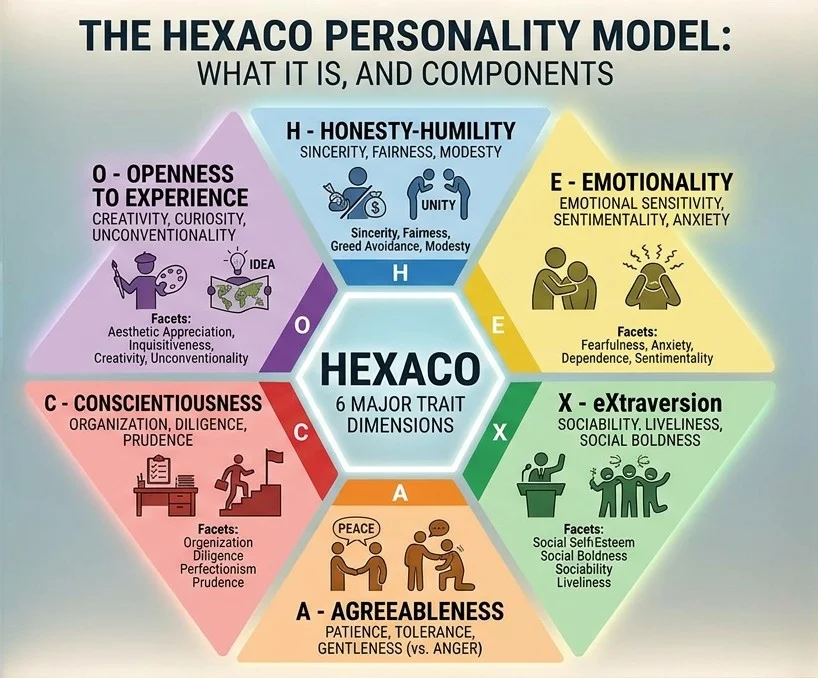
The six HEXACO dimensions are Honesty-Humility, Emotionality, eXtraversion, Agreeableness, Conscientiousness, and Openness to Experience, each representing a broad, statistically independent cluster of personality traits. Together they form the acronym that gives the model its name.
| HEXACO Dimension | Core Content |
| Honesty-Humility | Sincerity, fairness, greed avoidance, modesty |
| Emotionality | Fearfulness, anxiety, dependence, sentimentality |
| eXtraversion | Sociability, liveliness, social self-esteem, boldness |
| Agreeableness | Forgiveness, gentleness, flexibility, patience |
| Conscientiousness | Organization, diligence, perfectionism, prudence |
| Openness to Experience | Aesthetic appreciation, inquisitiveness, creativity, unconventionality |
Each dimension is measured through the HEXACO Personality Inventory-Revised, a self- and observer-report instrument that breaks each of the six broad factors down into four narrower facets, giving a more granular picture than a single broad score alone could provide. That structure matters for applied use. A person scoring moderately on overall Agreeableness might still show sharply different facet patterns, high on flexibility but low on patience, for example, and those distinctions carry real predictive value.
- Each dimension is treated as statistically independent, meaning scoring high on one doesn’t predict your score on another.
- Facet-level scores allow for more nuanced profiles than broad domain scores alone.
- The model applies consistently across cross-cultural samples, unlike some earlier trait frameworks.
- Both self-report and observer-report versions exist, supporting multi-rater assessment in research settings.
What distinguishes HEXACO most sharply from other trait models isn’t really the five familiar-sounding dimensions. It’s the sixth one, Honesty-Humility, which fundamentally didn’t exist as an isolated factor in earlier frameworks and turned out to predict behavior those older models routinely missed.
What Is the Honesty-Humility Factor and Why Does It Matter?
Honesty-Humility is the HEXACO dimension capturing sincerity, fairness, greed avoidance, and modesty, and it’s the model’s defining innovation since no comparable, isolated factor exists in the standard Big Five framework. Low scorers tend toward manipulation, entitlement, and a willingness to exploit others for personal gain.
People scoring high on this dimension generally avoid manipulating others for personal advantage, feel little pull toward flaunting wealth or status, and hold a relatively modest self-view rather than assuming they deserve special treatment. People scoring low, by contrast, tend to justify deception when it benefits them, actively pursue status symbols, and often feel a strong, sometimes conscious sense of entitlement. That’s a genuinely useful axis for predicting behavior the Big Five tends to blur together.
Researcher Delroy Paulhus, known for his foundational work identifying the Dark Triad of narcissism, Machiavellianism, and psychopathy, has demonstrated that low Honesty-Humility scores correlate strongly with all three of those traits. This connection turned out to be one of HEXACO’s most practically important findings. Rather than needing three separate scales to flag manipulative, exploitative tendencies, a single Honesty-Humility score does much of that predictive work on its own.
This has genuine real-world weight beyond academic interest. Workplace researchers now routinely use Honesty-Humility scores to help predict counterproductive work behaviors, from minor rule-bending to outright fraud, with considerably more precision than Big Five Agreeableness alone ever managed. That predictive edge is arguably HEXACO’s strongest practical selling point over the older, more familiar model.

How Does HEXACO Emotionality Differ From Big Five Neuroticism?
HEXACO Emotionality overlaps substantially with Big Five Neuroticism but restructures its content, removing anger and hostility, which HEXACO relocates to the low pole of Agreeableness instead. This single content shift changes what each dimension actually predicts.
In the Big Five framework, someone prone to angry outbursts and someone prone to anxious worry both get flagged under the same broad Neuroticism umbrella, even though those two tendencies feel psychologically quite different in daily life. HEXACO splits them apart. Emotionality now centers on fearfulness, anxiety, dependence on others, and sentimentality, while quick-tempered hostility gets folded into low Agreeableness instead, alongside stubbornness and a tendency toward grudges.
This reorganization isn’t arbitrary tidiness for its own sake. Researchers found that anger and anxiety, while both often grouped as “negative emotionality,” actually cluster with different behavioral outcomes once you look closely at real-world data. Anxious, fearful traits tend to predict caution and dependence on others; anger-related traits predict conflict, aggression, and interpersonal friction, patterns that make more sense split apart than lumped together under one broad label.
For anyone using personality data to understand relationship dynamics or workplace conflict specifically, this distinction carries real practical weight. Someone high in HEXACO Emotionality but low in anger-related traits might be anxious and easily overwhelmed, yet rarely confrontational, a combination the Big Five’s single Neuroticism score simply can’t capture with the same precision.
How Does HEXACO Agreeableness Differ From the Big Five?
HEXACO Agreeableness centers specifically on patience, forgiveness, and gentleness versus quickness to anger, having absorbed the hostility-related content that Big Five models place under Neuroticism. This makes HEXACO Agreeableness a noticeably different construct despite sharing the same familiar name.
In practice, this means a person’s Big Five Agreeableness score and their HEXACO Agreeableness score can diverge meaningfully, even though both use the same trait label. Someone easily provoked to anger scores lower on HEXACO Agreeableness specifically because of that irritability, whereas the Big Five would likely file that same tendency under low Emotional Stability instead. Trying to compare scores directly across the two models without accounting for this shift produces genuinely misleading conclusions.
Facet-level detail helps clarify the distinction further. HEXACO Agreeableness breaks down into forgiveness, gentleness, flexibility, and patience, each capturing a slightly different flavor of how someone handles interpersonal friction. A person low in forgiveness but high in gentleness, for instance, might avoid outward hostility while still privately holding grudges for years, a nuance that broad domain scores alone tend to flatten out entirely.
This restructuring reflects something important about how personality researchers refine models over time. Rather than treating trait boundaries as fixed and sacred, Lee and Ashton’s cross-language data forced a genuine reconsideration of where certain traits actually belong, even when doing so meant reshuffling a familiar, decades-old category like Agreeableness.

How Do Extraversion, Conscientiousness, and Openness Compare Across Models?
Extraversion, Conscientiousness, and Openness to Experience remain largely similar constructs across both HEXACO and the Big Five, with only modest content differences, unlike the more substantial restructuring seen in Emotionality and Agreeableness. This consistency actually strengthens confidence in these three dimensions as robust, cross-model findings.
HEXACO Extraversion captures sociability, liveliness, social self-esteem, and boldness, closely mirroring its Big Five counterpart. People scoring high tend to feel energized by social interaction and comfortable asserting themselves in group settings. Low scorers generally prefer solitude or small, familiar groups and often feel some discomfort in unfamiliar social situations. The core content barely shifts between models, which is exactly why researchers treat this dimension as one of personality psychology’s more settled findings.
Conscientiousness similarly holds steady across frameworks, covering organization, diligence, perfectionism, and prudence. High scorers plan carefully, follow through on commitments, and generally avoid impulsive decisions; low scorers tend toward spontaneity, sometimes at the cost of long-term planning. This dimension consistently predicts academic and workplace performance across both models, one of the most replicated findings in all of personality science.
Openness to Experience, covering aesthetic appreciation, inquisitiveness, creativity, and unconventionality, also transfers with minimal change between the two frameworks. Where subtle differences do appear, they tend to involve how strongly each model weights unconventionality versus pure intellectual curiosity, a nuance that matters more for researchers fine-tuning measurement than for someone simply trying to understand their own profile.
How Was the HEXACO Model Developed?
The HEXACO model emerged from systematic lexical research examining how personality-descriptive adjectives naturally cluster together within a language, a methodology with roots tracing back to earlier work by psychologist Lewis Goldberg on the Big Five itself. Lee and Ashton extended that same approach across many additional languages.
Goldberg’s earlier lexical studies in English had helped establish the Big Five as a dominant framework throughout the late twentieth century, based on the idea that the most socially important personality traits get encoded into everyday language over time. That’s a genuinely elegant assumption. If a trait matters enough for people to consistently need a word for it, it probably reflects something psychologically real and important.
Lee and Ashton took that same lexical logic and applied it more broadly, systematically analyzing personality-descriptive terms across a wide range of unrelated languages rather than relying primarily on English data. Their results kept surfacing the same pattern: five factors resembling the familiar Big Five, plus a consistent sixth cluster centered on honesty, fairness, and modesty that English-language studies had somehow split apart and buried within other categories.
This cross-language replication is really what gives HEXACO its scientific weight. A pattern showing up reliably across Dutch, Korean, Polish, French, and several other unrelated language families is much harder to dismiss as a statistical fluke than a finding limited to just one language and cultural context, which is exactly the kind of criticism the original Big Five occasionally faced, a genuine replication strength.

How Does HEXACO Relate to the Dark Triad?
HEXACO’s Honesty-Humility dimension shows strong, consistent negative correlations with all three Dark Triad traits, narcissism, Machiavellianism, and psychopathy, making it one of the most useful single predictors of manipulative or exploitative interpersonal tendencies currently available. This relationship has become one of HEXACO’s most cited applications.
Researcher Delroy Paulhus, working alongside colleagues studying so-called “dark” personality traits, found that people scoring low on Honesty-Humility consistently showed elevated levels across narcissistic entitlement, Machiavellian manipulation tactics, and psychopathic callousness. That’s a remarkably efficient finding for applied psychology. Instead of administering three separate specialized scales to flag potentially exploitative behavior, a single HEXACO dimension captures much of that same predictive signal.
This doesn’t mean Honesty-Humility and the Dark Triad are identical concepts; they aren’t. Someone can score moderately low on Honesty-Humility without meeting any clinical threshold for narcissistic or psychopathic traits specifically. The relationship is a strong correlational pattern, not a diagnostic equivalence, and researchers are careful to maintain that distinction in published work.
- Screen for extremely low scores on Honesty-Humility when evaluating risk for exploitative workplace behavior.
- Combine with other dimensions, since low Honesty-Humility paired with high Extraversion sometimes predicts different risks than paired with low Extraversion.
- Avoid treating scores as diagnostic, since personality inventories measure tendencies, not clinical conditions.
- Use facet-level data when possible, since greed avoidance and modesty don’t always move together within the broader factor.
This application has proven genuinely valuable in organizational psychology, where identifying employees at elevated risk of unethical behavior matters enormously for institutions trying to prevent fraud, harassment, or other serious workplace misconduct before it escalates.
HEXACO vs Big Five: Which Model Should You Use?
Choosing between HEXACO and the Big Five depends largely on your purpose: HEXACO offers superior prediction for ethical behavior, manipulation, and antisocial tendencies, while the Big Five, developed extensively by psychologists Robert McCrae and Paul Costa, remains more widely used, more thoroughly validated across decades of research, and easier to compare against existing studies.
The Big Five’s biggest advantage is simply its head start. Decades of accumulated research using the Five-Factor Model, refined extensively through McCrae and Costa’s NEO Personality Inventory, mean there’s an enormous existing body of comparative data available. If you’re trying to compare your results against a huge pool of prior research, the Big Five currently offers considerably more of that comparative context.
HEXACO’s advantage lies elsewhere. Its added Honesty-Humility dimension, combined with its restructured Emotionality and Agreeableness factors, gives it a meaningfully stronger track record predicting counterproductive behavior, workplace ethics violations, and interpersonal manipulation specifically. If your goal involves understanding integrity, fairness, or exploitative tendencies in particular, HEXACO consistently outperforms the older model on those specific outcomes.
Neither model is simply “better” in some absolute sense. They’re built for overlapping but distinct purposes, and researcher Reinout de Vries, whose applied HEXACO research spans organizational and social psychology contexts, has argued that the two frameworks are increasingly treated as complementary tools rather than competitors. Choosing between them often comes down to what specific behavior you’re actually trying to understand or predict.

How Is the HEXACO Personality Inventory Used in Practice?
The HEXACO Personality Inventory-Revised is used across research, organizational, and educational settings to assess personality structure, screen for workplace risk factors, and study individual differences in ethical behavior, relationship patterns, and academic performance. It’s freely available for research use, unlike some proprietary commercial instruments.
In organizational psychology specifically, the HEXACO-PI-R has become a genuinely popular tool for pre-employment screening in roles involving high trust, financial responsibility, or minimal direct oversight. Its Honesty-Humility scale offers something the standard Big Five simply doesn’t provide as cleanly: a dedicated, well-validated measure of integrity-related traits rather than a blurry proxy buried inside broader Conscientiousness or Agreeableness scores.
Researchers studying romantic relationships have also increasingly turned to HEXACO, since Honesty-Humility and restructured Agreeableness scores appear to predict relationship satisfaction and infidelity risk with somewhat more precision than equivalent Big Five measures. That’s not a small finding for relationship counseling and premarital assessment contexts, where understanding a partner’s baseline honesty and conflict style genuinely matters.
Academic researchers, meanwhile, frequently choose HEXACO specifically when studying antisocial behavior, aggression, or ethical decision-making, since its structure was quite literally built to capture exactly those distinctions with more precision than earlier trait models managed. The instrument itself remains freely accessible online, which has helped it spread quickly through academic psychology departments over the past two decades.
What Are the Criticisms and Limitations of the HEXACO Model?
Critics of the HEXACO model argue that its added complexity may not always justify abandoning the far more established Big Five framework, and that some cross-language lexical findings supporting the sixth factor remain open to alternative statistical interpretations. These are legitimate, ongoing scientific debates rather than dismissals of the model outright.
Some researchers point out that while Honesty-Humility clearly adds predictive value for specific outcomes like unethical behavior, its added complexity comes with real practical costs. Training raters, validating translations, and building comparative datasets all take considerably longer for a newer six-factor model than for an already well-established five-factor one. That’s a legitimate, pragmatic concern, not merely academic gatekeeping.
Other critics have questioned whether HEXACO’s six-factor solution is genuinely universal or whether certain languages and cultural contexts show the sixth factor more clearly than others, given that factor structures can sometimes be sensitive to which specific adjectives get included in a given lexical study. This is a fair methodological point. Lexical studies inevitably depend on researcher choices about which words to include, and those choices can subtly shape which factors emerge most clearly.
Still, the weight of accumulated evidence, spanning dozens of languages and multiple independent research teams over two decades, has convinced a growing share of personality psychologists that HEXACO’s sixth dimension reflects something genuinely real rather than a statistical artifact. The debate now centers less on whether Honesty-Humility exists and more on exactly how best to measure and apply it across different contexts and populations.
FAQs about the HEXACO Personality Model
What does HEXACO stand for?
HEXACO is an acronym combining the Greek root “hexa,” meaning six, with the initials of its six personality dimensions: Honesty-Humility, Emotionality, eXtraversion, Agreeableness, Conscientiousness, and Openness to Experience. The name was chosen deliberately by its creators, Kibeom Lee and Michael Ashton, to reflect both the model’s structure and its number of core factors. Unlike some personality frameworks with less descriptive names, HEXACO’s title functions almost like a built-in mnemonic device for remembering its six dimensions. This naming choice has also helped the model gain recognition relatively quickly within academic psychology, since researchers and students alike can decode much of its structure directly from the name itself without needing extensive additional explanation.
Is HEXACO better than the Big Five personality test?
Neither model is universally “better,” since each was built with somewhat different goals and strengths in mind. HEXACO tends to outperform the Big Five specifically when predicting ethical behavior, workplace misconduct, and manipulative or exploitative interpersonal tendencies, largely because of its dedicated Honesty-Humility dimension. The Big Five, meanwhile, benefits from decades of extensive prior research, broader name recognition, and a much larger existing body of comparative data across countless studies and populations. If your priority involves understanding fairness, integrity, or antisocial tendencies specifically, HEXACO likely offers more precise insight. If you’re trying to compare your results against a vast existing research base, the Big Five currently holds a practical advantage.
What is the Honesty-Humility trait in HEXACO?
Honesty-Humility is the personality dimension unique to the HEXACO model, capturing an individual’s tendency toward sincerity, fairness, avoidance of greed, and modesty in how they view themselves relative to others. People scoring high on this trait generally avoid manipulating others for personal gain, show little interest in flaunting status or wealth, and hold a relatively humble self-assessment. Those scoring low tend to justify deception when convenient, actively pursue status symbols, and often feel entitled to special treatment or privileges. This dimension doesn’t exist as a clearly isolated factor within the traditional Big Five model, making it HEXACO’s most distinctive and widely discussed contribution to personality science.
How do I take a HEXACO personality test?
The HEXACO Personality Inventory-Revised is freely available online through its official research website, offering both self-report and observer-report versions at no cost for personal or academic use. The full version typically includes around two hundred items assessing all six broad dimensions along with their underlying facets, while shorter versions exist for situations requiring a quicker assessment. After completing the inventory, most versions generate a breakdown showing where you fall on each of the six dimensions, sometimes including facet-level detail as well. It’s worth remembering that personality inventories like this measure general tendencies rather than fixed, unchangeable traits, and results should be interpreted as a general snapshot rather than a definitive verdict on your character.
Can your HEXACO personality scores change over time?
Yes, though generally more gradually than people often expect. Personality traits measured by frameworks like HEXACO tend to show meaningful stability over adult life, but they aren’t entirely fixed, and research on personality development shows most people experience modest shifts, particularly in Conscientiousness and Emotionality, as they move through different life stages. Major life events, sustained therapy, or significant environmental changes can also contribute to noticeable shifts over years, though dramatic overnight changes in core personality structure are uncommon and would generally warrant closer clinical attention. Honesty-Humility specifically appears to show relative stability similar to other broad traits, though facet-level scores can still show some movement in response to significant life experiences.
Why isn’t Honesty-Humility part of the Big Five model?
The Big Five was originally developed largely from English-language lexical studies, and honesty-related, fairness-related content in English tends to distribute thinly across both Agreeableness and Conscientiousness rather than forming its own clearly isolated cluster. When researchers later expanded lexical studies to include many additional languages, a distinct sixth factor centered on sincerity, fairness, and modesty kept emerging consistently, something the original English-based research simply hadn’t captured clearly. This suggests the omission wasn’t necessarily a fundamental flaw in the Big Five’s logic, but rather a limitation tied to which language the foundational research happened to rely on most heavily. HEXACO’s cross-language approach helped surface this previously obscured dimension more clearly.
Does HEXACO measure the Dark Triad traits directly?
Not directly, though it correlates strongly with them. HEXACO doesn’t include separate scales specifically labeled narcissism, Machiavellianism, or psychopathy the way specialized Dark Triad inventories do. However, research has consistently shown that low scores on HEXACO’s Honesty-Humility dimension correlate strongly with elevated levels across all three Dark Triad traits, making it a useful, efficient proxy measure in many research and applied contexts. This doesn’t mean the concepts are identical; someone can score moderately low on Honesty-Humility without meeting clinical thresholds for narcissistic or psychopathic traits specifically. Researchers generally treat this relationship as a strong statistical pattern rather than a diagnostic equivalence between the two frameworks.
Is the HEXACO model used in clinical psychology or just research?
HEXACO originated primarily as a research tool within personality psychology, and it remains most heavily used in academic and organizational research contexts rather than routine clinical diagnosis. It isn’t designed to diagnose mental health conditions, and clinicians generally rely on other, more specifically validated instruments for that purpose. That said, some clinicians and counselors do use HEXACO informally to better understand a client’s general personality structure, particularly around relationship patterns, workplace stress, or interpersonal conflict, since its facet-level detail can offer useful conversational starting points. Its most robust, well-established applications remain in organizational psychology, workplace ethics research, and academic studies of individual differences rather than formal clinical assessment.
Bibliography
- Lee, K., & Ashton, M. C. (2004). Psychometric Properties of the HEXACO Personality Inventory. Multivariate Behavioral Research, 39(2), 329-358.
- Ashton, M. C., & Lee, K. (2007). Empirical, Theoretical, and Practical Advantages of the HEXACO Model of Personality Structure. Personality and Social Psychology Review, 11(2), 150-166.
- Lee, K., & Ashton, M. C. (2013). The H Factor of Personality: Why Some People Are Manipulative, Self-Entitled, Materialistic, and Exploitive-And Why It Matters for Everyone. Wilfrid Laurier University Press.
- Ashton, M. C., & Lee, K. (2009). The HEXACO-60: A Short Measure of the Major Dimensions of Personality. Journal of Personality Assessment, 91(4), 340-345.
- Paulhus, D. L., & Williams, K. M. (2002). The Dark Triad of Personality: Narcissism, Machiavellianism, and Psychopathy. Journal of Research in Personality, 36(6), 556-563.
- Goldberg, L. R. (1990). An Alternative “Description of Personality”: The Big-Five Factor Structure. Journal of Personality and Social Psychology, 59(6), 1216-1229.
- McCrae, R. R., & Costa, P. T. (1999). A Five-Factor Theory of Personality. In Handbook of Personality: Theory and Research. Guilford Press.
- de Vries, R. E. (2013). The 24-Item Brief HEXACO Inventory (BHI). Journal of Research in Personality, 47(6), 871-880.
- American Psychological Association. (2021). Understanding Personality Structure and Trait Models. APA.
Use this citation format to reference the article clearly and help readers find the original source.
PsychologyFor. (2026). The HEXACO Personality Model: What it Is, and Components. PsychologyFor. https://psychologyfor.com/the-hexaco-personality-model-what-it-is-and-components/